

# Bespoke Interiors in Dubai: What They Are, What They Cost, and When They Are Worth It
TL;DR: A bespoke interior in Dubai means the space is designed and built specifically for you, with custom joinery, made-to-measure furniture and specified materials, rather than assembled from catalogue units. Design fees run roughly AED 80–250/m², and a full turnkey bespoke fit-out with materials commonly lands at AED 350–1,500+/m². A villa project typically starts around AED 500,000 and runs into the millions, over three to six months. The reason it costs more is that almost nothing is picked off a shelf.
The word bespoke gets stretched to sell showroom furniture that anyone can order. On a real project it means something narrower. Your wardrobe is drawn to the exact height of your ceiling. The marble on your bathroom wall is cut so the veins run continuously across the joints. That level of control is why owners pay for it, and why the number moves the way it does.
What a bespoke interior actually is (vs custom vs off-the-shelf)
Off-the-shelf, custom and bespoke get used as if they mean the same thing. The difference decides what you pay and what you get.
Off-the-shelf is a finished product you buy as it comes: a sofa from a showroom, a wardrobe in one of three standard widths, a kitchen assembled from a catalogue module. It is the cheapest and fastest route, and for a rental flat it is often the right one. Custom is a standard product adjusted to your choice: the same wardrobe carcass in your colour, or a sofa from an existing frame in your fabric. You choose from options the maker already offers. Bespoke starts from nothing. A joiner or designer measures your actual space, draws a piece that does not exist yet, and builds it to that drawing. Nothing about the dimensions, the material or the detail is borrowed from a range.
The practical test is simple. If a competing supplier could deliver the identical item to a different address, it is not bespoke, it is custom or catalogue. A bespoke run of joinery only fits the room it was drawn for. That is the value and also the reason it cannot be discounted the way a standard product can, because there is no production line behind it absorbing the cost.
Most Dubai homes that people call bespoke are actually a mix. The built-in joinery, the kitchen and the wet-area stonework are genuinely bespoke; the loose furniture is a blend of custom and high-end catalogue. That mix is sensible. You spend the bespoke budget where the space is fixed and hard to change later, and you buy the movable pieces from strong existing ranges.
Your next move: if you are unsure which parts of your home justify bespoke work and which do not, that split is exactly what a first design consultation resolves.
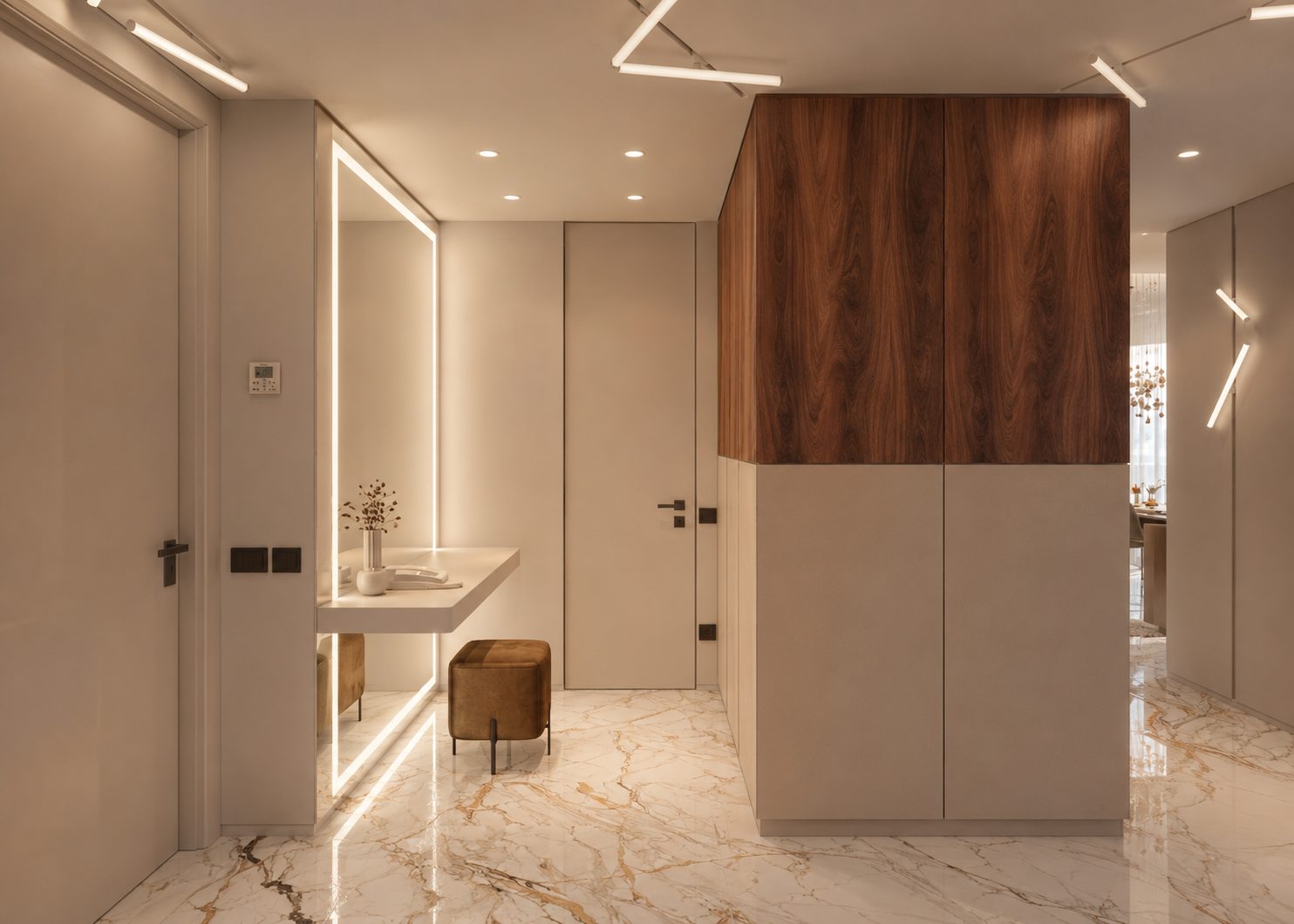
Why Dubai pushes owners toward bespoke
Catalogue interiors underperform in Dubai for reasons that are specific to the place, and understanding them tells you which materials to specify and why.
The climate is the first. Outdoor summer air sits above 45°C for weeks, and indoor air is chilled hard by the AC, so materials live in a permanent temperature swing. Solid timber that was kiln-dried for a European climate moves, cracks and warps in that cycle. Cheap MDF joinery in a bathroom swells the first time the extract fan fails to keep up with a hot shower. A bespoke joiner specifies marine-grade or moisture-resistant boards, seals the edges properly, and allows expansion gaps that a flat-pack unit never does. The wrong material does not fail on day one; it fails in month eighteen, after the warranty on a catalogue product has lapsed.
The second condition is the mix of people. Dubai's owners are largely expatriates who have lived in several countries and arrive with a specific idea of how a home should feel, and apartments here are handed over as bare developer shells with a generic finish. A bespoke interior is how that gap gets closed, turning a standard two-bedroom in Marina or Downtown into something that reads as the owner's rather than the developer's.
The third is the market itself. Dubai runs a genuine luxury property tier, and at the top of it a standard fit-out looks wrong against the price of the address. On the Palm, in Emirates Hills, in the branded residences on Sheikh Zayed Road, buyers expect interiors that match the exterior, and that expectation is bespoke by default. Humidity near the water adds its own demand: joinery and finishes on Palm Jumeirah and Bluewaters have to be specified for salt air, which a catalogue product is not.
Where to go from here: if your unit is a bare handover shell, the first decision is scope, and a walkthrough on site is faster than any brief on paper.
The elements that make an interior bespoke
Most of the budget concentrates in five parts of a home. The order matters: start with what is fixed to the structure, and work outward from there.
Joinery is the backbone. Wardrobes, walk-in closets, TV walls, wall panelling, floating vanities, dressing tables and any built-in storage are all joinery, and this is where bespoke earns its money because these pieces are fixed to the structure and shaped to the room. A wardrobe drawn to the exact ceiling height removes the dust-trap gap a standard unit leaves, and a TV wall built around your cable runs hides what a bought unit exposes.
Furniture made to order is the next layer: dining tables, headboards, sofas and occasional pieces built to your dimensions and covered in your chosen fabric. This is often where owners over-spend, because a strong catalogue piece can be indistinguishable in a photo. Bespoke furniture is worth it when the room has an odd dimension a standard piece will not fill, or when you want a material a showroom does not stock.
Lighting design is the element most people underestimate. A bespoke scheme layers ambient, task and accent lighting on separate circuits, hides LED strips in joinery reveals and cove ceilings, and specifies fittings to a colour temperature rather than buying whatever the electrician has in the van. In a Dubai apartment with low developer ceilings, lighting does more to lift the space than almost any finish.
Materials and finishes carry the character: natural stone with book-matched veining, engineered timber floors rated for the climate, microcement, veneers, wall coverings and specialist paint. The finishing trades then execute it: the joiner, the stone mason, the tiler and the decorator whose work decides whether the specification actually looks the way the drawing promised. A beautiful material laid by a rushed crew looks worse than a modest material laid well.
Before you commit: decide your material palette against real samples on site, because stone and timber read completely differently under Dubai daylight than under a showroom's lighting.

The process, stage by stage
Projects go wrong when stages get skipped. Here is how the sequence works in practice.
- 1. Consultation and brief. We visit the space, take real measurements, and pin down how you live in it, your budget band and your timeline. This is where the bespoke-versus-catalogue split gets decided, before anyone draws anything.
- 2. Concept and 3D design. The design team produces layouts, a material palette and photorealistic 3D visuals so you see the finished room before a wall moves. A standalone design package starts around AED 10,000 and takes three to six weeks. Make your changes on screen, where they cost nothing, not on site, where they cost a lot.
- 3. Technical drawings and specification. The concept becomes buildable: joinery shop drawings, MEP coordination, a bill of quantities and a fixed material schedule. This is also when permit drawings go to the building authority and the developer.
- 4. Procurement and production. Materials are ordered, and the joinery and furniture go into the workshop. Long-lead items like imported stone or specific veneers are placed here, because a two-week delay on a slab can hold up a whole bathroom.
- 5. Fit-out, installation and styling. The crew goes on site: demolition, MEP first fix, wet works, joinery installation, finishes and second fix, then final styling and a snag walkthrough before handover. Styling is the last five percent that separates a finished build from a finished home.
We fix the scope, the price and the timeline in a written contract before stage four, with a penalty for every day past the agreed deadline. How that works in practice is set out in our services. A design-only client can take the drawings elsewhere to build; a turnkey client keeps the whole chain under one roof, which is the arrangement most owners want because a single company carries both the drawing and the build.
What to do next: if you already have architect drawings, send them over, because a bespoke scheme built on an existing layout skips straight to concept.
What a bespoke interior costs in Dubai
These are 2026 Dubai market ranges to plan around, not a fixed DOMECO price list, because a serious firm prices against drawings rather than over the phone.
| Line | Range (AED) | Notes |
|---|---|---|
| Design service (fee only) | 80–250/m² | Concept, 3D visuals, technical drawings, specification |
| Turnkey fit-out with materials | 350–1,500+/m² | Full build, joinery, finishes, MEP, project management |
| Villa (full bespoke project) | 500,000–2,000,000+ | Scope and size dependent; large villas exceed this |
| Standalone design package | from 10,000 | Delivered in three to six weeks |
For an apartment, the per-square-metre figure is the one to work from. A 150 m² two-bedroom in Marina at a mid-to-high bespoke level, taken turnkey with materials, sits in the low-to-mid six figures once joinery, stone, lighting and loose furniture are counted. A villa is quoted as a whole project because the ranges are too wide to reduce to a rate: a compact townhouse and a Palm signature villa are not the same job.
Four drivers move the number more than anything else. The finish level does the most: the same room in a mid-range specification and a full luxury specification can differ by a factor of three, because the cost sits in the materials and the detailing, not the walls. The proportion of bespoke work is next, since every catalogue substitution pulls the price down and every made-to-order piece pushes it up. Then the property type, because a villa carries more structural and MEP work than an apartment of the same floor area. And finally the building's own rules, since a tower with a slow approval process and a large refundable security deposit, often AED 5,000–20,000 held against damage to common areas, adds cost and time before a single wall moves.
The cheapest quote is almost never the cheapest project. A low headline number in Dubai usually omits the compliance layer, the permit fees or half the joinery, and reappears as variation orders once you have signed. For a rough figure on your own space in four questions, the quick cost estimate gives a starting range.
Bespoke vs turnkey fit-out: they are not opposites
The two terms get set against each other, but they answer different questions, and confusing them leads owners to compare quotes that describe different jobs.
Bespoke describes *how much is made for you*: how far the interior is custom-drawn versus assembled from catalogue products. Turnkey describes *who carries the project*: whether one company handles design, build and handover so you receive the keys to a finished home, or whether you coordinate a designer, a contractor and a furniture supplier yourself.
You can have any combination. A turnkey project can be mostly catalogue, delivered fast and clean by one firm on a budget. A bespoke project can be run by an owner who hires the designer, the joiner and the contractor separately and manages them personally, which is cheaper on paper and far more work in practice. Most luxury projects in Dubai end up bespoke and turnkey together, because the owners who want made-to-measure interiors are usually the ones with the least appetite for chasing four separate suppliers across a six-month build.
Turnkey with mid-range materials commonly sits toward the lower end of the AED 350–1,500+/m² band; a bespoke turnkey villa runs to the top of it and beyond. The single question that decides your route is how much of the coordination you want to own yourself.
If you want the whole chain under one contract, that is what turnkey delivery means here, and it is how our fit-out projects run.
Styles that work in Dubai homes
A handful of directions dominate Dubai interiors, and each carries its own cost implication, so the style you choose is also a budget decision.
Contemporary minimalism is the most common: clean lines, a neutral palette, hidden storage and a few statement materials. It reads calm and it photographs well, but done properly it is not cheap, because minimalism hides nothing and every joint and reveal has to be precise. Modern Arabic and neo-Arabesque blend regional pattern, mashrabiya-style screens and warm tones with a modern layout, and it suits Dubai because it belongs here. Classic and neoclassical, all cornicing, panelling and formal symmetry, still sells strongly in the villa communities and carries the highest joinery cost of any style. Warm modern and Japandi have grown fast, trading cold marble for timber, textured plaster and softer light. Art-deco-influenced glamour, with brass, dark stone and geometric detail, appears often in the branded residences.
The material palette matters more than the label. Whatever the style, the finishes have to survive the Dubai climate cycle, which is why a bespoke specification for a Palm villa reads differently from the same style built inland.
Your next step: bring a few reference images to the first meeting, because a shared visual language shortens the concept stage more than any written brief.
Why bespoke lasts longer
The durability argument is real, and it is the honest reason custom-built work can be worth the premium even when catalogue looks identical on day one.
A catalogue wardrobe is built to a price point and an average room. In a Dubai climate, the wrong board swells, the wrong hinge corrodes in humid coastal air, and the wrong finish yellows under strong daylight. A bespoke piece is specified for the actual conditions: moisture-resistant substrates in wet areas, quality European hardware rated for daily use, and finishes chosen to hold their colour. It costs more up front and it is still standing when the catalogue equivalent has been replaced once. We back our work with a one-year warranty, which is only possible because we control the specification and run our own crew rather than sub-letting to whoever is cheapest that week.
There is a resale angle too, though it should be hedged. A well-executed bespoke interior can help a property show and sell better in a competitive market, particularly at the luxury end where buyers expect it. It does not add its full cost back as a fixed percentage, and anyone quoting a guaranteed ROI figure is guessing. The reliable statement is narrower: a considered made-to-measure fit-out makes a home easier to live in and easier to sell, and a cheap catalogue refit that dates in five years does neither.
The honest version: if the flat is a short-term rental hold, a clean catalogue fit-out often makes more financial sense than bespoke. Bespoke earns its keep in a home you will live in, or a luxury unit where the market expects it. Before you commit either way, our completed projects across Palm Jumeirah, City Walk, JLT and Dubai Hills show what the finished work looks like.
FAQ
What is the difference between bespoke and custom furniture?
Custom furniture is a standard product adjusted to your choice, such as an existing sofa frame in your fabric or a stock wardrobe in your colour. Bespoke furniture is drawn from nothing and built to your exact space, so the same piece could not be delivered to another address. Custom picks from a maker's existing options; bespoke starts with a blank sheet.
How much does a bespoke interior cost per square metre in Dubai?
Design fees run roughly AED 80–250/m², and a full turnkey bespoke fit-out with materials commonly sits at AED 350–1,500+/m² depending on finish level. These are market ranges rather than a fixed quote, because the number depends on how much is genuinely bespoke versus catalogue, and on the building's own rules. A serious firm prices against drawings, not over the phone.
How long does a bespoke interior project take in Dubai?
A typical apartment project runs three to six months end to end, with the design phase taking three to six weeks and permit approvals adding one to three weeks before works start. Villas take longer because of the extra structural, MEP and joinery scope. Long-lead materials such as imported stone can extend the timeline, which is why they are ordered early.
Can I get a bespoke interior done in an apartment as well as a villa?
Yes, and most bespoke work in Dubai is done in apartments. Built-in joinery, a bespoke kitchen and made-to-measure wardrobes make a bigger difference in a compact apartment than in a large villa, precisely because space is tight and every centimetre has to work. Developer shells in towers like Marina, Downtown and Business Bay are designed to be finished this way.
Which materials last best in Dubai's climate?
Moisture-resistant and marine-grade boards for joinery, natural stone and porcelain for floors and wet areas, engineered timber rated for temperature swing, and quality European hardware that resists corrosion in humid coastal air. Solid timber dried for a cooler climate tends to move and crack in the AC-to-outdoor cycle. Near the water, on Palm Jumeirah or Bluewaters, everything has to be specified for salt air.
Does a bespoke interior add value to a Dubai property?
It can help a property show and sell better, especially at the luxury end where buyers expect a finished, high-specification interior. It does not return its full cost as a fixed percentage, and any guaranteed ROI figure is a guess. The dependable version is that a considered bespoke fit-out makes a home easier to live in and easier to sell than a cheap catalogue refit that dates quickly.
Bespoke or standard fit-out: which has the better return?
For a home you will live in, or a luxury unit where the market expects it, bespoke usually pays off in both use and resale appeal. For a short-term rental hold where tenants change often, a clean standard fit-out is frequently the smarter financial call. Match the spend to how the property will actually be used rather than defaulting to the more expensive option.
Should I invest in bespoke joinery or bespoke furniture first?
Joinery first. Built-in wardrobes, kitchens, TV walls and vanities are fixed to the structure and shaped to the room, so they are hard and expensive to change later, which is where bespoke earns its money. Loose furniture can be upgraded over time and a strong catalogue piece often does the job well. Spend the bespoke budget where the space is fixed, and buy the movable pieces from good existing ranges.
If you want a priced quote against your own apartment or villa, the quick cost estimate gives a starting range in four questions, and you can send drawings or photos straight to the team on WhatsApp for a proper quote against your actual scope.