

# Cherwell Interiors Dubai vs alternatives: an honest fit-out and joinery comparison
TL;DR: Cherwell Interiors is a Dubai studio with its own joinery production, strongest on bespoke kitchens, dressing rooms, and built-in cabinetry, plus residential and commercial fit-out. Its own workshop means real quality control on custom timber work. It fits owners who want made-to-measure joinery. For a plain apartment renovation, a tight budget, a rental unit, or a fast deadline, a leaner fit-out contractor usually gives better value.
Who Cherwell is, and what they actually do well
Cherwell Interiors is a Dubai interior studio built around its own production. The centre of gravity is joinery: bespoke kitchens, walk-in wardrobes and dressing rooms, and built-in furniture made to measure rather than bought off a catalogue. Around that core they also take on residential and commercial fit-out, so a project can run from concept through to a finished, furnished space under one roof.
The thing that actually sets them apart is vertical integration. When a studio owns its workshop instead of pushing every cabinet out to whichever subcontractor is free that week, it controls two things that matter a lot in Dubai: the tolerance on custom pieces, and the finish quality on timber that has to survive 45°C summers and heavy AC humidity swings. A kitchen carcass that was cut and assembled in-house, by people the studio actually employs, is easier to hold to a standard than one that came off an anonymous line in Al Quoz.
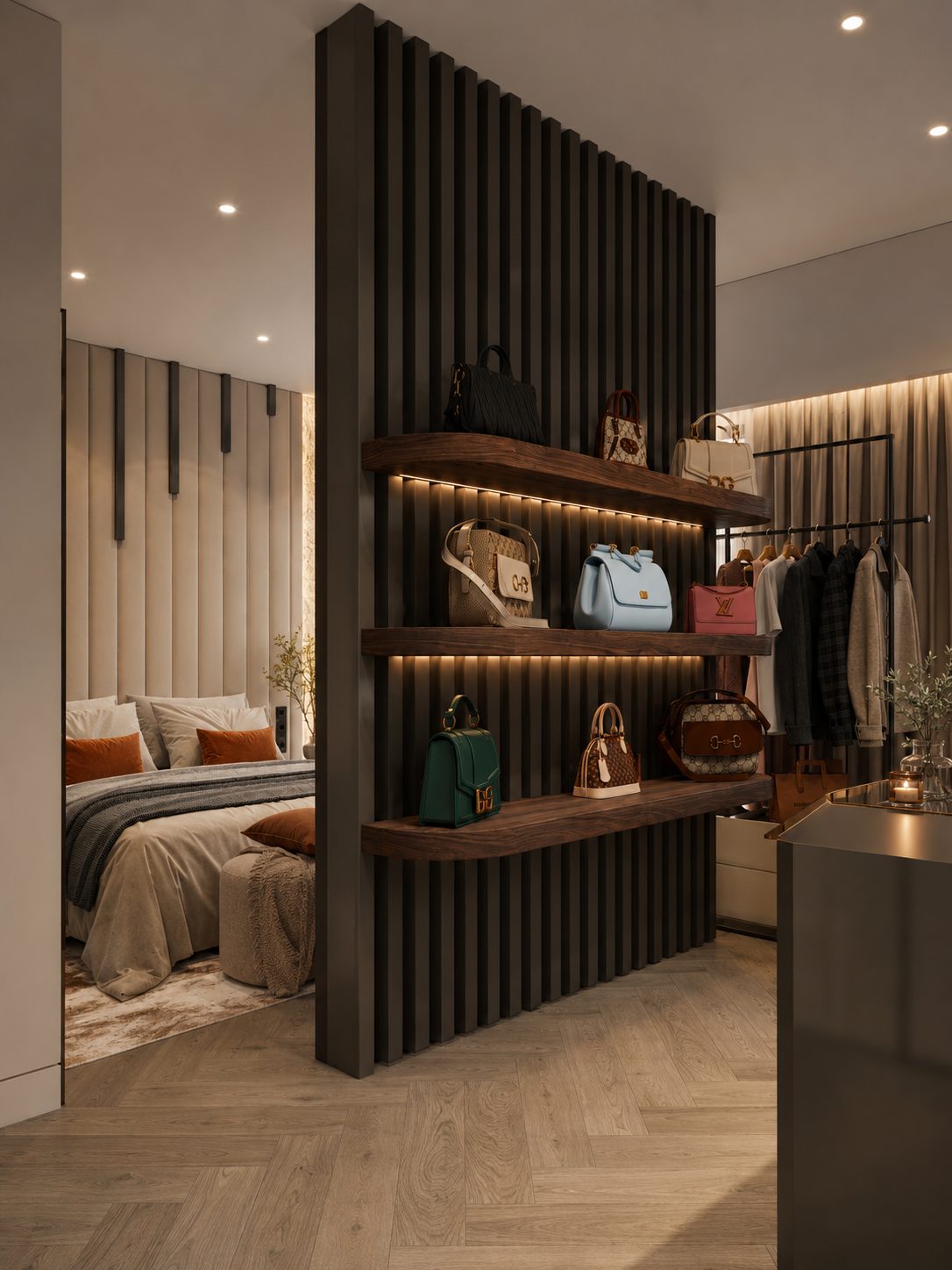
Where Cherwell is strongest is high-end bespoke timber work. A handleless kitchen with integrated appliances and stone worktops, a dressing room with fitted joinery down to the shoe racks, a media wall or a library run of shelving that has to sit flush to an irregular wall. If your project lives or dies on that kind of millwork, an in-house cabinetmaker is a genuine advantage rather than a marketing line.
The honest caveat sits right next to that strength. A workshop that makes everything to measure is slower than one that installs standard units, because custom fabrication runs on a queue. Bespoke kitchen and joinery lead times in Dubai commonly sit around eight to sixteen weeks before anything even reaches your flat. If your project is mostly plasterboard, paint, and a bathroom, you are paying for a capability you will barely use. Cherwell does not publish prices and quotes by consultation, which is normal for this tier but means you cannot sanity-check the number without a meeting. To pressure-test any studio against your own scope, our buyer's guide to choosing an interior design company in Dubai runs the licence and scope checks first.
When Cherwell is the right call, and when you overpay
Cherwell earns its price when the joinery is the project. A villa kitchen where the cabinetry defines the room, a master suite with a full fitted dressing room, a home that wants built-in furniture treated as architecture rather than decoration. In those cases an in-house workshop removes real risk, because getting bespoke timber wrong the first time is slow and expensive to fix, and a studio that fabricates its own work owns the outcome instead of pointing at a subcontractor.
The overpay case is just as clear, and it is not a criticism of the studio. Four situations where a joinery-led specialist is the wrong tool:
- You need a straightforward apartment renovation. If the job is repaint, reflooring, a bathroom refresh, and no custom cabinetry, a general fit-out contractor does it faster and cheaper. You do not need a workshop for that.
- Your deadline is tight. Custom joinery is a queue. If the flat has to be ready in eight weeks, a studio optimised for made-to-measure fabrication is fighting its own process.
- Your budget is hard and fixed. Bespoke timber is one of the most expensive line items in any interior. On a thin budget, that money is often better spent elsewhere.
- It is a rental unit with a slim return. Bespoke joinery rarely pays back inside a tenant's timeline. A tenant does not value a hand-built dressing room the way an owner-occupier does.
The most expensive mistake in Dubai interiors is hiring a studio whose strength sits outside your actual scope. Match the workshop to the work.
What interior design and fit-out actually cost in Dubai
Straight numbers, because most brand searches end here anyway. Design fees in Dubai run roughly AED 200-1,000 per square metre depending on tier: basic concept and drawings sit near AED 200-400/m², mid-range full-service design lands around AED 400-700/m², and premium bespoke design with custom procurement runs AED 700-1,000+/m² at the luxury end of the market. Treat these as market bands, not a rate card, because finish and the amount of custom work move them fast.
Fit-out is a separate line. A two-bedroom apartment fit-out commonly falls between AED 200k and AED 1.8M, or roughly AED 80-300 per square foot depending on finish. Villas start higher: expect AED 350k on the modest end and AED 1.2M or more for a full high-finish renovation. Permit and authority approvals typically add AED 5,000-20,000 across building, DEWA, and community sign-offs, and most design-and-build firms charge a project-management fee of about 8-15% of the build cost.
Custom joinery deserves its own note here because it is Cherwell's core and it behaves differently from the rest of the budget. A bespoke kitchen or a full run of fitted wardrobes is usually quoted as its own package, and the lead time is the real cost of made-to-measure — fabrication commonly runs eight to sixteen weeks before installation, on top of design sign-off. Budget does not shorten that queue much.
On our own contracts we quote in AED/m²: from 1,500 AED/m² for cosmetic work, from 3,000 AED/m² for a capital renovation, and 8,500-16,000 AED/m² for a full turnkey fit-out with furniture, appliances, and décor handed over ready to live in. A standalone design project starts from AED 10,000 and takes three to six weeks. The full interior design contractor cost breakdown shows where a real 150 m² apartment budget goes line by line.
Timelines are the number people underestimate. An apartment fit-out runs three to six months end to end; a villa runs six to twelve. Approval time and building access usually move the handover date more than the construction itself, so any firm promising a full villa turnkey in eight weeks is quoting a different scope.
| Item | Market band (AED) |
|---|---|
| Design fee, basic concept | 200-400/m² |
| Design fee, mid full-service | 400-700/m² |
| Design fee, premium bespoke | 700-1,000+/m² (luxury end) |
| Apartment fit-out (2-bed) | 200k-1.8M (80-300/sqft) |
| Villa fit-out | 350k-1.2M+ |
| Bespoke kitchen / joinery lead time | 8-16 weeks fabrication |
| Permits and approvals | 5k-20k |
| PM / supervision fee | 8-15% of build cost |
Design-only vs turnkey: what a real 2-bed budget looks like
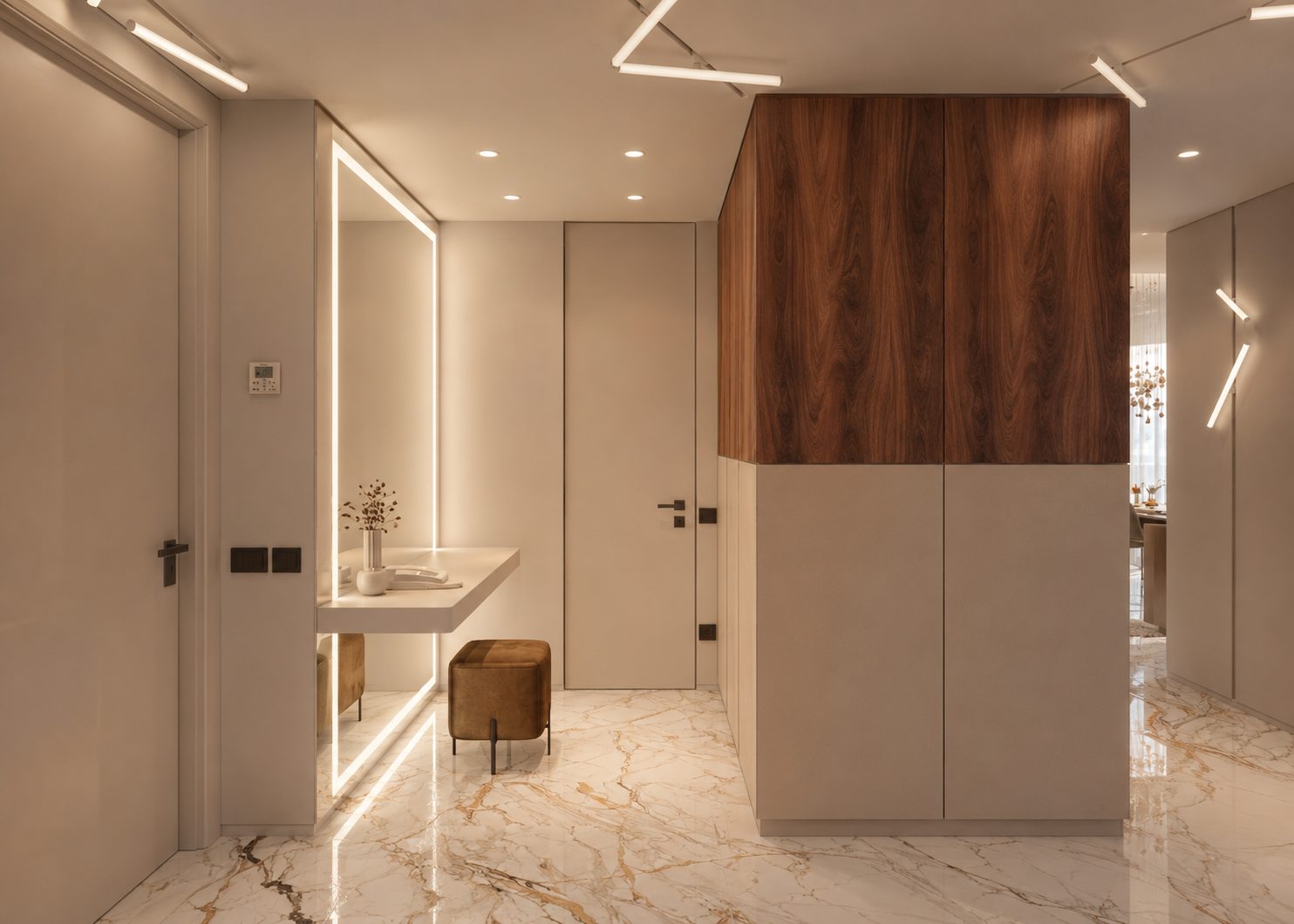
To make the two paths concrete, here is a worked example on a 90 m² two-bedroom apartment at a mid-finish standard, roughly AED 3,000-3,500/m² for construction.
Path A: Design-only, then separate contractor
You hire a design studio for drawings and concept, then tender the construction to a fit-out contractor independently.
| Item | AED |
|---|---|
| Interior design fee (approx. 450/m² mid-service) | 40,500 |
| Fit-out contractor (90 m² at 3,000/m²) | 270,000 |
| Permit and authority fees | 8,000 |
| PM/supervision (self-managed or 5% contingency) | 15,000 |
| Total | 333,500 |
Path B: Turnkey, one contract
You sign a single design-and-build contract. The studio handles concept, drawings, procurement, and construction.
| Item | AED |
|---|---|
| Turnkey contract (90 m² at 3,200/m² blended) | 288,000 |
| Furniture and décor allowance (not always included) | 40,000 |
| Permit and authority fees (usually bundled) | 8,000 |
| Total | 336,000 |
The totals land within roughly 10-15k AED of each other on a project this size. That gap is real but not decisive.
What the gap does not capture is the seam risk in Path A. When your designer and your contractor are two separate companies, disagreements about what the drawings meant, who owns a material substitution, or whose fault a tiling error is get expensive to resolve. The designer points at the contractor, the contractor points at the drawings, and you are in the middle with a half-finished bathroom and no single party obligated to fix it without a fee conversation.
Joinery sharpens this point. If the design studio drew a bespoke kitchen but a separate contractor installs it against site conditions that shifted during the build, a millimetre out on a wall becomes a fight about who measured wrong. A studio that both designs and fabricates its own joinery, like Cherwell, closes that particular seam for the cabinetry, which is exactly where the argument usually starts. Turnkey removes the seam across the whole job: one contract, one accountable party, one phone call when something is wrong. For an apartment at 90 m², either path is workable. At villa scale, 300 m² and up, the seam risk compounds across dozens of subcontractors and the single-contract argument gets stronger.
Red flags when shortlisting a studio in Dubai
Six things to check before you sign anything, all of them more diagnostic than a portfolio review.
No valid DET or DED trade licence for interior design or fit-out. In Dubai a company must hold a trade licence issued by the Department of Economy and Tourism (formerly DED) with an activity that specifically covers interior design, interior decoration, or fit-out contracting. The register is public. A studio that hesitates to share its licence number, or whose licence lists a different activity such as general trading, cannot legally carry out the work, and any fit-out done without the correct authority creates problems at handover with building management and DEWA. Ask for the number before the first meeting and verify it yourself.
Refusal to show completed projects of your specific type. Renders and mood boards show intent. Finished, photographed sites show delivery. If a studio cannot provide examples of completed projects at your scale and typology from the past two years, you do not know whether they can execute at your level. With a joinery-led firm this matters twice over: ask specifically to see installed kitchens and wardrobes, not just drawings, because the finish on real timber is the whole point. Completed projects are what matter. Awards tell you the firm is good at entering awards; installed photos show whether it can actually build what it draws.
A lump-sum estimate with no line-item breakdown. A single number, or one split only into "design" and "construction," tells you nothing about where the money goes and gives you no basis for managing scope changes. A credible studio breaks it out by work category: demolition, MEP rough-in, tiling, joinery, paint, loose furniture. Without that, every change order becomes a negotiation with no reference point.
A promise to deliver a full villa fit-out in under eight weeks. A standard apartment fit-out runs three to six months once you include design sign-off, permit approvals (Dubai Municipality typically takes five to ten working days, some free-zone authorities are faster), procurement, and construction. A villa is six to twelve months minimum, and any custom joinery adds its own eight-to-sixteen-week fabrication queue on top. Anyone quoting less is describing a different scope or planning to cut approval corners. Ask for a phased schedule with approval milestones.
A large upfront deposit without milestone-linked payments. Standard practice in Dubai fit-out ties payment to completion stages: mobilisation, structural completion, MEP rough-in, finishing, handover. Deposits of 50% or more before any work starts are a red flag. They cut your leverage if the work stalls, and they are not the norm among established studios. Get a milestone payment plan written into the contract before you transfer anything.
No in-house crew, everything on ad-hoc subcontracts. Some studios are pure design offices that hand off to whichever subcontractor is available. That model can work if the studio actively manages quality and holds contractual responsibility, but the red flag is when it cannot name its regular trades and makes clear the contract is between you and the subs. This is one area where a firm with its own production, again like Cherwell on the joinery side, has a structural answer: the people making your cabinets are on its payroll, so accountability does not evaporate at the design stage. Ask directly who employs the people on site and who is liable if the work needs redoing.
Honest alternatives to Cherwell in Dubai
A quick screen of studios worth shortlisting alongside Cherwell, each with a different centre of gravity. Verify each firm's live portfolio and DET trade licence before you brief them, because the shorthand below is a starting filter, not a ranking.
- Zen Interiors — long-established design-and-build with a broad residential and commercial range. Good fit when you want one contract covering both design and construction, and a house style that flexes between classical and contemporary.
- ANARCHITECT — architecture-led, restrained, materially serious. The right call for minimalist and contemporary interiors where the shell and the interior are one idea rather than a joinery showcase.
- XBD Collective — full-service design and fit-out with strong commercial and hospitality work. Fits offices, F&B, and retail where brand and buildability move together.
- Muse Design — contemporary luxury residential with a lighter hand than the heavy classical studios. A useful middle ground when you want bespoke feel without full ornament.
The spread is deliberate. One is design-and-build, one is architecture-first, one is commercial-first, one is contemporary-residential. If your project is genuinely joinery-driven, a firm with its own workshop stays on the shortlist. If it is not, one of these probably fits your actual scope better than any bespoke-cabinet specialist.
How to choose between them
Run every studio, Cherwell included, through the same six filters before you fall for a portfolio.
Scope first. Be honest about whether your project is joinery-led or fit-out-led. A kitchen-and-wardrobe-heavy villa points one way; a repaint-and-reflooring apartment points the other. The single most useful question you can ask yourself is what percentage of the budget is custom timber, because that number tells you whether you need a workshop at all.
Aesthetic and finish second. Look at the last five completed projects, not the awards page, and for a joinery firm insist on installed photos rather than renders. A studio builds what it already knows how to build, and the finish on real cabinetry is where a workshop proves itself or does not.
Budget third, and be honest with yourself. A premium studio inside a mid-tier budget delivers a compromised version of premium. Tell the firm your real number and watch how it responds, because that reaction tells you more than the pitch.
Timeline fourth. If you have a hard deadline, ask about fabrication lead times explicitly, not just the build schedule. Bespoke joinery has a queue that budget does not shorten, and a schedule that ignores it will slip.
Turnkey versus design-only fifth. Turnkey means one contract and one accountable party. Design-only means you hold drawings and hire a separate contractor, which gives flexibility and a second set of eyes but also a seam where designer and builder can blame each other. Neither is better in the abstract.
Licence and legality sixth. The DET register is public. Confirm the licence is valid and that the activity covers interior design or fit-out. A firm that hesitates to show its number has given you your answer.
Comparison table
A side-by-side of Cherwell and three common alternatives, on the axes that actually decide the hire. Positioning notes are directional and based on each studio's publicly visible work, not an internal cost quote.
| Axis | Cherwell Interiors | Zen Interiors | ANARCHITECT | XBD Collective |
|---|---|---|---|---|
| Core strength | Bespoke joinery, kitchens, dressing rooms | Design-and-build, broad | Minimalist, architecture-led | Commercial, hospitality, F&B |
| Own production | Yes, in-house joinery workshop | Managed subcontract | Design-led | Design and fit-out |
| Best fit | Joinery-driven residential | One-contract residential | Contemporary apartment / villa | Office, retail, restaurant |
| Turnkey | Yes | Yes | Project-dependent | Yes |
| Overpay risk | Plain reno, rental, tight deadline | Highly bespoke joinery | Large joinery-heavy job | Small private residential |
| Lead-time note | Custom fabrication queue, 8-16 weeks | Standard fit-out timeline | Design-dependent | Fit-out timeline |
Where we sit in that picture: DOMECO is a design-and-fit-out studio built for residential and commercial work in Dubai, with a Russian-speaking team, our own crew rather than one-off subcontractors, a quote fixed by contract, and a one-year workmanship warranty. Cherwell is the sharper choice when the project is bespoke joinery front to back. We are the sharper choice when you want a full renovation on honest, fixed pricing with guaranteed timelines rather than only custom cabinetry. You can see the range of completed work on our projects page.
FAQ
Is Cherwell Interiors expensive?
Cherwell does not publish prices and quotes by consultation, which is normal for a bespoke joinery studio. Expect the pricing to sit at the premium end, because in-house fabrication of custom kitchens and cabinetry costs more than installing standard units. That is fair value when joinery is the heart of the project and poor value for a plain apartment where you pay for a workshop you barely use. Ask for a line-item breakdown so you can see what the custom work actually costs.
How long does a bespoke kitchen or joinery take in Dubai?
The lead time is the real cost of made-to-measure. Custom kitchen and joinery fabrication commonly runs eight to sixteen weeks before installation, on top of design sign-off, and budget does not shorten that queue much. If you have a hard deadline, ask about fabrication lead times explicitly before you commit, because they usually move the handover date more than the on-site work does.
Does Cherwell do apartments or only villas?
Both, across residential and commercial fit-out, though the studio is at its strongest wherever there is significant bespoke joinery, which is more common in villas and larger apartments. For a small flat with no custom cabinetry, a general fit-out contractor is usually a better match. The deciding factor is how much of your project is made-to-measure timber, not whether it is a villa or an apartment.
Can I get a fixed-price quote for a full renovation?
From a joinery-led studio you can usually get a fixed quote on the custom pieces, but a full end-to-end renovation is where a design-and-build contractor with its own crew tends to give a cleaner fixed price. On our contracts the quote is fixed by contract with no top-ups after start, and the work carries a one-year warranty. Whichever route you take, insist on a milestone-linked payment schedule rather than a large upfront deposit.
How is Cherwell different from a full fit-out contractor?
Cherwell's centre of gravity is its own joinery production, so it is strongest on bespoke kitchens, wardrobes, and built-in furniture, with fit-out built around that core. A full fit-out contractor is organised the other way round: it manages the whole renovation, from demolition to MEP to finishes, with joinery as one line among many. If your project is timber-led, the workshop matters. If it is a broad renovation, the contractor model usually fits better.
Is Cherwell worth it for a rental apartment?
Usually not. Bespoke joinery rarely pays back inside a tenant's timeline, and the fabrication queue slows a turnaround where speed to re-let is the whole return. For a rental, a straightforward cosmetic or capital refresh from a general contractor protects the yield better than a hand-built dressing room a tenant will not value. Save the bespoke workshop for an owner-occupied home where the finish is the point.
*Written by Artur Gall, DOMECO Design and Fit Out.*