

TL;DR: A plain flat gypsum ceiling in Dubai runs AED 75 to 120 per square metre supplied and fixed in 2026, before paint. Cove and tray work lands at AED 130 to 240, multi-level at AED 200 to 320, curved sections higher. Labour is roughly half of it. Access panels, diffuser cut-outs and light points sit outside that rate.
What a Dubai gypsum ceiling is made of, and how much height it costs you
A gypsum ceiling here is a galvanised steel frame hung off the concrete soffit with board screwed to it. Adjustable hangers, main runners, furring channels at 400 to 600 mm centres, a perimeter angle, then 12.5 mm board, tape, compound and a skim. Metal stud framing is the same family of sections used for partitions, so contractors usually quote both together.
The drop matters more than the finish. The void starts around 100 to 150 mm and grows wherever ducting, a sprinkler branch or a drainage stack crosses. Over a corridor with a duct through it, 300 to 400 mm is normal, which is why so many Dubai flats have a low corridor and a high living room. Survey the soffit before the design is frozen, because in older Marina and JLT towers beam depths differ from the drawings on file.
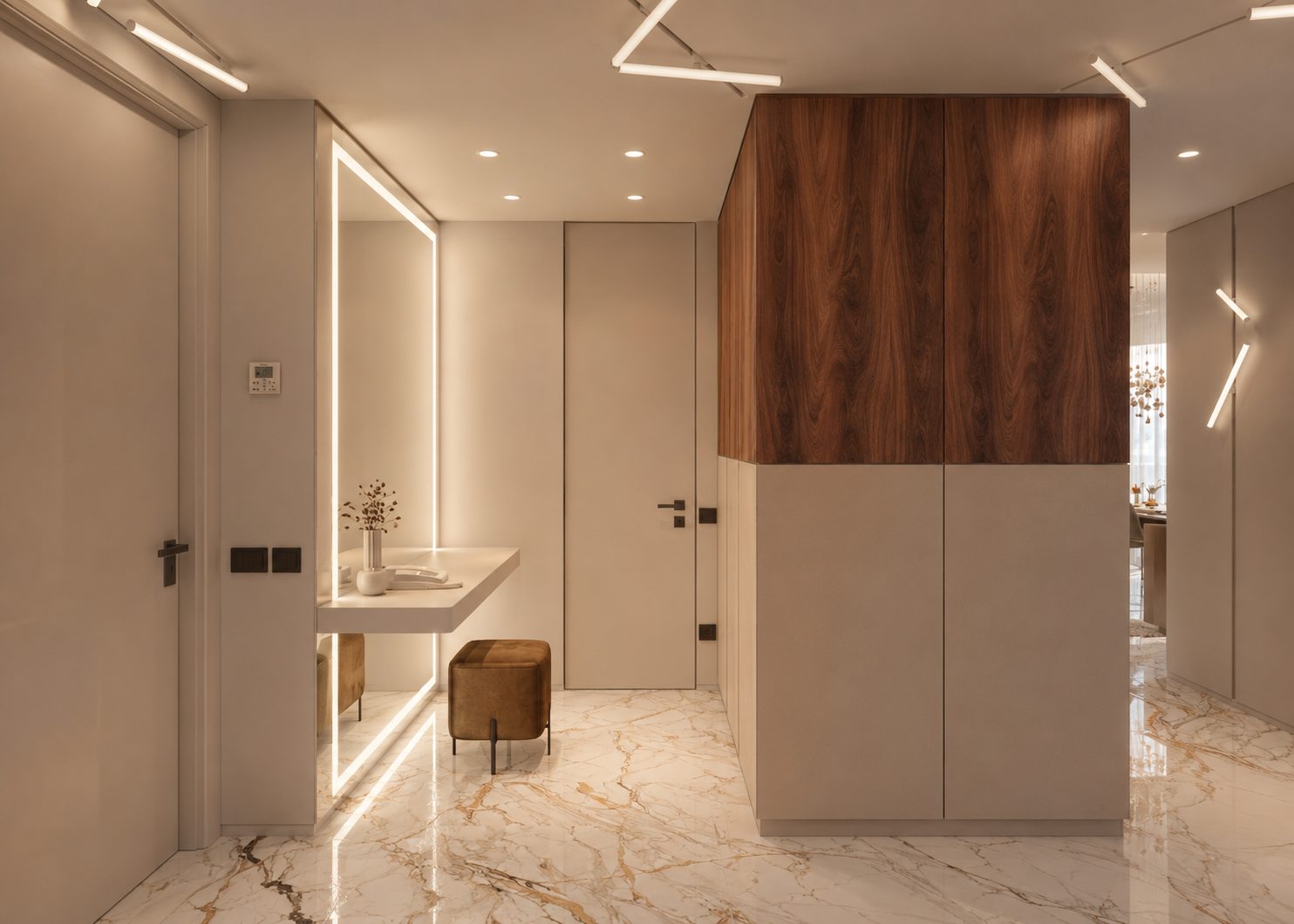
Ceiling types and what each one is for
- Flat suspended ceiling. One plane, no steps. Hides wiring and shallow ducting, gives a clean field for downlights. Cheapest and fastest.
- Drop ceiling over services only. A bulkhead following the duct route, the rest of the slab painted. Loses the least height and costs the least.
- Cove ceiling. A perimeter step with a concealed LED channel washing the outer band. Ambient light without adding fittings.
- Tray or coffer. A recessed central panel over a table or a bed, often with cove lighting inside. Zones an open plan without a partition.
- Multi-level. Two or more planes at different heights. Every level adds framing, edges and jointing.
- Curved and radius work. Bent board over a shaped frame, two layers of thinner sheet, wet-bent or kerfed. Slow and skilled.
- Backlit panel. Translucent acrylic or stretch fabric lit from behind, framed in gypsum by a separate trade.
GRG and GFRG sit alongside this. Glass-reinforced gypsum is cast in a mould rather than cut on site, which is the sane way to get cornices, domes and tight radii.
One honest note. Many Dubai apartments hand over with the developer's ceiling already in place and a decent finish on it. A fresh full ceiling then costs 100 mm of height for a cosmetic gain, and a repaint plus one cove in the living room is often the better spend.
Gypsum board against POP in this climate
POP is plaster of Paris: powder mixed wet on site, applied over mesh or a light frame, shaped by hand. Cheap and freely shaped. The problem is water. POP sets by absorbing water and keeps absorbing it afterwards. In a flat where the AC drops out for two days in August, POP softens at the edges and sags before board does. It cracks along its own set lines and cannot be given a tested fire rating as a system.
Gypsum board arrives as a factory sheet with a controlled core and a paper liner, fixed to steel. You get a known weight per square metre, a documented specification, and a ceiling that can be opened in one section and rebuilt. Where services run above, board wins here. POP keeps its place in mouldings and small ornamental runs.
Regular, moisture-resistant or fire-rated board: where each is required
Regular board goes in bedrooms, living rooms, internal corridors and dry storage. Standard thicknesses are 9.5 mm and 12.5 mm. On a ceiling use 12.5 mm, and treat 9.5 mm as a curved-work and double-layer material only.
Moisture-resistant (MR) board, the green-faced sheet, belongs in bathrooms, kitchens, laundry rooms and any ceiling next to a balcony door that spends the summer being opened. Manufacturer specifications for MR sheets sold here quote surface water absorption under 180 g/m² and total water absorption under 10 per cent, with no such limit on regular board.
MR board resists humid air and an occasional splash, but it is not waterproof and still softens under a leaking pipe or direct spray. Over a shower tray, fibre cement board is the correct call, because it holds shape through wet and dry cycles.
Fire-rated board appears in shared corridors, escape routes, service risers and most commercial fit-outs. The UAE Fire and Life Safety Code of Practice defines a Class A interior finish as flame spread 0 to 25 and smoke development 0 to 450, tested to ASTM E84 or UL 723. Where the ceiling forms part of a rated assembly, the assembly is what gets certified, so framing, fixing centres, layer count and every penetration have to match the tested build-up. Hatches included: fire-rated access panels supplied in the UAE carry Dubai Civil Defence approval and are tested to BS 476 and EN 1634, FD60 being the common specification. On our office fit-out in Platinum Tower, JLT, the tenancy ceiling and the shared-route ceiling were two specifications with two price lines.
Gypsum ceiling cost in Dubai 2026, with material and labour on separate lines
These are the bands we work to on our own Dubai sites, per square metre of ceiling area, supplied and fixed to a paint-ready skim. Planning figures, not a rate card.
Flat suspended ceiling, 12.5 mm regular board: AED 75 to 120 per m²
- Board, 12.5 mm regular: AED 14 to 22
- Galvanised frame, hangers, perimeter angle, fixings: AED 18 to 30
- Tape, joint compound, skim material: AED 6 to 12
- Labour, framing through sanding: AED 35 to 55
Perimeter cove with concealed LED channel: AED 130 to 220 per m², or AED 90 to 180 per linear metre where the cove is priced separately from the flat field. Around 60 per cent of the uplift is labour, because a cove is edges and edges are hand work.
Tray or coffer: AED 140 to 240 per m² over the tray footprint.
Multi-level: AED 200 to 320 per m², driven by the number of planes rather than the area.
Curved and radius sections: AED 280 to 550 per m² of curved surface, two layers of 9.5 mm over a shaped frame.
Backlit acrylic or stretch fabric: AED 450 to 1,200 per m² as a market band, set by the panel system.
Board upgrades, added to whichever rate applies: MR adds AED 8 to 18 per m². Fire-rated adds AED 12 to 30 per m² for a single layer, more where a rated assembly needs two.
Priced per piece rather than per square metre:
- Painted flush access panel, supplied and fitted: AED 120 to 350 each
- Fire-rated FD60 panel with Civil Defence approval: AED 350 to 900 each
- Downlight cut-out and local reinforcement: AED 20 to 45 each
- AC diffuser or grille opening with plenum trim: AED 60 to 150 each
- Stripping an existing ceiling and clearing debris: AED 25 to 60 per m²
- Painting the finished ceiling: AED 12 to 25 per m², above wall rates in an itemised quote
One square metre is 10.76 square feet, so a flat ceiling is roughly AED 7 to 11 per square foot and multi-level work reaches about AED 30. Advertised rates of AED 25 to 70 per square foot circulate around Dubai, and most of that gap is scope: lighting, painting, design and a minimum job charge sit inside those numbers. Below about 25 m² you pay for mobilisation rather than area.
Inside a larger renovation the ceiling folds into the overall rate. How we scope, sequence and fix a quote by contract is set out with the services.
What pushes a ceiling quote up
- Light points. Each aperture is a cut-out, a reinforcement and a clash check, and it costs again in the electrical package.
- Access panels and diffusers. Every opening interrupts framing and needs a trimmer, and ten in an apartment is normal.
- Curves and levels. A radius doubles the board layers, and each extra plane adds a full set of edges.
- Height. Above roughly 3.2 m the crew works off towers rather than steps. Double-height voids in Dubai Hills and The Meadows carry that premium.
- Area measured on the surface, not the floor. A stepped ceiling has more surface than the floor plan. When two quotes differ by 20 per cent, check which area each measured.
AC ducting, diffusers and the access panels nobody draws
You can conceal ductwork in a gypsum ceiling, and in most Dubai apartments that is what the ceiling is for. Keep the insulation intact and keep an air gap. Duct pressed hard against the back of the board sweats where it touches, and in a humid August that condensation stains the plaster within a season. Where flexible duct meets a diffuser, keep the run short and gently curved, because a crushed flex kills airflow to that room.
Every serviceable item above the ceiling needs a way in: the fan coil unit, its filter and drain pan, the condensate trap, any VAV box or fire damper, valves and every LED driver. Put the hatch where a technician can actually reach the thing, rarely the tidy corner that suits the drawing. We size 450 x 450 mm minimum for a valve, 600 x 600 mm for a filter change.
Condensate drainage causes the most damage. The drain needs a fall the whole way to its connection, plus a secondary pan under any FCU over a finished area. When an FCU drain blocks with no pan and no hatch, the first sign is a wet patch spreading across a coved ceiling. We ran MR board through the wet areas and pan-drained every concealed unit on the Palm Jumeirah apartment project for that reason.
Apartments: ceiling height, developer NOC and building rules
The 2021 edition of the Dubai Building Code sets a minimum clear height of 2.7 m for living and bedroom spaces. That governs the design of the building, and it frames your arithmetic: a flat handed over at 2.8 to 3.0 m clear loses 100 to 150 mm to a standard drop and more under a duct, and 300 mm off a 2.75 m room reads as low from the doorway. Where headroom is tight, build the bulkhead only over the services and paint the rest of the soffit.
Purely cosmetic work is frequently exempt from a developer NOC, but a suspended ceiling touches lighting circuits, AC and sometimes sprinkler heads, which pushes it out of the cosmetic bracket in most buildings. Emaar clears NOC submissions in roughly 5 to 10 working days and Nakheel in 7 to 15, which is two to three and two to four calendar weeks once weekends and one round of comments are counted. Palm Jumeirah then goes to Trakhees rather than Dubai Municipality. Fee schedules get revised, so confirm current numbers with community management.
Sprinkler heads left above a new lower ceiling have to be relocated or extended by a Civil Defence approved contractor, with its own approval and lead time. Buildings also set working hours and lift windows, and the national midday break runs 15 June to 15 September, banning outdoor work in direct sunlight from 12:30 to 15:00. Ceiling fixing is indoors and continues, but deliveries and skip runs land in that window.
Timeline, and where cutting cost costs you later
Working days from a cleared room to a paint-ready ceiling, once MEP first fix is signed off and any pressure or flood test has passed:
- One room, 15 to 25 m², flat: 3 to 5 days
- Two-bedroom apartment, around 110 m², flat with a cove in two rooms: 8 to 14 days
- Full apartment, 150 m², multi-level with coves: 15 to 25 days
- Villa, 350 to 450 m², mixed levels and some curved work: 4 to 7 weeks
Roughly half of that is drying. Compound goes on in two or three passes with sanding between, and in an unconditioned flat in July the surface skins over while the inside stays wet, producing a joint that cracks a month later. Running the AC or a dehumidifier during jointing is part of the programme. Never board before first fix is complete and tested.
Where saving money reliably backfires:
- Hanger and furring spacing. Furring past 600 mm centres or hangers past about 1,200 mm shows as a visible wave under daylight, and filler will not fix it.
- MR board in wet rooms. The saving on one bathroom is a couple of hundred dirhams. The repair is the ceiling, the paint and the lights.
- Access panels. Every hatch deleted to keep the ceiling clean becomes a hole cut with a knife by whoever needs the valve.
- Movement joints. Runs over about 10 to 12 metres need a control joint. Without one, the crack arrives on schedule.
- Driver location. Drivers above a sealed ceiling mean opening plaster the first time one fails, and they fail one at a time.
- Skim and paint. A cove throws light at a grazing angle and exposes every joint. The finish you accept in a cupboard will not survive in a lit cove.
Ceilings we have built across apartments, villas and commercial units are in the project gallery. For a specific unit, send the floor plan and a photo of the existing ceiling to WhatsApp on +971 54 307 4888 or info@domeco.ae.
FAQ
How much does a gypsum ceiling cost per square metre in Dubai in 2026?
A plain flat 12.5 mm ceiling runs AED 75 to 120 per square metre supplied and fixed to a paint-ready skim, roughly AED 7 to 11 per square foot. Cove work is AED 130 to 220, tray AED 140 to 240 and multi-level AED 200 to 320. Painting, access panels and light-point cut-outs are priced separately.
What is the difference between gypsum board and POP?
Gypsum board is a factory sheet screwed to a steel frame, with a controlled core and joints that can be opened and reclosed. POP is plaster of Paris mixed and applied wet on site. POP is cheaper and shapes freely, but it absorbs humidity, sags earlier in a Dubai summer and cannot carry a tested fire rating as a system.
Do I need moisture-resistant board in a bathroom ceiling?
Yes for the general bathroom ceiling, where MR board handles humid air and the occasional splash. Directly over a shower, use fibre cement board instead, because MR gypsum still softens under repeated water contact. No board replaces waterproofing.
Can AC ducting be hidden inside a gypsum ceiling?
Yes, and that is the main reason most Dubai apartments have one. Keep duct insulation intact with an air gap behind the board, keep flexible connections short, give the condensate a continuous fall, and fit a secondary drain pan under any fan coil unit over a finished area. Every serviceable item needs an access panel above it.
Will a gypsum ceiling crack from humidity in Dubai?
A correctly built one will not. Cracks here almost always trace to compound cured too fast in an unconditioned flat, long runs with no movement joint, or framing spaced too wide. When a ceiling cracks along a straight line a year after handover, the cause was the build.