

Interior designers in Dubai charge one of three ways: a rate per square foot, a lump sum for a defined scope, or a percentage of the project budget. As of 2026 the per-sqft band runs from roughly AED 75 to over AED 600, lump sums for a one or two bedroom apartment sit around AED 25,000 to 60,000, and percentage arrangements land at 10 to 20% of total project cost. Which model costs you least depends entirely on how tightly the scope is written before you sign.
One thing to separate straight away: the design fee buys drawings, specifications and decisions. It does not buy demolition, blockwork, MEP, joinery or finishes. Those sit in the construction budget, and if you want the build side of the arithmetic, that is a different calculation covered in our fit-out cost per sqft breakdown. Mixing the two numbers is the single most common reason a client thinks a quote is double what it is.
Three fee models, and when each one favours you
Per square foot is the default in Dubai because it is easy to compare across quotes. It works in your favour when the area is fixed and the scope is genuinely proportional to floor area, such as an open-plan office or a repetitive apartment layout. It works against you on a large, simple villa: 4,000 sqft with three near-identical bedrooms does not take four times the design hours of a complex 1,200 sqft apartment with a reconfigured kitchen and two wet areas. If your space is big and repetitive, ask for a stepped rate that drops above a threshold. Most studios will agree to it if you raise it before the proposal is drafted.
Lump sum is the safest model for a homeowner with a defined scope. You know the number, the designer carries the risk of their own inefficiency. The catch is under-scoping: a low lump sum with a thin deliverables list gets recovered later through "additional services". Read the exclusions list before you read the price.
Percentage of project cost shows up on larger residential work and on commercial projects where the final budget is unknown at appointment. It suits an open-ended scope, and it carries a structural problem that deserves its own section below.
For a one-bedroom renovation, lump sum wins almost every time. For a villa where furniture and joinery specification is still undecided, a percentage with a hard cap in dirhams is more honest than a lump sum built on guesses. For a shell-and-core commercial unit where the tenant's requirements are still moving, per sqft with a defined revision allowance is the cleanest.
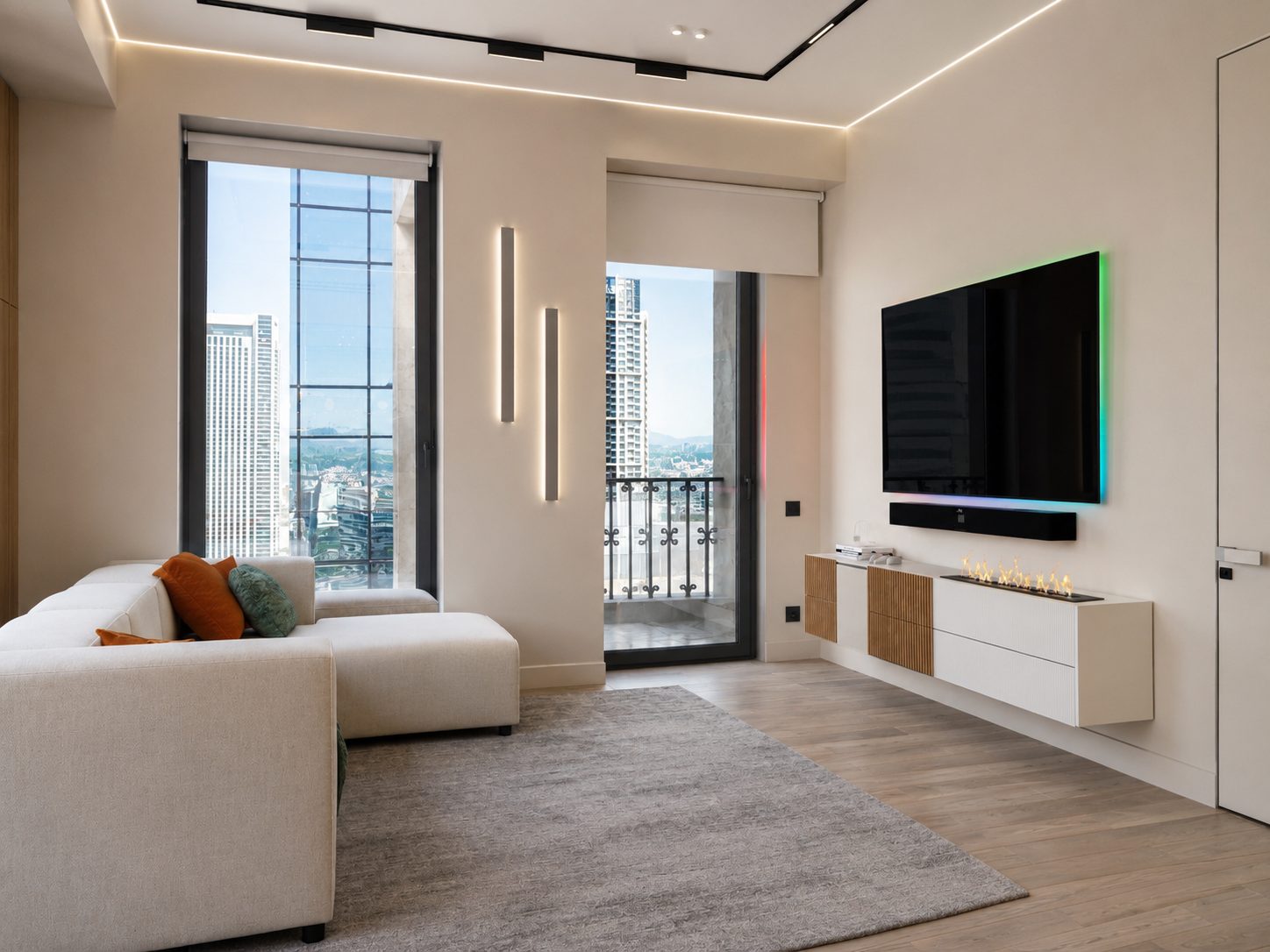
Interior design fee ranges in Dubai for 2026
These are market observations, not a DOMECO price list. Treat them as the bands you should expect to see in proposals during 2026.
- AED 75 to 150 per sqft. Budget tier. Usually means moodboards, a space plan and renders, with drawings thin enough that the contractor makes decisions on site.
- AED 200 to 400 per sqft. Standard residential and small commercial. A proper drawing set, real material specification, defined revision rounds.
- AED 400 to 600 per sqft. Premium. Custom joinery detailed to fabrication level, lighting design coordinated with the ceiling, supplier-specific schedules.
- AED 600+ per sqft. Luxury and bespoke, typically with imported specification, a dedicated project architect, and supervision built into the scope.
Lump sums track the same logic. Market ranges as of 2026: a studio at AED 10,000 to 25,000, a one or two bedroom apartment at AED 25,000 to 60,000, a three to five bedroom villa at AED 80,000 to 250,000 and upwards. Our own design projects start from AED 10,000, with a delivery window of three to six weeks depending on scope. A separate project management fee of 10 to 20% of project cost is common when the designer also runs the site, and that fee is distinct from the design fee itself.
Watch the units. Design fees in Dubai are quoted per square foot, construction is often quoted per square metre, and one square metre is 10.76 square feet. AED 200 per sqft is about AED 2,150 per m². I have sat in meetings where a client compared a design fee in sqft against a build rate in m² and concluded the designer was cheaper than the tiling. Ask every quote to state the unit.
Design stage timelines run one to three months for an apartment and three to six months for a villa, measured from the signed brief to a complete drawing set. An advance of 30 to 50% before work starts is standard practice across the market.
What each design stage actually buys
The useful question is not "how much is the fee" but "what arrives at the end of each payment". A workable stage breakdown looks like this.
Concept, roughly 10 to 20% of the fee, buys a measured survey of the existing space, a space plan with two or three layout options, moodboards and an outline budget. This is the stage where changes are free, and the stage most clients rush.
Detailed design and 3D, roughly 25 to 35% of the fee, covers finish selections, joinery concept, lighting intent, sanitaryware and brassware direction, and visualisations. The design is locked here, not earlier.
Working drawings, roughly 30 to 40% of the fee, is the set a contractor can actually build from. For a 1,200 to 1,800 sqft apartment, a buildable set is typically 45 to 70 sheets: demolition and setting-out plans, partition layouts with dimensions to the millimetre, floor finish plans showing where the first tile lands and where the cuts fall, a reflected ceiling plan coordinated against AC grilles and sprinkler heads, lighting circuits and switching, power and data with socket heights, wet area waterproofing details, joinery elevations at 1:20 with sections at 1:5, a door and ironmongery schedule, and finish schedules carrying supplier names and product codes. A three to five bedroom villa runs 90 to 140 sheets. If the set you are handed for an apartment has fewer than 30 sheets, your contractor will be making the missing decisions himself, and those decisions arrive later as variations.
Authority and permit submission drawings are frequently excluded from the headline fee. Community management in developments like Emaar, Nakheel or DMCC will not accept a permit application from a designer without the correct trade licence, and structural or MEP alterations need drawings stamped by a licensed consultant. Ask who submits, who pays the fees, and who chases the NOC.
Site supervision is separate again, priced monthly or per visit. More on why that line item earns its keep below.
Normally outside the fee: structural and MEP consultant stamps, third-party surveys, authority fees, procurement, and post-completion photography. None of these are unreasonable exclusions. They become a problem only when nobody mentions them until month three.

The percentage model and its built-in conflict of interest
If a designer is paid 15% of the project cost, every expensive specification increases their fee. Nobody in the industry likes talking about this openly, and it is the reason percentage deals develop a reputation.
The conflict is manageable, but only in writing. Four clauses that close it:
- 1. Calculate the percentage on the approved budget agreed at concept sign-off, not on final spend. If the client later adds scope, the fee adjusts by agreement, not automatically.
- 2. Convert to a fixed dirham amount once that budget is signed. A percentage is a way of arriving at a number, not a permanent condition.
- 3. Exclude from the fee base any variation caused by the designer's own error or omission. Redrawing a ceiling because a beam was missed is not billable work.
- 4. Require full disclosure of trade discounts and commissions from every supplier used on the project.
Skip these and you are relying on goodwill. Most designers in Dubai have plenty of it; the ones who do not are precisely the ones who suggest a percentage model without a cap. If you are weighing whether to keep design and construction under one contract or split them, the trade-offs sit in our comparison of design-and-build against a separate designer and contractor.
Procurement fees and who keeps the supplier discount
Dubai showrooms give trade accounts a discount, commonly somewhere between 15 and 40% off retail depending on the category and the volume. Someone gets that money. The contract decides who.
There are three arrangements that are honest, and one that is not. Honest: the designer passes the trade price through and charges a stated procurement fee, usually 10 to 15% of the goods value; or the designer keeps the trade margin and charges no separate procurement fee; or you buy direct on your own account and pay the designer a coordination fee for specification and follow-up. The arrangement that is not honest is charging a percentage of your spend while also quietly retaining the supplier discount on the same goods. Ask one question in the first meeting: "will supplier invoices be issued in my name". The answer tells you which of the four you are in.
Procurement is also where lead time bites. Imported Italian joinery and slab stone routinely run 8 to 14 weeks from order to delivery in Dubai, locally fabricated joinery 4 to 8 weeks. A design fee does not compensate you for a specification ordered too late. Insist that the finishes schedule carries lead times next to the product codes, and that long-lead items are ordered at working drawing stage rather than when the contractor reaches them.
3D visuals and revisions: what is included and what starts the meter
Visualisation is priced separately more often than clients expect. Market range as of 2026 is AED 3,000 to 15,000 for a package, with per-view rates in the region of AED 800 to 2,500 depending on realism and how many revision passes are included. A typical apartment package is six to ten views.
Two rounds of comments per stage is the industry norm. What matters is the definition of a round. A round is your consolidated comments delivered in one document within an agreed window, usually five working days. It is not four emails over three weeks, each contradicting the last. Anything that changes an approved decision is a new instruction and gets charged, commonly at AED 150 to 450 per hour as a market indicator.
Here is the pattern I see on almost every residential project: clients change their minds about the kitchen layout and the bathroom finishes, and they do it after seeing the first 3D. That is normal and not a problem, because at that point the change costs almost nothing. The cost curve after that is steep. At concept, a change is free. After the 3D, it is an afternoon. Once working drawings are issued, moving a kitchen island ripples through 8 to 15 sheets, because the plan, the RCP, the lighting circuits, the power layout, the floor setting-out and three joinery elevations all reference it. Once joinery is in production, expect to pay 30 to 60% of that item's value, because MDF, veneer and stone are cut to order and a cancelled panel has no second life.
If you take one thing from the fee discussion, take this: the money you spend deciding early is a fraction of the money you spend deciding late.
Site supervision: the line item that pays for itself
Design supervision, sometimes called author supervision, is usually quoted at 5 to 15% of the design fee or as a per-visit rate, with a weekly site visit as the baseline. Clients cut it first because it looks like an optional extra on a proposal. It is the cheapest insurance on the project.
What a weekly visit actually catches: a tile setting-out that would have put a 40 mm sliver against the most visible wall, found at dry-lay stage and fixed in an hour. Stripping and re-laying a 20 m² bathroom after grouting costs roughly AED 6,000 to 12,000 in labour and material, plus a week of programme, plus the risk of the batch being out of stock. Ceiling clashes are the second recurring one: the RCP shows a cove where the AC grille needs to sit, and nobody notices until the gypsum is up. Socket heights that fight the joinery, chases cut through the wrong wall, waterproofing screeded over before the flood test, cornices ordered to a drawing that ignores a 30 mm skew in an existing wall. None of these are exotic. All of them are cheap to catch and expensive to discover.
Season matters too. Between June and September, screed and paint behave differently in Dubai humidity, and a contractor under programme pressure will close up a floor before it has given up its moisture. Someone has to be on site saying no. That is what you are paying for.
You can see the kind of detailing this produces across our completed projects in Palm Jumeirah, Dubai Hills, City Walk and Downtown Boulevard.
What the design contract has to say
A design agreement in Dubai should be readable in fifteen minutes and should answer all of the following. If it does not, ask before signing rather than after.
- Stage-by-stage deliverables, named individually, with an approximate sheet count for the working drawing set.
- A payment schedule tied to accepted deliverables rather than calendar dates.
- The number of revision rounds per stage, and the hourly rate for anything beyond that.
- Ownership of the output. Many contracts hand over PDFs only and keep the DWG files, which locks you to that designer if you ever want a change. Negotiate DWG handover at final payment.
- A programme with dates, and a stated consequence if the designer misses them. Our own construction contracts carry a percentage penalty for each day of delay, and there is no reason a design contract cannot carry something equivalent.
- An explicit exclusions list: authority fees, consultant stamps, surveys, procurement, supervision.
- Procurement rules and discount disclosure.
- What happens if you change contractor mid-project, and whether the designer's drawings can be used by someone else.
The build-side equivalent, including how retention and stage payments should be structured, is set out in our guide to contractor payment schedules and retention. On our own projects the estimate is fixed by contract with no top-ups after the start, and the works carry a one-year warranty. Whoever you appoint, get the equivalent commitments written down.
Why cheap design ends up expensive
At AED 75 to 150 per sqft in Dubai, the arithmetic does not allow for a full drawing set. A designer working at that rate produces attractive renders, a mood direction and a handful of plans, then hands it to a contractor who fills the gaps with his own judgement. His judgement is not worse than the designer's, it is just cheaper and quicker: standard socket heights, standard skirting, tiles laid from whichever corner is convenient. The renders you approved and the flat you receive drift apart, and every attempt to close that gap is a variation you pay for.
The honest counterpoint, since it cuts against our own interests: not every property needs a paid design package. If the unit is a one bedroom going straight onto the rental market, a full AED 30,000 design rarely returns its cost in rent achieved. A paid consultation of a few hours plus a written finishes schedule with product codes gives your contractor enough to work from, and the money is better spent on the kitchen and the AC. Design fees earn their keep when the space is being reconfigured, when joinery is bespoke, or when you intend to live there for years. Buying a design package for a rental refresh is a decision made with the heart.
Where the property is your home or a genuine premium asset, spend the money at the drawing stage and spend it once. Everything downstream is cheaper for it.
FAQ
How much do interior designers charge in Dubai in 2026?
Per-sqft rates run from roughly AED 75 to 150 at the budget end, AED 200 to 400 for standard residential, AED 400 to 600 for premium and AED 600 or more for luxury. Lump sums typically sit at AED 10,000 to 25,000 for a studio, AED 25,000 to 60,000 for a one or two bedroom apartment and AED 80,000 to 250,000 upwards for a villa. Percentage deals run 10 to 20% of total project cost.
Is the interior design fee included in the renovation cost?
No. The design fee covers drawings, specifications and coordination. Construction, materials, joinery and MEP works are a separate budget. Some design-and-build companies present a single combined figure, and if yours does, ask for the design portion to be shown separately so you can compare it against standalone studios.
What percentage do interior designers take of the project cost?
Between 10 and 20% where a percentage model is used, and a further 10 to 20% is common if the same firm also runs project management. The percentage should be calculated on the budget agreed at concept sign-off and converted to a fixed dirham figure at that point, otherwise the fee rises every time the specification does.
How many revisions are included in a design fee?
Two rounds per stage is standard. A round means consolidated comments delivered in one document within an agreed window. Changing something you already approved counts as a new instruction, not a revision, and is normally billed hourly at a market range of AED 150 to 450.
Do I need to pay extra for 3D renders?
Often yes. Visualisation packages in Dubai run about AED 3,000 to 15,000 as of 2026, with six to ten views typical for an apartment. Check whether renders are included in the detailed design stage or quoted per view, and how many revision passes come with them.
How long does the design stage take in Dubai?
One to three months for an apartment and three to six months for a villa, from signed brief to complete drawing set. Our design projects run three to six weeks depending on scope. Authority and community approvals sit outside that window and depend on the developer or free zone authority involved, so build in extra time before construction starts.