

TL;DR: Villa landscaping in Dubai runs roughly AED 50 to 100 per sqm for softscape, AED 150 to 300 per sqm for hardscape, and AED 250 to 500 per sqm for a premium finish. A standard four to five bedroom villa garden lands between AED 40,000 and 150,000. Permanent pergolas and outdoor kitchens need a community NOC, and often a municipality permit on top.
Those bands are market orientation, not a rate card. What decides the number on your plot is the microclimate, the community you sit in, and whether the yard was designed alongside the interior or bolted on eight months later. The third factor costs owners more than the first two combined.
Why a Dubai yard dies without design
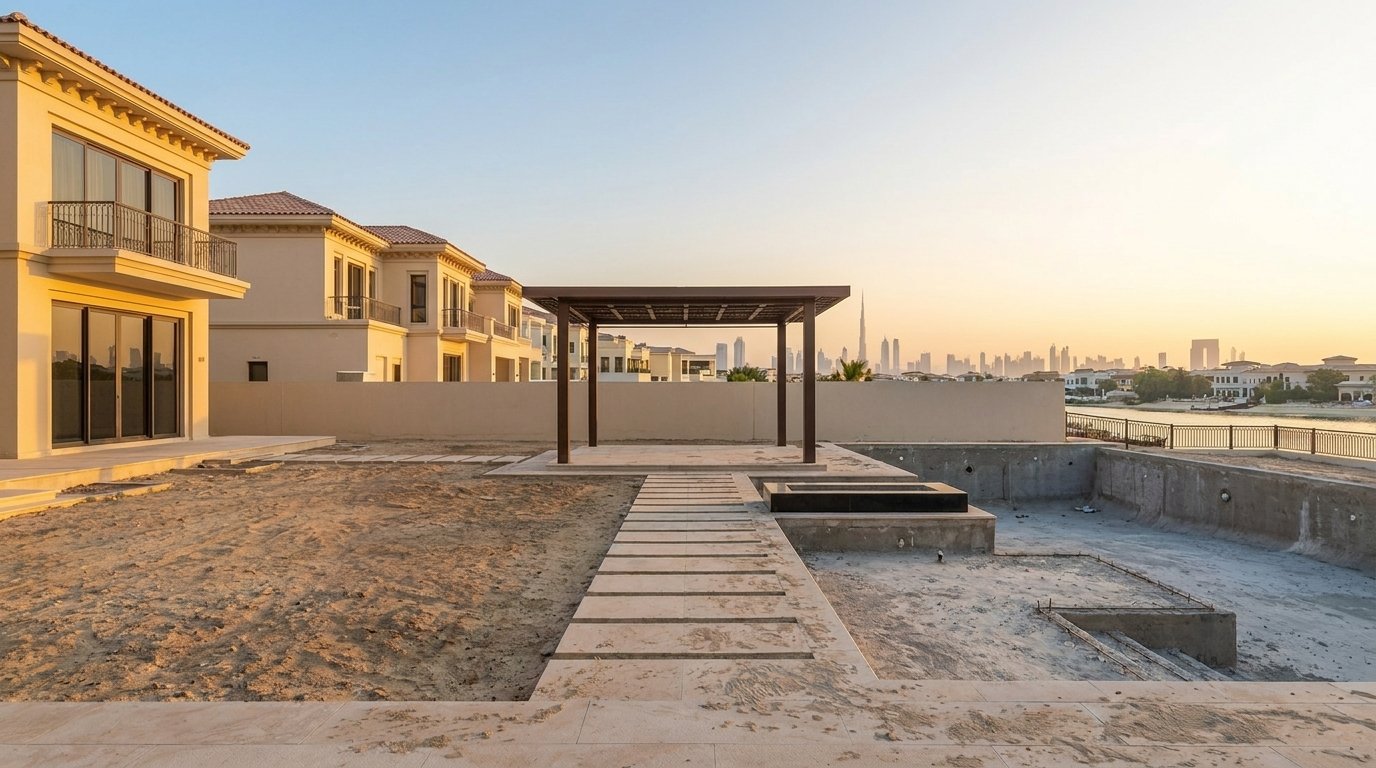
A garden here fails for reasons that have nothing to do with plant choice. Summer air sits at 45 to 50°C for weeks, surfaces in direct sun go well above that, and evaporation pulls water out of the soil faster than most timer settings replace it. Sandy substrate holds almost nothing, so a long weekly soak drains past the root zone and does little except raise your DEWA bill.
Then there is salt. Groundwater and some supply sources carry enough dissolved salts that repeated irrigation concentrates them in the top layer of soil as water evaporates. Plants that looked fine in March show leaf-edge burn by July, and the owner blames the nursery. The fix is a design decision made before planting: soil replacement or amendment, drainage below the bed, and a leaching cycle built into the irrigation programme.
The third failure is structural. Paving laid without a proper sub-base moves within two summers, because the sand beneath it shifts with thermal cycling and irrigation water. Falls set at zero, or worse, set towards the house, push storm water and pool splash back at the villa's damp-proofing. We have opened up terraces where the tanking behind a two-year-old garden had already given up.
Three microclimates, three different briefs
Dubai is not one climate for landscaping purposes. Three site types cover most villa and townhouse work, and the specification changes materially between them.
On Palm Jumeirah, Bluewaters and the seafront strip, onshore wind carries salt aerosol onto every surface all year. Untreated aluminium chalks, standard 304 stainless fixings bloom rust within a couple of seasons, and mild steel is simply not a material here. Specify marine or architectural-grade powder coating with the correct pre-treatment, 316 stainless for anything exposed, and isolate dissimilar metals so you do not build a galvanic cell into your own pergola. Planting on the seaward face takes the scorch first, so salt-tolerant species go there and softer material shelters behind them.
In Arabian Ranches, Dubai Hills and Damac Hills, the enemy is fine dust and wind-driven sand rather than salt. Dust clogs drip emitters, gets into pool filtration, and coats leaves heavily enough to cut photosynthesis. Filters and pressure regulators on the irrigation line stop being optional. These communities also carry the tightest external appearance rules, because the master developer is protecting a streetscape: pergola colour, boundary wall height, and what is visible above that wall are all controlled.
Terraces and podium gardens on coastal towers are a different job again. No soil, no ground, everything in planters, which means dead load on a slab designed for furniture rather than 600mm of wet substrate. The waterproofing membrane under that terrace cannot be penetrated, so nothing gets fixed down with a through-bolt without a proper detail. Wind uplift at forty storeys turns a loose planter into a hazard, and the terrace usually has one drain outlet sized for rainfall, not for a garden's runoff. Approval here comes from building management and the owners association rather than a master developer.
What outdoor living includes, and what each part costs
Owners tend to think of landscaping as plants. On a real project the planting is usually the smallest line. Reported Dubai market bands, for planning:
- Softscape, meaning soil replacement, planting, turf and mulch: AED 50 to 100 per sqm, with turf on its own at AED 35 to 80 per sqm.
- Hardscape, meaning excavation, sub-base, paving, steps and kerbs: AED 150 to 300 per sqm, rising towards the top with large-format porcelain or natural stone.
- A premium full-garden finish across the plot: AED 250 to 500 per sqm, which is where most Palm and Dubai Hills projects sit.
- Automated drip irrigation with controller, filtration and zoning: commonly AED 8,000 to 15,000 for a villa plot.
- Pergola: reported at AED 1,200 to 4,000 per sqm of covered area, so a 30 sqm aluminium structure with a solid roof and integrated lighting is realistically AED 40,000 to 120,000, not AED 15,000.
- Exterior lighting: a working figure of AED 350 to 1,200 per fitting installed, putting a 25 to 40 fitting garden between roughly AED 9,000 and 48,000.
- Outdoor kitchen: AED 25,000 to 120,000 and up, driven by carcass material, worktop and appliances rather than by size.
Every figure above is a market band, not a DOMECO quote. Our pricing is fixed in the contract before work starts, with no top-ups once the scope is signed, and a garden follows the same rule as an interior. The interior side of the arithmetic sits in our full breakdown of villa renovation costs in Dubai.
One honest note, because it saves people money. If the villa is going out for rent, a AED 200,000 garden does not come back in the lease. Shade, working irrigation and a decent exterior lighting circuit do move a listing. A bespoke water feature does not. Spend the difference inside.
The pool splash zone, where most gardens fail first
The metre or so of paving around a pool takes constant wetting, chlorinated water, and then bakes dry. Travertine and soft limestone pit and stain under that cycle, cement grout washes out, and salts migrate to the surface as white bloom that no amount of scrubbing removes permanently.
What holds: low-porosity 20mm porcelain, an adhesive and grout system rated for external wet use, a fall of at least 1% away from the pool, and a linear drain that actually goes somewhere. The coping detail needs tanking underneath it, rather than a bed of mortar alone. That is wet-room discipline applied outdoors, and it is the detail we most often find missing on gardens built by a crew with no waterproofing background.
Outdoor kitchen ventilation, the other quiet problem
An outdoor kitchen under a solid pergola roof with three walled sides is, in practice, an indoor kitchen with worse extraction. Grease and smoke collect against the roof, discolour the finish within a season, and drift back into the house through the nearest opening. Either keep two sides genuinely open, or install mechanical extraction with a grease filter and a duct run that discharges away from seating and windows.
If the kitchen runs on LPG, Dubai Civil Defence requirements govern cylinder siting, ventilation of the storage area, detection and emergency shut-off. LPG is heavier than air and pools at low level, which is exactly why a cylinder tucked into a sealed base cabinet is a bad idea. Added electrical circuits on the plot are DEWA-licensed contractor work and load onto the villa's existing supply, which on an older villa is not always as spare as owners assume.
Approvals: municipality permit, community NOC, and who files what
There are two gates, and they run in a specific order.
The first is the community NOC. In master-planned communities the master developer's design review committee approves any change to the external appearance of the plot before anything goes to an authority. Emaar, Nakheel and DAMAC each run their own version. Your contractor's consultant uploads drawings, a site plan and a method statement through the developer portal. Reported review times for a home modification NOC commonly sit at 7 to 14 working days, with hardscape and landscape packages more often quoted at two to three weeks. Treat those as planning bands rather than guarantees, because a resubmission resets the clock.
The second gate is the authority permit, and it only triggers for permanent structures. Depending on the plot, that is Dubai Municipality, Dubai Development Authority, or Trakhees for Palm Jumeirah and the Jebel Ali area. Approval consultants widely quote the trigger as a fixed pergola or gazebo above roughly 20 sqm of footprint or 3 metres in height, above which a building permit with wind-load calculations and approved materials is required. That threshold circulates among contractors more consistently than the authority publishes it, so confirm it for your specific plot before relying on it. Landscaping-only work, meaning planting, turf, soil and drip with no permanent structure, is generally reported as needing the community NOC alone.
Palm Jumeirah deserves its own paragraph. There you clear Nakheel as master developer and Trakhees as technical regulator, a double gate rather than a single one. Reported end-to-end timelines are four to eight weeks when the two applications run in parallel, and materially longer when they run one after the other. Any foundation work within three metres of the plot boundary is reported to require a geotechnical investigation confirming soil bearing capacity at that exact location, which is a Palm-specific requirement most owners have never heard of until a consultant raises it.
Three rules catch people out repeatedly:
- 1. A minimum proportion of the plot, reported at around 30% excluding the building footprint, must stay as soft landscaping in some jurisdictions. A swimming pool counts as hardscape, which changes the arithmetic on a small plot.
- 2. Permanent structures need a setback from the boundary wall, commonly quoted between 1 and 1.5 metres. Building a pergola tight to the wall to gain floor area is the fastest route to a rejection.
- 3. Colour, material and height are controlled in most communities. Dark timber-effect cladding that looks fine in a render gets refused when it sits outside the community palette.
Working without the NOC is a stop-work risk rather than a paperwork risk. The community suspends the contractor's access cards, work halts mid-excavation, and reinstatement lands on the owner. You supply title deed, Emirates ID, passport and tenancy documents if the property is leased. The trade licence, insurance, drawings and method statement are the contractor's job. A contractor who asks you to handle the submission yourself is telling you how many of these they have done.
Plants and irrigation that survive July
The list that reliably comes through a Dubai summer is short and well proven. Desert rose (Adenium) handles heat and low water and gives sculptural form. Bougainvillea flowers hard through the worst of it as long as it is not overwatered. Neem grows fast and throws real shade. Date palm is the most salt and heat tolerant of the palms and the safest choice on a coastal plot. Foxtail palm suits a contemporary scheme but is less forgiving of salt, so keep it inland or sheltered. Tecoma gives colour on a boundary with very little fuss.
Two honest exclusions. Ficus nitida hedging is everywhere in Dubai because it screens quickly, but it drinks heavily and its roots go looking for water in drainage runs and under paving. We have lifted terraces to find ficus roots inside the irrigation line. And artificial turf, which owners often propose to solve the water problem, reaches surface temperatures that make it unusable barefoot from May to September. It works in shaded courtyards and almost nowhere in full sun.
On irrigation, drip beats sprinklers here and it is not close. Sprinklers throw water into 45°C air where a meaningful share evaporates or blows off target, and they wet foliage, which leaves salt deposits on leaves. Drip puts water at the root, under the mulch, where evaporation cannot reach it.
Programme it for sandy soil: short frequent cycles rather than one long soak, running before sunrise rather than in the evening, plus a periodic heavier cycle whose only job is flushing accumulated salts below the root zone. Fit a filter and pressure regulator, because dust and hard-water scale block emitters within a season, and a blocked emitter stays invisible until the plant it feeds is dead. Where the community supplies treated sewage effluent for landscape irrigation, Dubai Municipality encourages its use and it costs considerably less than mains, so ask whether your plot has a connection before designing the system.
Materials that hold at 45°C and under UV
Powder-coated aluminium has become the default for pergolas here for good reason: it does not rot, does not rust, and takes a durable finish. The detail that matters is coating grade. Near the coast, ask for a marine or architectural-grade system with the correct pre-treatment and check what the coating warranty actually covers, because standard interior-grade powder coat on the seafront will chalk.
Timber is the material owners want and the one that disappoints most often. Softwood decking is finished in three summers. Hardwood and thermally modified timber perform better but still move with the daily temperature swing, so fixings and gaps have to allow for it. Composite decking is stable and low maintenance, though dark tones get hot enough underfoot to be unpleasant by mid-morning. Take the lighter shade even if the sample board flatters the dark one.
Porcelain has quietly won most of the paving market. Low porosity means no efflorescence, no chlorine etching, no sealing programme. Natural stone still reads better in a luxury scheme, and travertine is genuinely cooler underfoot, but it is porous, so keep it away from the pool edge and accept a maintenance cycle. Dark granite is durable and gets brutally hot.
Fabric shade sails deserve realistic expectations. A high-UV-rated PTFE or HDPE fabric has a service life measured in years, not decades, and budget fabric looks tired after two or three summers, so price the replacement cycle in at the start. Glass balustrades follow the same logic: structurally fine, but between construction dust and hard-water spotting they need cleaning far more often than owners expect.
Where landscaping sits in the fit-out sequence
This is where a full-cycle contractor differs from a landscape crew, and where money leaks on badly run projects.
The yard is your site compound. During strip-out and MEP first fix it holds skips, material and mixers. Building a finished garden and then running an interior renovation across it means either protecting it at real cost or rebuilding it. So a villa runs roughly like this:
- 1. Design and survey, alongside the interior design. Levels, existing drainage, utility routes and the plot's actual falls get recorded once, for both scopes. A design package starts from AED 10,000 and takes three to six weeks.
- 2. Approvals in parallel with demolition. The NOC and any authority permit go in while the interior is being stripped, so the paperwork clock runs during work you are doing anyway.
- 3. Interior wet trades finish. Waterproofing, screed and tiling generate the dirtiest traffic across the plot, and nothing external gets finished until that stops.
- 4. Excavation, drainage and buried services. Pool shell if there is one, drainage falls, irrigation mains, low-voltage lighting cable in sleeves. Every buried run gets sleeved and recorded on a drawing, because the alternative is cutting new paving in year two to trace a fault.
- 5. Hardscape. Sub-base, compaction, paving, steps, pergola foundations. The sub-base is the line item people cut and the reason paving lifts.
- 6. Structures and fittings. Pergola, kitchen carcass, lighting fittings, furniture bases.
- 7. Soil and planting last, then irrigation commissioning and lighting scene programming.
That ordering is why we run landscaping inside the villa contract rather than as a separate trade. On the Dubai Hills villa in our portfolio, a 290 sqm turnkey job over eight months, the garden and the interior were one programme with one site team, which is the only way irrigation sleeves end up under the paving instead of chased in afterwards. The scope on that and other completed jobs is in our project archive.

One seasonal caveat worth planning around. Hardscape can be built through the summer. New planting installed in June, July or August usually means replacing a share of it in October, whatever the nursery tells you. If the programme allows, land the planting phase between October and April and let it establish before the first real heat.
Timelines, the fixed quote and the penalty for running late are written into the contract before the first skip arrives, and workmanship carries a one-year warranty. If you want the sequence mapped against your own plot and community, send us the plot details and we will tell you which gate applies before anything is priced.
FAQ
Do I need Dubai Municipality approval for a pergola or outdoor kitchen?
For a permanent structure, usually yes, on top of the community NOC. Approval consultants commonly quote the trigger as a fixed pergola above roughly 20 sqm of footprint or 3 metres in height, at which point a building permit from Dubai Municipality, DDA or Trakhees is required with wind-load calculations. Confirm the current threshold for your plot, since that figure circulates among contractors more consistently than it is published. An outdoor kitchen running LPG brings Dubai Civil Defence requirements for cylinder siting, ventilation and shut-off.
How long does a community NOC take?
Reported review times for a home modification NOC from a master developer commonly sit at 7 to 14 working days, with landscape and hardscape packages more often quoted at two to three weeks. Palm Jumeirah is the outlier, because Nakheel and Trakhees are two separate gates and the reported end-to-end range there is four to eight weeks when applications run in parallel. Any resubmission restarts the review, so treat these as planning bands rather than commitments.
Which plants actually survive a Dubai summer?
Desert rose (Adenium), bougainvillea, neem, date palm, foxtail palm and tecoma all come through reliably with correct irrigation. Date palm is the most salt-tolerant of that group and the safer choice on the Palm or any seafront plot, while foxtail does better inland. Species matters less than substrate and watering: the same bougainvillea thrives on drip in amended soil and dies on a weekly sprinkler soak in raw sand.
How much does villa landscaping cost in Dubai?
As a market band, softscape runs AED 50 to 100 per sqm, hardscape AED 150 to 300 per sqm, and a premium full-garden finish AED 250 to 500 per sqm. A standard four to five bedroom villa garden typically lands between AED 40,000 and 150,000, while a full transformation with pool, outdoor kitchen and lighting can pass AED 500,000. Those are planning figures rather than a quote, and plot condition plus community rules move them.
When in the renovation should landscaping happen?
After the interior wet trades finish and before final interior handover. The yard serves as the site compound during strip-out and MEP, so a garden built early either gets destroyed or gets expensively protected. Irrigation and low-voltage lighting runs go in during excavation, before any paving is laid, which is precisely the coordination that gets missed when the garden is contracted to a separate crew months later.