
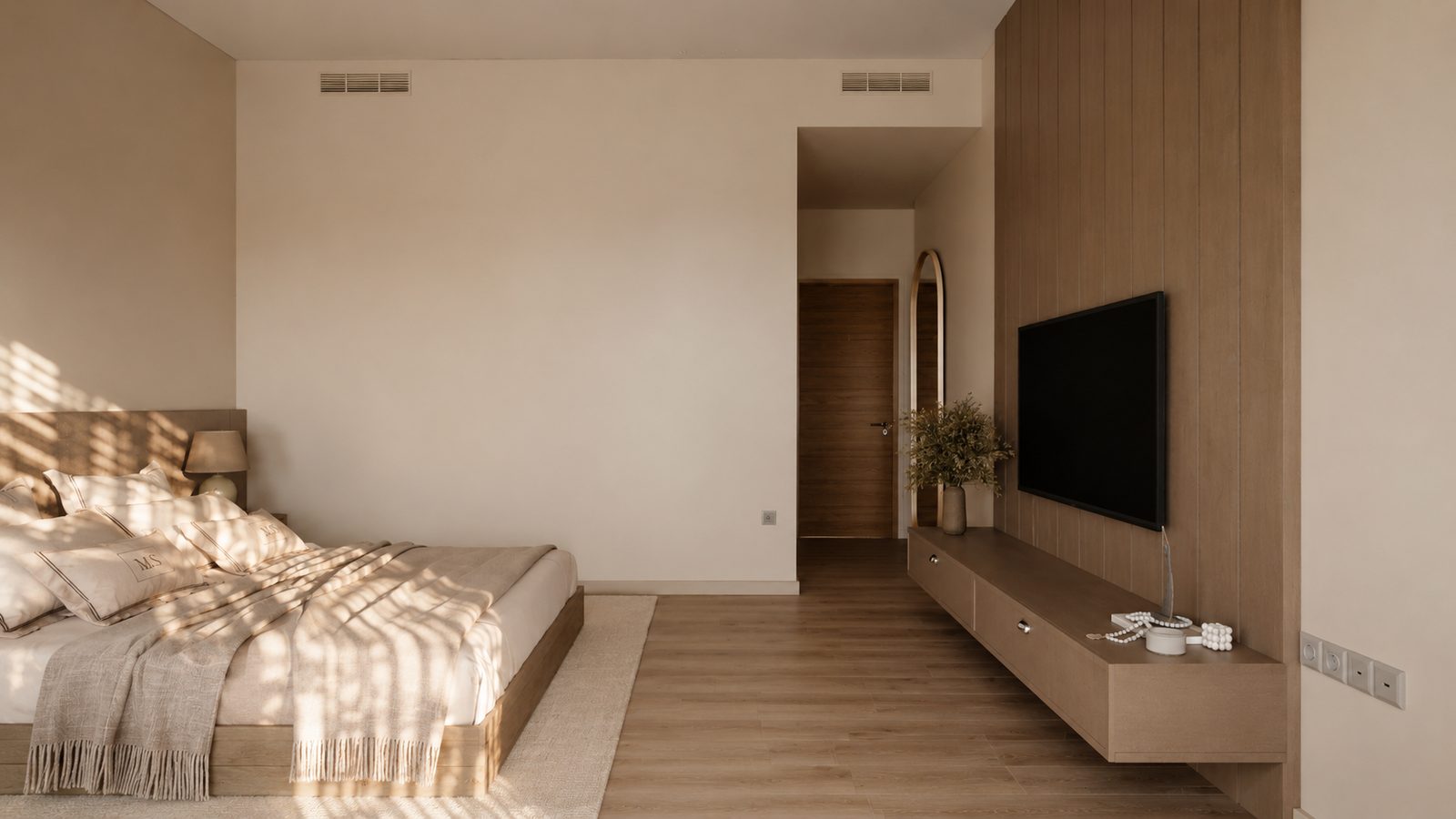
TL;DR: Lighting is decided three times in a Dubai renovation: at concept, at electrical first fix, and on the day the ceiling closes. After the gypsum board goes up, every change costs money and days. European fittings run 8 to 12 weeks, so the order sits near the start of the programme, not the end.
We wire apartments in JLT and Business Bay and villas out in Dubai Hills and The Meadows, then come back for snagging a year later. Almost every lighting problem we return to was created on paper, weeks before anyone touched a wall.
When lighting decisions actually happen in a renovation timeline
Owners treat lighting as shopping. It behaves as a series of locks, and each one shuts harder than the one before. On a 150 m² apartment running three to four months, the sequence looks like this.
- 1. Concept, weeks 1 to 3. Where light comes from in every room, what the ceiling will be, whether anything dims. Changes here cost nothing but drawing time.
- 2. Strip-out and survey, week 3 or 4. The existing wiring is exposed, the electrician reports what can be reused, and the slab tells you what is possible above your head.
- 3. First fix, weeks 4 to 7. Conduit, back boxes, cable cores, circuit split, distribution board ways. This is the last cheap moment.
- 4. Ceiling closure, weeks 7 to 9. Boarding, skim, paint. Once the plane is closed and painted, a new aperture means repainting the whole plane, because patched paint never matches under grazing light.
- 5. Second fix and commissioning, final two weeks. Fittings in, drivers paired to dimmers, scenes set at night with the furniture in place.
The lock people miss is the third one. A lighting plan approved at week five is a plan you live with, because the cores in the wall decide what the switch can do later. Owners who send us a Pinterest board in week eight have already paid for a decision they had not made yet.
What the electrical first fix locks in permanently
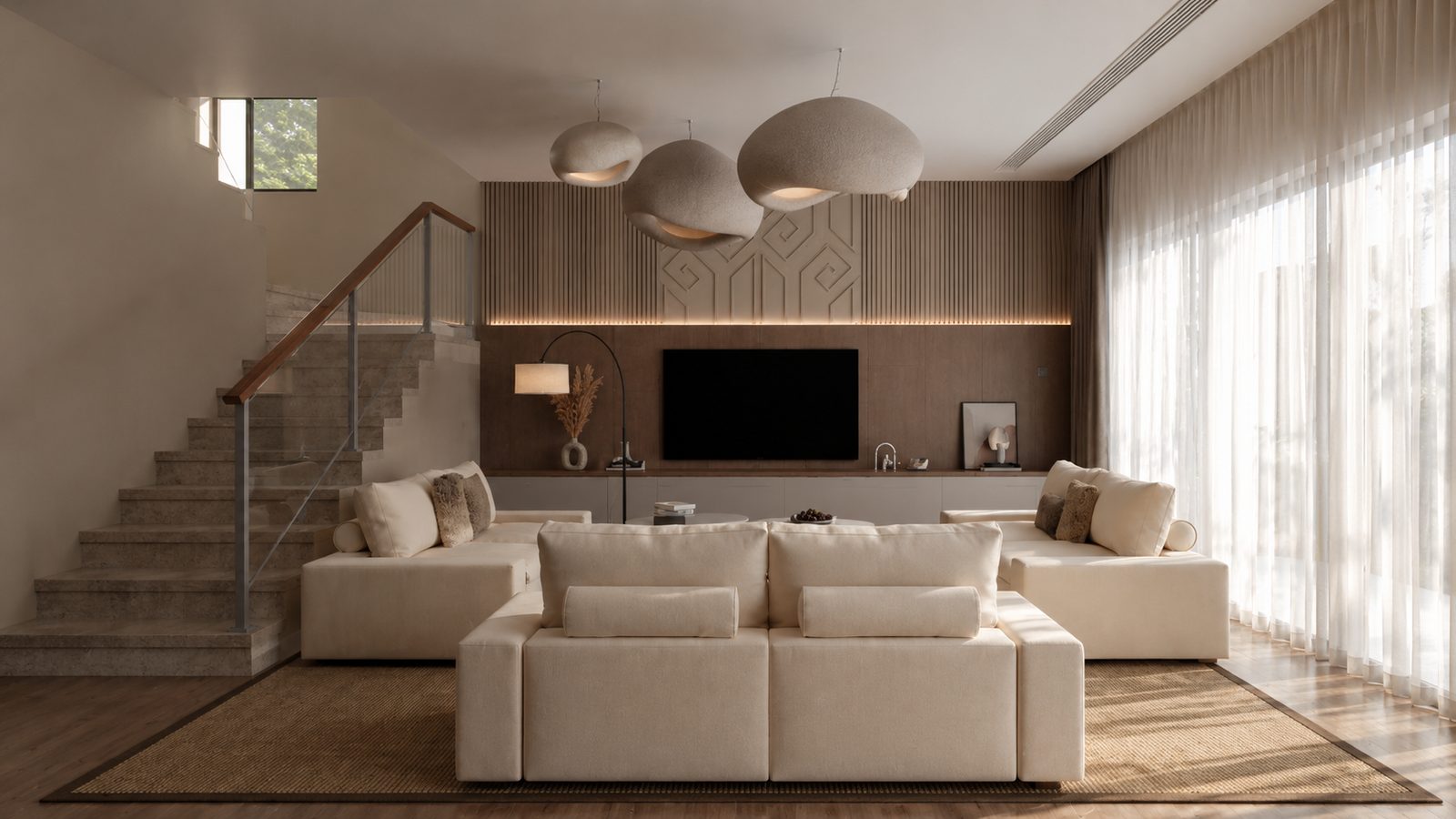
First fix buys you three things that are effectively permanent: the position of every point, the number of cores at every switch, and the space above the ceiling.
Ceiling space is the one that surprises apartment owners. Most Dubai towers sit on post-tensioned slabs, and you do not chase or core-drill a post-tensioned soffit without scanning and a structural engineer signing it off. Nobody sensible does it for a downlight. So every cable runs inside a dropped ceiling, and that drop starts around 100 to 150 mm, more wherever AC ducting or a fire sprinkler branch crosses. In a flat with 2.7 m slab-to-slab, that is real headroom gone, and the decision is made at first fix or not at all. Villas are easier: block walls chase happily, concrete columns and beams do not.
Cores at the switch decide the control you can have. Simple mains dimming needs two cores at the fitting and a dimmer that the driver actually likes. DALI and 0-10V need a separate control pair pulled to every driver. Deciding on DALI after the ceiling is skimmed means pulling new cable through a closed void, which usually means opening it.
Then there is driver access. Every LED driver eventually fails, and in Dubai it fails sooner than the datasheet promises, because the void above your ceiling in August is nowhere near the ambient temperature the driver was rated for. Ask for the Ta rating, keep drivers away from duct runs, and insist that each one is reachable through the fitting aperture or a hatch. We have opened a painted ceiling to replace a driver worth about AED 40.
One more thing your electrician will mention and the designer will not. LED drivers draw a short, sharp inrush current at switch-on. Twenty downlights on one 10 A circuit can trip the breaker every time you flick the switch, even though the steady-state load is trivial. Splitting the lighting across more ways at first fix costs almost nothing. Doing it afterwards means a new board layout.
DEWA, wiring and what really needs a signature
Two separate approvals get confused with each other constantly.
The first is your building. Owners associations and developer-appointed management in Dubai towers require a fit-out NOC before work starts, issued to a contractor they have registered, usually against a refundable deposit held for damage to common areas. They set working hours, they control service lift bookings, and they will stop a job that starts without paperwork. Expect several working days to a few weeks for that NOC depending on the building, and start it before demolition rather than after.
The second is DEWA, and this is where owners over-worry and under-prepare in the same conversation. Work on the fixed electrical installation has to be carried out by a contractor enrolled with DEWA, and where the distribution board changes, the connected load increases, or metering is affected, drawings go in as a formal application. Adding fittings to circuits that already exist generally stays inside the building's fit-out approval and the contractor's competence rather than triggering a DEWA submission. What triggers what depends on the property type, the developer and the scope, so the honest answer is that your contractor confirms it before pricing, not after. Palm Jumeirah and other master developments add their own authority on top, and a newly handed-over unit still inside its defects liability period brings a further question: cutting into ceilings and services can void cover you are still entitled to.
The wider sequence of NOCs, drawings and inspections is set out in our Dubai fit-out process guide, and lighting sits inside it rather than beside it. Supply here is 220 to 240 V at 50 Hz and the installation standards are inherited from British practice, so European fittings work without conversion. American fittings bought online do not, and we have unpacked plenty of them.
Layering light when the sun is this strong
Ambient, task and accent is the standard model. Dubai bends it, because daytime is not the problem you are solving.
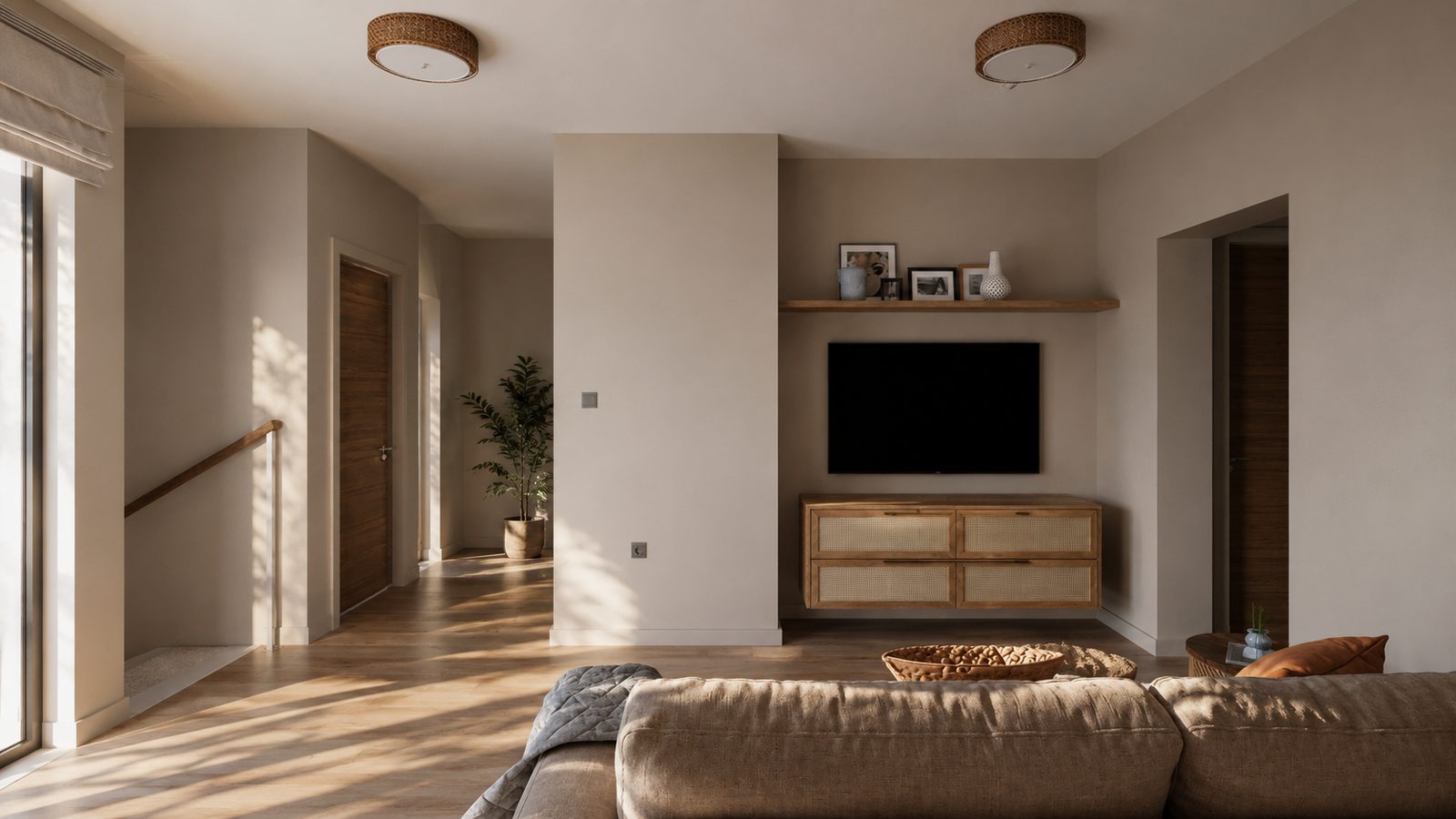
Stand in a Marina apartment at two in the afternoon. The metre nearest the glass is sitting at several thousand lux even behind film and sheers, while the back wall of the same room is in what reads as gloom. No ceiling downlight competes with that, and trying is a waste of a circuit. Design the electric light for the evening, and handle daytime with shading, sheer layers and surface reflectance instead. West-facing glazing in Marina, JBR and Bluewaters also carries a solar load your AC is already fighting, which is one more reason the answer is fabric rather than fittings.
For the evening, the mistake is quantity. A 20 m² bedroom does not need twelve downlights in a grid. Four correctly placed apertures, a pair of wall lights either side of the bed, and a cove or a lit headboard niche will give a better room and a lower load. Wall washing beats ceiling grids in almost every Dubai apartment, because the walls are usually the largest continuous surface and the ceilings are low.
Reflective finishes change the aiming. Polished porcelain and marble throw a downlight straight back at eye level, so beam angle and the setback from the wall matter more here than in a carpeted European flat. Villas with double-height entrances need the opposite thinking: a 6 m void needs a fitting with output and optics designed for the throw, not a bigger version of a bedroom downlight.
What lighting design costs inside a Dubai renovation
Our design fee starts at AED 10,000 and runs three to six weeks, and the lighting layout, the switching and dimming schedule and the fitting schedule are all part of that deliverable rather than an add-on. Dedicated lighting consultants who work only on light price separately, and published Dubai design fees for full interior design sit broadly between AED 200 and 1,000 per m² by finish tier, or a percentage of build cost. Treat that as market orientation, not our rate card.
The fittings themselves spread wider than any other line in a renovation. Locally stocked recessed downlights start in the low hundreds of dirhams; specification-grade architectural downlights with proper optics and CRI land several times higher; a single European designer pendant can exceed the cost of every downlight in the flat combined. That spread is why a lighting budget without a fitting schedule is a guess.
As a planning figure, we work on lighting taking roughly 5 to 10% of a residential renovation budget once you count fittings, wiring, control and commissioning. Against our own bands, cosmetic work from AED 1,500 per m² and full renovation from AED 3,000 per m², that is a line worth pricing properly rather than leaving to the end. Turnkey projects at AED 8,500 to 16,000 per m² already carry fittings and decor inside the figure. Where lighting budgets grow after signing is predictable: fitting count creep during ceiling coordination, trimless and plaster-in details that cost two to three times a surface trim and need the housing installed before boarding, and control systems added late. For how this line sits next to joinery, MEP and finishes across a whole property, our villa renovation cost breakdown puts the numbers side by side.
Lead times: the fittings decide your finishing date
European designer fittings typically quote 8 to 12 weeks from order, and bespoke or made-to-order pieces run longer. Add shipping and customs clearance on top of the factory quote. Locally stocked product from Dubai showrooms is usually 2 to 4 weeks, sometimes off the shelf.
Now put that against a three to four month programme. If the fitting schedule is signed at week two, everything arrives before you need it. If the owner is still choosing pendants at week ten, the job stops with the ceiling closed and the paint done, waiting on boxes. We have held a handover on one dining pendant while the rest of the apartment sat finished and empty.
Lead time also drives ceiling detail, which is why the schedule has to be frozen before first fix. Cut-out diameter, housing depth and trim type are properties of a specific product. Change the product after the ceiling is boarded and you are cutting new apertures. For anything with a long lead, approve an alternate at the same time: same aperture, same output range, similar beam, in stock locally. On roughly a third of our projects that alternate ends up saving the programme.
Moving a light point later: the real cost
The ladder is steep and it is worth seeing it as numbers.
- On drawings, before anything is built: free.
- After first fix, ceiling still open: roughly AED 150 to 400 per point in market terms, mostly labour and a bit of conduit.
- Ceiling boarded, skimmed and painted: roughly AED 400 to 900 per point, plus repainting the entire ceiling plane. That repaint is the number nobody quotes for, and it is often larger than the electrical work.
- After stone, wallpaper or fitted joinery is in: budget in thousands and in days, because access means dismantling finished work.
Those are market bands for orientation rather than a fixed price list, and the real figure depends on access, finish and how much has to come off to reach the void. The pattern holds regardless: twelve changed points on a 150 m² apartment after ceiling closure routinely turns into a five-figure line and a week added to the programme. Our smaller apartment jobs run two to six months precisely because sequencing like this is planned rather than improvised.
Colour temperature and CRI under Dubai daylight
Use 2700K in living rooms and bedrooms, 3000K as a general residential default, and 3500K to 4000K over kitchen worktops and utility areas. Bathrooms sit around 3000K to 3500K; go to 4000K at a vanity mirror and the room reads like a clinic, which is a complaint we get after handover rather than before.
Never mix temperatures on one visual plane. Two 3000K downlights next to one 4000K in the same ceiling looks like a fault, and to most guests it is a fault.
CRI matters more here than the marketing suggests. Specify 90 or above for anything lighting stone, timber, artwork, food or people, and check R9 specifically, because it governs reds and skin tone and is the value cheap fittings quietly fail. Marble under CRI 80 looks flat and grey, which is a painful outcome after paying for marble. Ask about binning too: fittings held within three MacAdam steps stay visually matched, while budget product drifts enough that adjacent apertures in one row read slightly different colours by the second year.
Heat degrades all of this. High ambient temperature in a Dubai ceiling void accelerates lumen depreciation and colour shift, so the cheap fitting is not cheap over five years. Outdoors, on terraces in Palm Jumeirah or Bluewaters, salt-laden humidity means IP65 as a floor and marine-grade housings where the fitting is exposed. Warm outdoor colour temperatures also attract noticeably fewer insects than cool ones, which matters on a terrace you actually use.
Smart lighting: when it earns the wiring
The honest split runs along the type of job. For a cosmetic refresh, wireless retrofit dimming and smart bulbs are fine, and you can undo them. For a full renovation, run a neutral conductor to every switch position whether or not you commit to a system, because that single decision at first fix keeps the door open at almost no cost.
A control bus such as DALI or KNX earns its money in a villa with sixty or more circuits, where it saves cable runs and reduces a wall of switch plates to something usable. In a two-bedroom apartment held as a rental, it rarely returns the outlay, and tenants tend to use one scene. If you are selling within three years, put the money into fittings, optics and CRI instead.
Whatever you choose, ask the supplier for a tested compatibility list between the dimmer and the specific driver. Flicker and buzz at low dim levels are almost always a mismatch rather than a defect, and the argument about whose fault it is happens after both are installed.
Mistakes we keep fixing on other people's projects
- The ceiling plan drawn before the furniture plan. Downlights end up over the middle of the bed, aimed at the pillow.
- Wardrobe and joinery lighting agreed after the joinery drawings are frozen. No cable arrives, no driver space exists, and the fix is a visible surface channel.
- Mirrors lit only from above, which drops shadow straight onto the face. Vertical light either side is the answer, and it has to be in the wall at first fix.
- Curtain pelmets left out of the ceiling coordination, so the track collides with the first row of downlights or the cove.
- Drivers buried above a closed ceiling with no hatch anywhere.
- Bathroom fittings chosen without checking the IP zone they sit in.
- One dimmer for the whole open-plan area, which means the kitchen worktop and the dining table are permanently on the same setting.
Every one of these is a drawing problem, and every one is cheap to prevent and expensive to repair. Our scope, price and programme are fixed in the contract before work starts, with a one-year warranty on workmanship and a daily penalty on us if we overrun. You can see how ceilings and lighting details land in finished work in our completed projects, and if you have a floor plan, send it through contacts and we will mark up the lighting sequence against your programme before anyone quotes.
FAQ
How much does lighting design cost in Dubai?
Inside our full design service the lighting layout, switching schedule and fitting schedule are part of a design project that starts at AED 10,000 and takes three to six weeks. Standalone lighting consultants price separately, and published Dubai design fees run broadly AED 200 to 1,000 per m² for full interior design by finish tier. As a budget planning figure, lighting including fittings, wiring and control commonly absorbs 5 to 10% of a residential renovation.
Do I need DEWA approval to move light points?
It depends on scope. Work on the fixed installation must be done by a contractor enrolled with DEWA, and changes to the distribution board, connected load or metering go in as a formal application with drawings. Adding fittings to existing circuits usually stays within the building's fit-out NOC. Your contractor confirms which route applies before pricing, because the answer differs between an apartment in a managed tower and a villa in a master development.
How long do designer light fittings take to arrive in Dubai?
European designer product typically quotes 8 to 12 weeks from order, plus shipping and clearance, and bespoke pieces run longer. Locally stocked fittings arrive in 2 to 4 weeks. Freeze the fitting schedule before electrical first fix, because cut-out size and housing depth decide the ceiling detail.
What colour temperature works best in a Dubai home?
Use 2700K to 3000K in living rooms and bedrooms, and 3500K to 4000K over kitchen worktops and in utility areas. Bathrooms work at 3000K to 3500K. Keep one temperature per visual plane, and specify CRI 90 or above wherever light falls on stone, timber, food or people.
Can I keep my existing fittings during a renovation?
Sometimes, and it is worth asking. If the fittings are recent, dimmable and the apertures suit the new ceiling, reusing them saves both money and lead time. Older halogen or early LED units are usually not worth relocating: the drivers are near the end of their life, the colour will not match new product, and the labour to refit them is the same as fitting new ones.
When is it too late to change the lighting plan?
Practically, at ceiling closure. Before boarding, a moved point is labour and conduit. After boarding, skim and paint, it is the point plus repainting the whole ceiling plane. After stone, wallpaper or joinery, you are dismantling finished work, and the cost stops being about lighting altogether.