
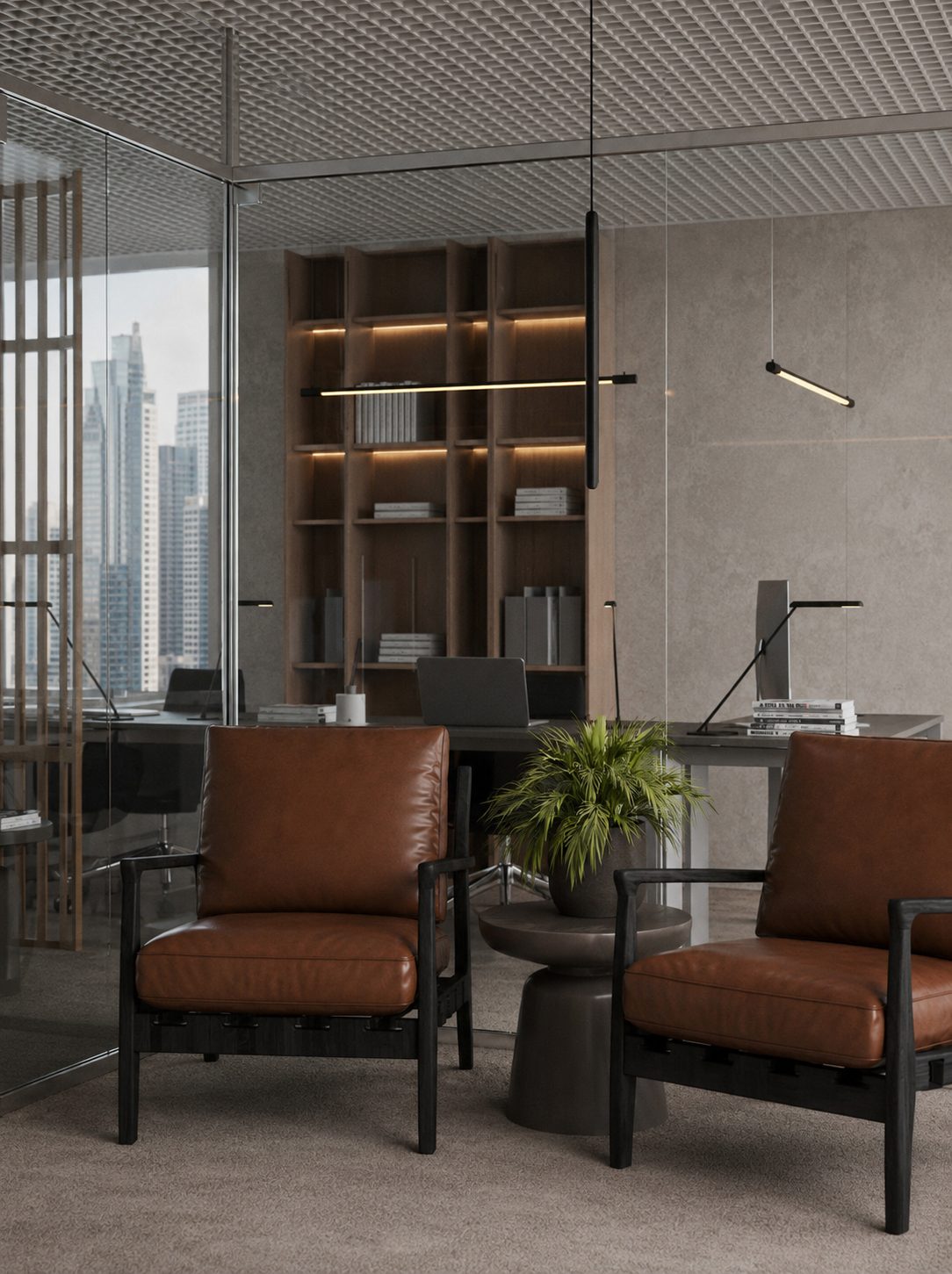
A luxury office fit-out in Dubai — whether you call it interior design or fit-out, the market treats the terms as one — commonly runs from AED 500 to over 1,000 per square foot for a full premium build, and a 2,000–5,000 sqft space takes roughly three to four months from signed design to handover. The number and the timeline both move with your district, your lease category, and how early you file for approvals.
Most agency pages on this search sell you a look. Fewer explain the mechanics: why a DIFC office and a Business Bay office go through completely different approval bodies, why a Cat A shell costs a third of a finished floor, and where the hidden money sits. I have run enough of these to tell you the honest version.
What "luxury" actually buys inside an office
Luxury in a premium office fit-out comes down to the materials you touch, the way the floor is zoned, and the technology buried behind the walls and above the ceiling. These three layers interact, and cutting any one of them turns a premium project into an expensive-looking one.
On materials, the premium tier means engineered stone or natural stone reception desks, veneer or acoustic timber wall panels, full-height glazed partitions with switchable or fritted glass, and flooring that mixes large-format porcelain, engineered timber and high-grade carpet tile by zone. The jump in cost from a mid-range Cat B to a premium build is rarely the labour. It is the specification: an AED 90/sqft carpet tile versus an AED 400/sqft stone floor, an off-the-shelf partition versus a bespoke acoustic system rated to block a director's call.
Zoning is where a good designer earns the fee. A premium office plans for how people actually move: a client-facing reception and boardroom that feel calm, a working floor with the right desk density, quiet rooms and phone booths for hybrid calls, a pantry that doubles as informal meeting space. Get the ratios wrong and you either pay for square footage nobody uses or cram people into a space that photographs well and works badly.
Then there is the layer nobody sees. MEP, the mechanical, electrical and plumbing works, carries a large slice of any premium budget. Reconfigured VRF air conditioning, a lighting system with proper scene control, structured cabling, access control, meeting-room AV, sensors and a network that will not choke a video call. On a luxury floor this often includes raised flooring to route power and data cleanly, and suspended ceilings that hide services while carrying acoustic treatment and integrated lighting. When a budget blows up, MEP and its coordination are usually where it started.
Cat A, Cat B and shell & core: what you are actually leasing
Before you cost anything, you need to know which condition your space comes in, because it decides how much of the build is already done.
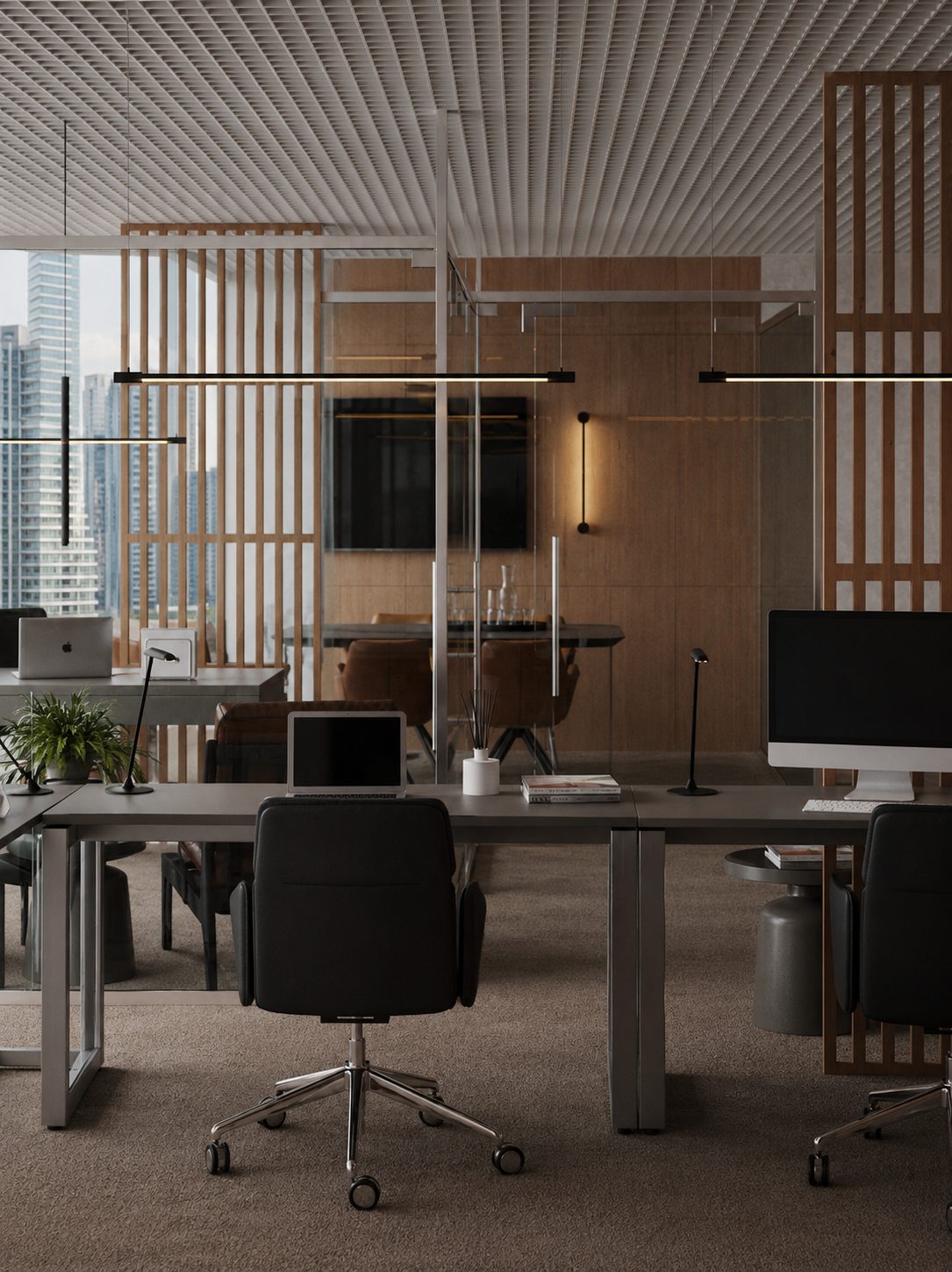
Shell & core is a bare structure. Concrete floor, external envelope, core services brought to the floor but not distributed. You are building almost everything. Cat A is a landlord-finished baseline: raised floors, suspended ceilings, basic MEP distribution, fire detection and often a finished common area, delivered as a blank but functional space. Cat B, sometimes written Cat C when it includes furniture, is the fit-out that makes the space yours: partitions, joinery, finishes, branding, meeting rooms, the works. Category A gets a building leasable. Category B gets a company working.
This matters for your budget in a direct way. If your landlord hands you a Cat A floor, you are paying only for the Cat B layer on top. If you take a shell, you carry the Cat A works too, and that shifts the whole cost base up. It also shifts responsibility: some landlords deliver Cat A and reclaim the cost through rent, others expect you to build it and reinstate at lease end. Read the fit-out clause and the reinstatement clause before you sign anything, because "shell & core at this rent" and "Cat A included" are two very different deals.
Budget per square foot, hedged honestly
Rates in Dubai are quoted per square foot, and the spread is wide because "office fit-out" covers everything from a partition refresh to a bespoke headquarters. Treat these as market bands, not a fixed price list.
- Cat A works typically land around AED 150–250 per sqft, depending on floor height, MEP density and the standard of the base build.
- Cat B fit-out commonly ranges from AED 250 to 500 per sqft for a good-quality corporate finish.
- A genuine premium build, with stone, bespoke joinery, high-end AV and switchable glass, runs from AED 500 to over 1,000 per sqft, and the ceiling is set by how far the specification goes.
Where you land inside those bands depends on four factors: the finishes schedule, the MEP scope, how much bespoke joinery the design carries, and the district premium — DIFC and Downtown typically run 20–25% above JLT or Dubai Internet City at the same spec level. A 3,000 sqft office at AED 600/sqft is roughly AED 1.8 million all-in for the fit-out, before your own furniture and IT hardware if those sit outside the contract. We fix that figure in the contract before work starts, so the number you sign is the number you pay. How we structure a fixed fit-out quote is set out in our design and fit-out services.
Two costs sit outside most headline rates and catch people out. Loose furniture and workstations are often a separate line, and a premium chair-and-desk package alone can add a meaningful amount per head. IT active equipment, servers, switches, screens, is usually the tenant's own procurement. Ask what is in the per-sqft number and what is not before you compare two quotes, because one contractor's "AED 450/sqft" may quietly exclude what another's "AED 550" includes.
Districts and the bodies that approve them
This is the part most guides skip, and it is the part that decides your timeline. In Dubai, the authority that signs off your fit-out depends on which free zone or authority governs your building, not on a single city-wide process.
If your office sits in Business Bay, on Sheikh Zayed Road, or in JLT, you are generally under Dubai Municipality, with DEWA for power and Dubai Civil Defence for fire and life safety. A DIFC address is different: DIFC has its own building control through DIFC Engineering, its own fit-out guidelines, and its own permit route that does not touch DM. Media, internet and production zones fall under the Dubai Development Authority, so an office in Dubai Media City or a similar TECOM community goes through DDA rather than the Municipality. Master-developer communities like some waterfront and Palm addresses can route building control through Trakhees, the regulatory arm of Ports, Customs and Free Zone Corporation. One Central and similar DWTC-linked developments carry their own building management and NOC process on top.
The practical point: your building's location tells you which rulebook applies, and each rulebook has its own drawings standard, its own approved-contractor list, and its own inspection regime. A contractor who has closed permits in DIFC is not automatically fluent in DDA. Ask specifically about experience in your district before you appoint anyone.
Approvals and the real timeline
The single most useful thing I can tell you about approvals is that they run in parallel, not one after another. Teams that treat them as a straight line lose weeks they never get back.
The typical clock looks like this. Design and technical drawings take two to four weeks depending on the size and complexity of the space. Permits and NOCs take roughly one to three weeks, and this is where parallel filing pays off: the landlord's fit-out approval and NOC, the authority's building permit, the Civil Defence fire and life-safety review, and any specialist MEP or DEWA approvals should be moving at the same time, not queued. Construction on a premium 2,000–5,000 sqft office then runs commonly four to twelve weeks, with the finishes and MEP commissioning at the tail.
Add it up and a full premium project of that size lands around three to four months from a signed design to a clean handover. That assumes drawings go in complete and the landlord's fit-out guide is followed to the letter. The two things that reliably blow the schedule are a landlord NOC that stalls because the submission was incomplete, and a Civil Defence rejection that forces a redesign of sprinkler or exit routing. Both are avoidable with a contractor who reads the building's fit-out guide before drawing a line.
Choosing a contractor for a premium office
The stakes on a luxury fit-out are high enough that the appointment decision matters more than the price. A cheap quote that misses a Civil Defence requirement is not cheap.
Start with the licence. The company should hold a valid Dubai trade licence for fit-out or interior contracting, and, where the district requires it, sit on the relevant approved-contractor list, DIFC, DDA or Trakhees. Then check district experience directly: a firm that has delivered offices in your specific authority zone knows the drawings standard and the inspectors, which shaves real time off approvals. Ask what warranty they stand behind after handover; a serious contractor covers the works for a defined period rather than walking away at final payment.
Do not appoint on a portfolio PDF alone. Visit three to five completed projects if you can, ideally ones a year or two old so you see how the joinery, the glazing and the flooring have aged. Talk to those clients about whether the quote held, whether the programme held, and how change orders were handled. Our own delivered work includes commercial spaces such as an office in Platinum Tower JLT and a spa in Dubai Media City, and you can walk through the full project list before you brief anyone.
Keeping the budget from drifting
Most office fit-outs that overrun do not overrun because of one big shock. They drift, a change order here, a spec upgrade there, until the total is fifteen or twenty percent over the day-one figure.
Three disciplines keep it honest. First, lock the design and the finishes schedule before construction starts, and price against a complete drawing set, not an outline; a quote against half-finished drawings is a quote that will grow. Second, agree how change orders are handled in writing, so any variation comes with a priced instruction you approve before the work happens, not a surprise on the final invoice. Third, ask the contractor to name the usual hidden costs upfront: DEWA connection and load charges, Civil Defence NOC and inspection fees, landlord reinstatement obligations at lease end, loose furniture, IT active equipment, and any authority-specific submission fees. Every one of those is knowable at quote stage. A contractor who fixes the total by contract and carries a day-rate penalty for overrunning has every reason to keep the programme tight. If a quote leaves those lines vague, treat the low number with suspicion. The gap usually reappears later as a variation.
FAQ
How much does a luxury office fit-out cost in Dubai?
For a genuine premium build with stone, bespoke joinery and high-end AV, expect commonly AED 500 to over 1,000 per square foot. A good corporate Cat B finish sits lower, around AED 250–500 per sqft. The final figure depends mostly on your finishes schedule and MEP scope, so compare quotes on what they include, not just the headline rate.
How long does an office fit-out take?
A premium 2,000–5,000 sqft office typically runs three to four months from a signed design to handover. That breaks down into roughly two to four weeks of design, one to three weeks of permits and NOCs filed in parallel, and four to twelve weeks of construction. Incomplete drawings or a stalled landlord NOC are the usual reasons a project slips.
Is my office under DDA, DIFC or Dubai Municipality?
It depends on your building. Business Bay, Sheikh Zayed Road and JLT generally fall under Dubai Municipality. DIFC has its own building control through DIFC Engineering. Media and internet zones like Dubai Media City sit under the Dubai Development Authority, and some master-developer communities route through Trakhees. Your building management can confirm which authority governs your fit-out.
What is a landlord fit-out guide and NOC?
The fit-out guide is the building owner's rulebook for any tenant works: permitted hours, protection requirements, MEP tie-in points, and what you may and may not touch. The NOC, a no-objection certificate, is the landlord's written consent to start work, and most authorities will not issue a building permit without it. Getting the NOC quickly comes down to a complete, guide-compliant submission.
What approvals do I need before starting work?
On a typical fit-out you will need the landlord NOC, a building permit from your governing authority (DM, DIFC, DDA or Trakhees), a Civil Defence fire and life-safety approval, and often DEWA sign-off for power. These should be filed in parallel. Skipping or delaying any one of them can halt the site, so they belong at the front of the programme, not the middle.
What is the difference between Cat A and Cat B?
Cat A is the landlord's finished baseline: raised floors, suspended ceilings, basic MEP distribution and fire detection, delivered as a blank but functional space. Cat B is the tenant's fit-out on top: partitions, joinery, finishes, branding and meeting rooms. Cat A makes a floor leasable; Cat B makes it yours. If your lease includes Cat A, you only pay for the Cat B layer.
How do I avoid a budget overrun?
Lock the design and finishes before construction starts, and price against complete drawings rather than an outline. Agree in writing how change orders are handled, so every variation is priced and approved before it happens. Ask the contractor to list the hidden costs, DEWA charges, Civil Defence fees, reinstatement, furniture and IT, at quote stage, and prefer a contract that fixes the total with a penalty for overrunning.
Should I hire a consultant or go straight to a contractor?
For a straightforward fit-out where design and build sit under one roof, a single design-and-build contractor is usually faster and cleaner, because one team owns both the drawings and the delivery. A separate consultant makes sense on large or complex headquarters where you want independent oversight of the build. For most premium offices under 5,000 sqft, a capable design-and-build firm handles concept, approvals and construction in one contract. You can talk through which route fits your space on our contact page.