

# Marble vs porcelain flooring for a Dubai home
TL;DR: In the marble vs porcelain flooring decision, porcelain wins for most Dubai homes. It absorbs under 0.5% water, shrugs off acid and sand, and lands at roughly AED 165–270 per m² installed against AED 420–600 for marble. Marble earns its place in a low-traffic living room or entrance you own and maintain yourself. Keep it out of kitchens, family bathrooms and terraces.
We lay both materials, and we come back to the same floors for snagging visits two and three years later. That second visit shapes the advice below far more than any supplier datasheet does.
Marble vs porcelain flooring: what actually differs
| Property | Natural marble | Porcelain (group BIa) |
|---|---|---|
| Water absorption | roughly 0.2–0.6% | under 0.5%, fully vitrified near 0.05% |
| Surface hardness | calcite, around 3 on the Mohs scale | glazed or full-body surface around 6–7 |
| Acid resistance | etches on contact with lemon, vinegar, descaler | unaffected by household acids |
| Consistency | veining unique per slab, colour drifts between crates | repeatable within a batch |
| Typical thickness | 18–20 mm slab | 9–12 mm indoor, 20 mm outdoor paver |
| Damage repair | grindable and re-polishable | chip is permanent, the tile gets replaced |
Water absorption decides staining behaviour. A fully vitrified porcelain body sits near 0.05%, so spilled wine or olive oil stays on the surface until somebody wipes it. Marble at 0.2 to 0.6% draws liquid into the stone. Oil is the worst of them, because it migrates sideways under the polished surface and darkens the slab from within, where no cleaner reaches.
Hardness decides what the floor looks like after two years of traffic. Airborne dust in the UAE is largely quartz, around 7 on the Mohs scale. Marble is calcite at roughly 3. Every guest who walks in off a Marina walkway is carrying an abrasive harder than your floor. A porcelain surface at 6 to 7 is roughly a match for that dust, which is why porcelain in a hallway still reads flat and even at year three while marble in the same hallway has a visibly duller traffic lane down the middle.
Acid is the third axis and the one people underestimate. Lemon, vinegar, tomato, wine and every limescale remover on a Dubai supermarket shelf will etch marble. Etching is not a stain that sits on top. The acid dissolves calcite and leaves a matt patch with a slightly rough feel, and it comes back only with mechanical re-polishing.
One clear point goes to marble. Stone is restorable. A marble floor with three years of scratches and traffic wear can be ground, honed and re-polished back to a uniform surface. A chipped porcelain tile is a replacement job, and if the batch is three years old, the replacement will not match, because production runs shift shade.
Before comparing prices, ask the showroom for the water absorption group under ISO 13006. A fair amount of what is sold as porcelain in Dubai is ceramic at 3 to 6% absorption carrying a porcelain price. Group BIa is the one you want on a floor.
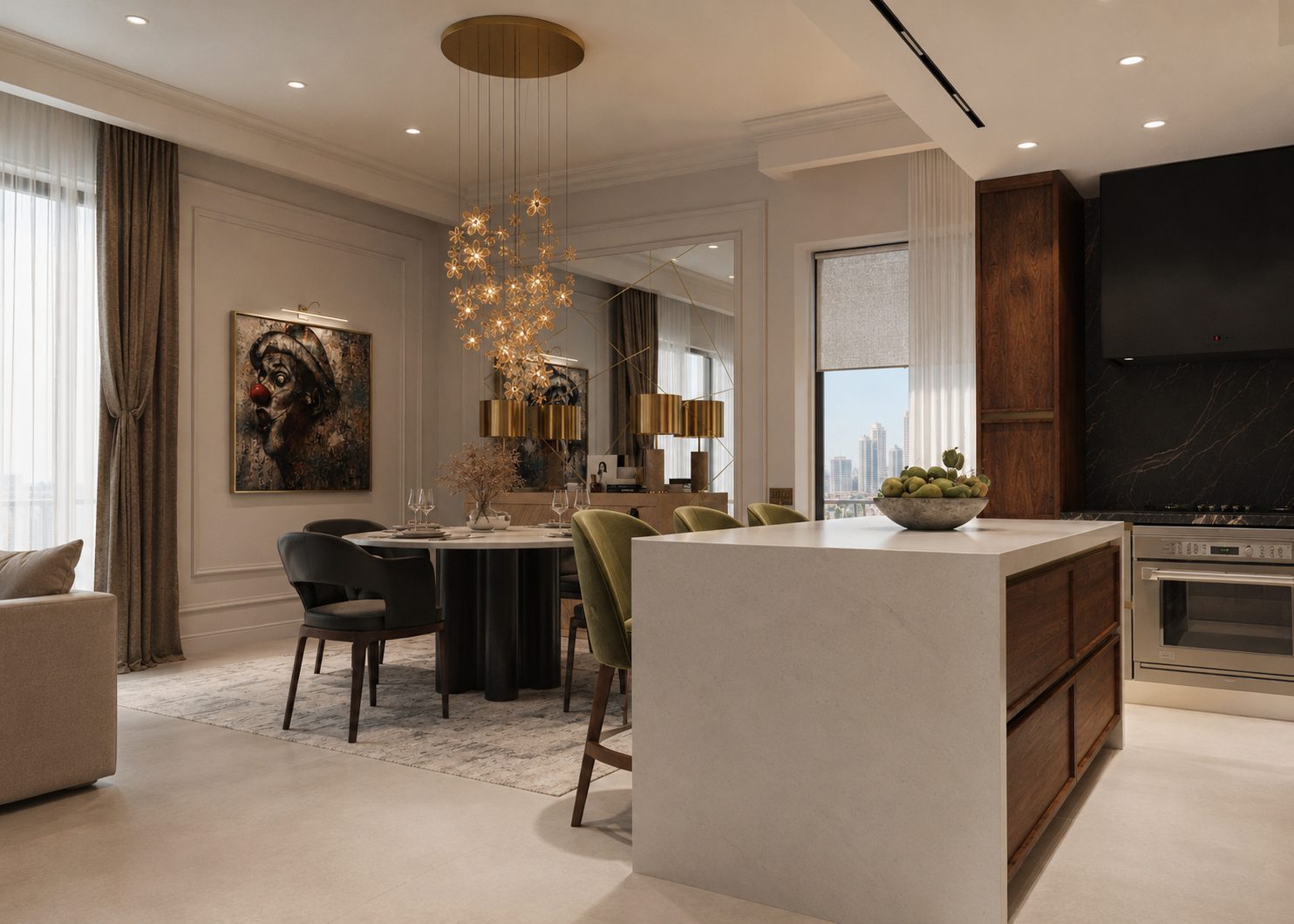
Flooring cost in Dubai: material, labour and the lines people forget
| Line item, per m² | Natural marble | Large-format porcelain |
|---|---|---|
| Material | AED 300–400 | AED 100–180 |
| Installation | AED 120–200 | AED 65–90 |
| Installed | AED 420–600 | AED 165–270 |
Standard 60x60 porcelain drops installation to roughly AED 45–65 per m², because one installer can handle each piece and the cuts are simple. Large format costs more to lay for the opposite reason: a 120 by 120 sheet needs two or three men, a suction frame, a levelling clip system and a full adhesive bed rather than blobs.
The lines that rarely appear on a first quote are the ones that move the total:
- Substrate preparation. Screed correction or a self-levelling layer typically adds AED 30–70 per m², more if the existing slab is out by more than a few millimetres over a two-metre straightedge.
- Wastage. Budget around 10% on porcelain and 15 to 20% on marble, because vein matching means rejecting slabs that arrived paid for.
- Skirting, thresholds, stair nosings and step treads, priced per linear metre and easy to forget entirely.
- Removal and disposal of the existing floor, plus skip runs.
- Tower logistics. A 100 m² marble floor at 20 mm is roughly five tonnes of stone on pallets. No building in JLT or Business Bay is letting that go up the passenger lift, so you book the service lift in the slots the management company allows, frequently outside working hours, and that adds crew days rather than material cost.
Most buildings also want a fit-out NOC and an approved contractor before flooring work starts, and the approval usually takes several working days with a refundable deposit held against damage to common areas. On a recently handed-over villa, check the developer's defect liability period first. Cutting into a slab or disturbing wet-area waterproofing can void cover you are still entitled to.
These are 2026 Dubai market bands rather than our rate card. We price after a survey, because substrate condition moves the figure more than tile choice does. To see where flooring sits against joinery, MEP and finishes in a full budget, our villa renovation cost breakdown sets the same numbers side by side.
Why Dubai ages a floor differently from Europe
Start with heat. In July a dark terrace surface in direct sun runs well above 60°C, while the living room slab on the other side of the sliding door is held at 20 to 22°C by the AC. That gradient exists across roughly one metre of construction, every afternoon, for five months a year. Tile, adhesive and screed each expand at their own rate, so the assembly is under a daily push-and-pull that European floors never experience. Every failure we open at a threshold traces back to that.
Water chemistry is the second force. UAE supply is desalinated and often stored in building tanks, and it leaves a mineral deposit on anything it dries on. On porcelain that deposit wipes off. On marble, residents reach for a limescale remover, which is acidic, and the descaler removes the scale along with the polish underneath. That is the trap: the routine Dubai cleaning habit is the exact thing marble cannot survive.
The white haze around a marble shower tray is frequently two problems stacked. Scale sits on the surface, and efflorescence pushes up from underneath, because salts dissolved in the screed travel with moisture through the pores of the stone and crystallise when they reach air. Wiping treats half of it. The other half returns until the substrate stops feeding it.
Sand is the third. Fine quartz dust gets tracked in daily and works as grinding paste under shoe soles. A doormat at every external door and a shoes-off habit do more for a marble floor than any sealer sold in Dubai. Coastal addresses such as Palm Jumeirah, Bluewaters and JBR add salt-laden humid air, which matters mostly for sealer choice and for anything metallic in the threshold detail.

Best flooring for a Dubai villa or apartment, room by room
| Area | Our call |
|---|---|
| Living room, bedrooms | Either. Marble is defensible here |
| Entrance, formal lobby | Marble if you want it, with mats at the door |
| Kitchen | Porcelain. Marble is the wrong material |
| Family bathroom | Porcelain. Marble only with a changed cleaning routine |
| Guest WC | Marble is fine, traffic and chemicals are minimal |
| Terrace, balcony | 20 mm through-body porcelain paver, R11 finish |
| Pool surround | Porcelain or a honed non-calcareous stone |
| Stairs | Either, with the nosing detail resolved in drawings |
| Underfloor heating | Both work, marble needs a slower design |
The kitchen is where we argue with clients most. A half lemon left on a marble worktop overnight leaves a permanent dull ghost by morning, and the floor in front of the sink takes the same abuse in smaller doses every day. Olive oil that drips behind the hob and is not caught within the hour will still be visible next year. If you want the marble look in a working kitchen, use a porcelain slab that reproduces it, and put the real stone somewhere it can age gracefully.
Bathrooms need a different conversation about waterproofing, not just about tile. Marble is vapour-open, so any residual moisture in the screed and any water that gets past the grout travels up through the stone and shows as dark, slow-drying patches around the shower. That means the screed must be genuinely dry before laying, the falls must actually drain, and the membrane detail has to be right, because with stone above it you will see the failure as blotches on the floor long before a neighbour sees a stain on their ceiling. Grey cement adhesive is a second trap: under pale marble it bleeds through and leaves a shadow map of the trowel. Use a white rapid-set adhesive and let the substrate dry. Wet-area membranes fail here for specific and repeatable reasons, which we set out in why bathroom waterproofing fails in Dubai.
Terraces are the clearest no. Polished marble in direct Dubai sun loses its polish to UV and abrasion within a couple of seasons, becomes dangerously slick when a pool splash lands on it, and takes the full thermal cycle described above. There is one more effect people never predict: white and pale marbles are slightly translucent, so an uneven adhesive bed shows through the slab as blotching once the surface heats and dries unevenly. You end up looking at a map of your installer's trowel work. Twenty-millimetre through-body porcelain in an R11 textured finish handles all of it, and if a paver cracks in year four you lift and replace one piece.
Underfloor heating is a small market here, usually a warm bathroom floor rather than whole-house. Both materials conduct well enough. Marble needs the slower approach: a system designed for stone thickness, a controlled commissioning ramp rather than switching straight to maximum, and movement joints that were planned before anything was laid.
Five-year cost of ownership, including marble polishing
Take a 100 m² floor and run it forward five years using the same market bands.
| Cost over five years, 100 m² | Marble | Porcelain |
|---|---|---|
| Installation | AED 42,000–60,000 | AED 16,500–27,000 |
| Sealing, roughly every 12–24 months | AED 2,500–4,500 total | not required on the tile |
| Light polish, twice in five years | AED 1,000–2,000 total | none |
| Grout maintenance and spot repair | included above | AED 1,000–3,000 |
| Five-year total | AED 45,500–66,500 | AED 17,500–30,000 |
Light marble polishing runs around AED 5–10 per m² and restores gloss on a floor that is only dulled. Full restoration, meaning diamond grinding of etch marks and scratches, runs closer to AED 30–60 per m² and turns into a project: furniture out, dust containment, the room unusable for two or three days. On a 100 m² floor that single service is AED 3,000–6,000, which is most of the way to a new porcelain floor.
Here is the part that does not help us sell the more expensive job. If the property is a rental or you plan to exit within three years, porcelain is the correct answer with almost no argument. Tenants do not treat marble the way owners do, a full restoration between tenancies wipes out any rent premium the stone earned, and Dubai buyers rarely pay a marble premium on a two-bedroom apartment. Marble makes financial sense when you live in the property, keep it, and genuinely like it. That is a valid reason to buy it, and it is the honest one.
Installation: the details that decide year three
Most floors we are called back to did not fail because of the material. They failed at one of these points.
- 1. Adhesive bed. Large-format tile and marble need full coverage with back-buttering, not five blobs. A void under a slab is silent for months, then a chair leg or a dropped pan finds it and the corner chips. On marble a void gives you a crack running clean across the slab.
- 2. Movement joints. A perimeter joint at every wall and column, and intermediate joints in the field. Common practice is a joint roughly every 6 to 8 metres indoors, tightening to around 3 to 4 metres on anything in direct sun. Skipping them is invisible on handover day.
- 3. The threshold. This is the specific mistake we open up most often. A crew runs the same tile straight through the sliding door onto the balcony with no separating joint, because the unbroken line looks better in photos. The terrace field expands all summer, the interior field does not, and the pressure has nowhere to go. Nine to fifteen months later the row at the door lifts, tents or cracks, and the repair means lifting both sides of the threshold rather than replacing one tile.
- 4. Screed moisture. Marble laid on a screed that is not dry goes blotchy and throws efflorescence months afterwards. The trade rule of thumb, roughly a millimetre a day for the first 40 mm and slower after that, gets ignored whenever a programme slips. Ask for a moisture reading, not an opinion.
- 5. Sealer type. Use a penetrating impregnator, not a topical acrylic gloss coat. In coastal humidity a topical film clouds and peels, and it traps moisture inside stone that needs to breathe. Re-test with a water drop every year: if it darkens the stone within a minute, reseal.
- 6. Protection and sequencing. Lay the floor as late in the programme as the sequence allows, and board it out afterwards. We have seen a finished marble entrance ruined in one afternoon by a wheelbarrow and a painter's spirit.
As a working benchmark, 100 m² of porcelain takes a competent crew around five to eight working days plus curing before loading, and marble adds two to three days on top for on-site polishing and dust containment. Both need a genuinely level substrate first, which is where the honest days go.
Finished floors say more than specifications do, so if you want to see how these details land in practice, the work is in our completed projects. For a fixed scope, a fixed price and a one-year workmanship warranty, send the layout and the room list through contacts and we will survey the substrate before quoting.
FAQ
Is marble suitable for a Dubai kitchen?
No, and we say that to clients who have already bought the slabs. Lemon, vinegar, wine and tomato etch calcite on contact, and a kitchen floor and worktop meet all four weekly. If you want the look, use a porcelain slab with marble veining and keep the real stone in the living areas.
How often does marble need polishing in Dubai?
A well-maintained residential floor usually needs a light polish every two to three years, at roughly AED 5–10 per m². Full restoration by diamond grinding, at around AED 30–60 per m², becomes necessary when etch marks and scratches have gone deep, which in a busy household with hard water and tracked-in sand can be as soon as year four. Doormats and a shoes-off rule genuinely push both intervals out.
What is the real installed cost difference?
At 2026 Dubai market rates, marble lands around AED 420–600 per m² installed and large-format porcelain around AED 165–270, so marble runs roughly two to three times the cost before maintenance. Over five years on a 100 m² floor the gap widens to about AED 45,500–66,500 against AED 17,500–30,000. These are market bands, and your exact figure depends on substrate condition, which we check on site.
Can marble go over underfloor heating?
Yes, with a system designed for stone. Marble conducts heat well, so it performs fine once warm, but the mass means slower response and it is less forgiving of rapid temperature swings. The system needs a controlled commissioning ramp rather than being switched to full output, and the movement joints have to be planned before the first slab is laid.
Which needs less maintenance with hard water?
Porcelain, by a wide margin. Mineral deposits wipe off a vitrified surface with ordinary cleaner, whereas on marble the scale invites an acidic descaler that removes the polish along with the deposit. If nobody in the household will remember to use a pH-neutral stone cleaner, that decision has already been made for you.
Why does marble get white stains in summer?
Usually two causes at once. Hard-water scale dries on the surface, and efflorescence rises from below when salts dissolved in the screed travel with moisture through the pores of the stone and crystallise at the surface. Summer makes the second one worse because evaporation rates climb. Surface scale wipes off, but efflorescence keeps returning until the moisture source in the substrate is dealt with.
How long does each last?
Properly laid porcelain on a sound substrate lasts decades and generally outlives the interior design around it. Marble also lasts decades as a material, but its appearance needs periodic restoration, so the practical question is how often you are willing to refinish. Both fail early for the same reason: a bad substrate, missing movement joints or a rushed adhesive bed.
What sealer works in Dubai humidity?
A penetrating impregnating sealer, solvent or water-based, that soaks into the stone and leaves no film. Avoid topical acrylic gloss coatings, which cloud, peel and trap moisture in coastal humidity such as Palm Jumeirah or JBR. Retest annually with a drop of water: if the stone darkens within a minute, it is time to reseal.