
TL;DR: A private pool in Dubai typically costs AED 25,000–45,000 for a plunge pool, AED 45,000–80,000 for fibreglass, AED 80,000–150,000 for a concrete family pool, and AED 120,000–250,000 for infinity or overflow designs. Renovation ranges from AED 40,000 to well past AED 300,000. Construction takes 6–16 weeks once approvals are granted, and the approvals themselves usually take four to eight weeks before anyone breaks ground.
Most owners plan the pool and forget the paperwork. Then the excavator sits idle for a month while a developer NOC works its way through a community office. Below is the sequence we follow on villa projects, plus the failures that keep Dubai pool contractors busy repairing each other's work.

What a pool costs in Dubai, by type
These are working bands from projects we have priced and built, not a fixed rate card. Ground conditions, access, and finish level move them more than anything else.
- Plunge pool, 8–12 m³: AED 25,000–45,000. Concrete shell, single pump, cartridge filter, basic tiling. Common in Jumeirah townhouse gardens and Meadows plots with 20 m² of usable outdoor space and no more.
- Fibreglass shell pool: AED 45,000–80,000. Faster and cleaner to install. You are buying a shell someone else moulded, so you lose design freedom and you need crane access.
- Concrete (gunite or shotcrete) family pool, 25–40 m³: AED 80,000–150,000. The standard villa pool across Dubai Hills, Arabian Ranches, and The Meadows.
- Overflow (deck-level) pool: AED 100,000–200,000. The jump in price is the balance tank, the second pump set, the perimeter grating, and the level tolerance the tiler has to hold.
- Infinity edge: AED 120,000–250,000. Only worth it where there is a real drop or a view to run the water into. On a flat plot it is expensive theatre.
- Renovation of an existing pool: AED 40,000 to AED 300,000 and beyond, depending on whether you are retiling or rebuilding the hydraulics.
Add maintenance of roughly AED 800–1,500 a month for weekly service and chemicals, plus electricity. Electricity is the line owners underestimate, and we cover why further down.
Our concrete pool projects split close to this: labour 30–35%, materials and MEP 45–50%, design, structural engineering and approvals 10–15%, with the rest as contingency for ground conditions. If a quote shows almost nothing against engineering and permits, that cost has not disappeared. It has been hidden or skipped.
The approval chain, in the order it happens
Nobody digs legally in Dubai on the strength of a contractor's word. The chain has four gates and they run in sequence, not in parallel.
1. Developer NOC. If your villa sits in a master community, the master developer approves first. Emaar handles Dubai Hills, Arabian Ranches, and The Meadows through its community management. Nakheel covers Palm Jumeirah, Jumeirah Park, Jumeirah Islands, and Jumeirah Village. Expect to submit a site plan, pool layout, setbacks from boundaries and the villa footprint, and drainage routing. A Nakheel NOC is typically valid for six months, which is your window to secure the permit behind it.
2. The regulator: Dubai Municipality or Trakhees. This is where owners get confused. Dubai Municipality handles most of the emirate through the Dubai Building Permits System. Communities inside Ports, Customs and Free Zone Corporation jurisdiction go to Trakhees instead, including Palm Jumeirah, Jumeirah Islands, JVC, and the Nakheel estates. Trakhees is a technical regulator, not a labour authority, and it reviews structural and MEP drawings in real detail. It has also been asking for a structural stability report on pool works at Palm villas.
3. DEWA. You need a water connection for filling and top-up, and a supply sized for the plant room. A pump set, a chiller, and lighting on a villa board that was never designed for them is a load calculation, not an assumption.
4. Community management, again. After the permit, the community office issues the works permit: contractor insurance, working hours, skip location, access passes, and a refundable deposit that in several Emaar communities sits in the AED 5,000–20,000 range.
On fees, budget a few thousand dirhams across the whole chain rather than one number. Municipal and Trakhees charges scale with pool area and drawing scope, and developer NOC charges vary by community. Anyone quoting an exact government fee before seeing the drawings is guessing.
Realistic timing is four to eight weeks from first submission to permit, assuming your drawings are complete. Incomplete submissions cause most delays, and they are the contractor's fault. We fix scope and programme in the contract before the first submission, and that structure is set out in our renovation and fit-out services.
What the drawings have to show
Dubai Municipality publishes technical guidelines for the approval of swimming pool plans through its Health and Safety Department. A contractor who has never opened that document will produce drawings that come back rejected.
Access at depth is the point most first-time drawings get wrong: steps or a ladder are required once depth exceeds 0.6 m, with at least one ladder per 30 m of pool perimeter. The submission also carries a turnover calculation proving the pump and filter move the full pool volume through filtration within the design period — we size private pools to a four to six hour turnover, because an undersized pump is how you get cloudy water in August. Filtration, the circulation pump, dosing kit, and any heating or chilling unit need a dedicated plant room with power, drainage, ventilation, and room to service them; a plant pit with no drain floods the first time you backwash. At the deck and edge, reviewers look for a non-slip surface, safe walking width at the coping, and surface drainage that takes splash water away from the villa rather than toward it. Where children have access, expect a barrier or self-closing gate arrangement to come under review as well. And on coastal plots or near a high water table, a soil report is worth having whether or not it is demanded — it tells the engineer what he is designing the shell against.
Why Dubai pools crack, leak, and stain
Every pool contractor in the emirate has a repair backlog, and the causes repeat.
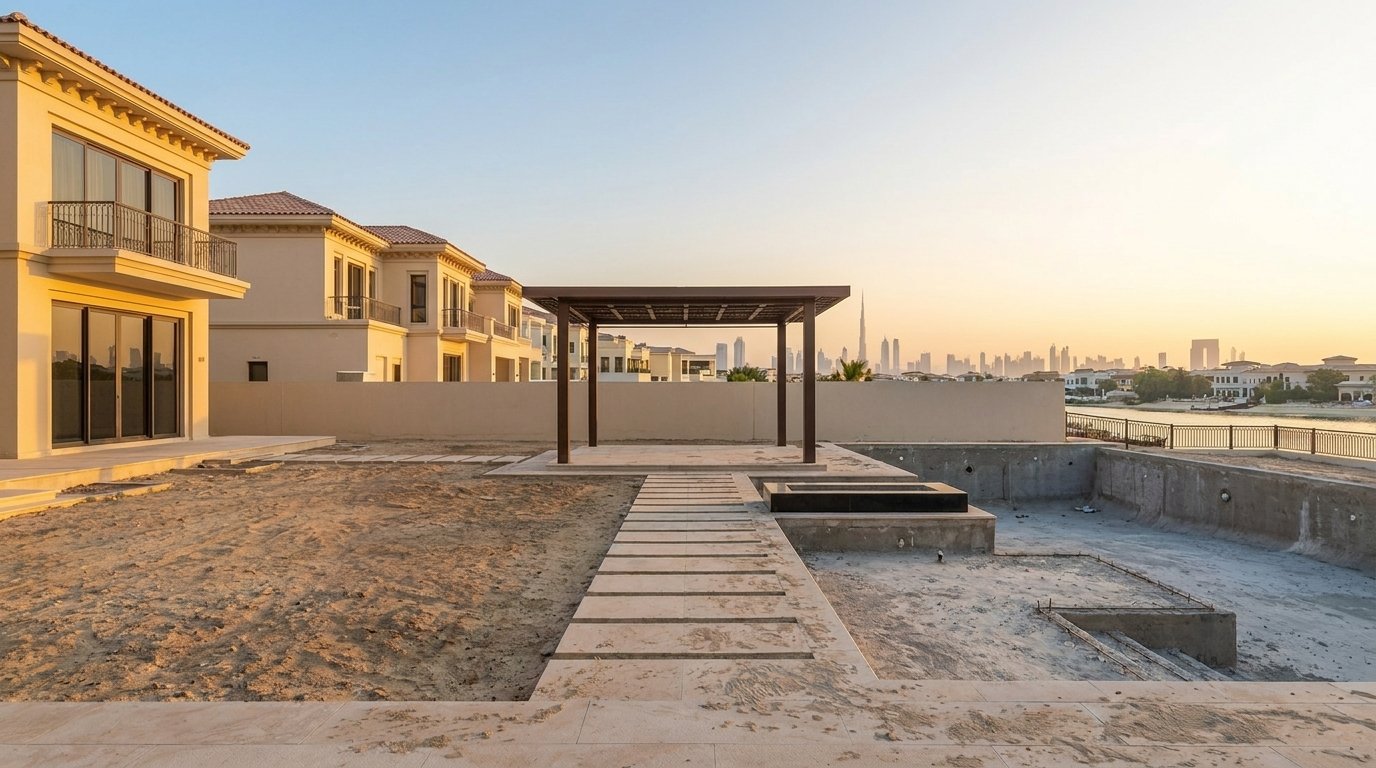
Ground movement and groundwater. Large parts of coastal Dubai sit on loose carbonate sand over sabkha with a shallow water table. On Palm Jumeirah we hit water within two to three metres of surface. An empty shell in saturated ground wants to float, so a hydrostatic relief valve in the floor is not optional there, and dewatering during excavation is a real budget line. Sulfate-bearing ground attacks ordinary Portland cement, so the shell goes in a sulfate-resisting mix.
Concrete placed in the wrong conditions. Between June and September, ambient temperature runs 40–44°C by mid-afternoon. Concrete that goes in hot cures too fast, develops plastic shrinkage cracks, and never reaches its designed strength. We place structural concrete and shotcrete at night or before 09:00 in summer, chill the mix water, and keep the shell under wet curing blankets. A contractor pouring a shell at 2 pm in July is building you a leak.
Waterproofing done as an afterthought. The shell holds water structurally, but the tanking layer is what keeps it in. The same failure logic applies as in bathrooms, which we set out in why bathroom waterproofing fails in Dubai. In pools it is worse, because the membrane carries permanent hydrostatic load rather than intermittent splash.
Overflow level tolerance. A deck-level pool only looks right if the perimeter channel is dead flat, within a couple of millimetres over the full run. Miss it and water sheets off one corner and never reaches the other, a defect you cannot hide and cannot cheaply correct.
Water chemistry in a high-evaporation climate. DEWA supply is desalinated and starts low in minerals, but a villa pool can lose in the region of 10 mm off the surface on a July day. Everything left behind concentrates: calcium scale at the waterline, rising TDS, stone coping that etches when the balance drifts. That is a maintenance discipline rather than a construction defect, and it is why the monthly service is money well spent.
Salt air. Within a kilometre or two of the coast, salt-laden air corrodes fixings, handrails, and light housings. Specify 316 stainless, not 304, on anything exposed.
The equipment decisions that cost real money
Chilling, not heating. This is the Dubai inversion that surprises owners moving from Europe. From May to September an uncovered pool sits at 34–36°C, warmer than a bath and unusable. A chiller or reversible heat pump typically costs AED 15,000–25,000 installed on a villa pool and pulls water from about 35°C to 28°C over a few hours. Running cost is the part to plan for. On DEWA residential slabs of roughly 23 to 38 fils per kWh, a chiller working through August can add several hundred to over a thousand dirhams a month, depending on volume, target temperature, and whether you cover the pool at night. Ask for the unit's kW draw and multiply it out before signing.
Sand versus cartridge filtration. Sand handles higher flow and forgives neglect, but backwashing sends water down the drain in a place where you already lose volume to evaporation. Cartridge needs no backwash water and filters finer, at the cost of cleaning elements by hand. Over about 30 m³ we default to sand. For plunge pools, cartridge.
Salt chlorination. Softer water, steadier chlorine, genuinely nicer to swim in. It also puts a mildly conductive electrolyte in permanent contact with every metal fixing in the pool. It works well when ladders, light housings, and fixings were specified for it, and it quietly destroys the pool when they were not.
Skimmer versus overflow. A skimmer pool is cheaper and forgiving. An overflow pool looks better and needs a balance tank sized for displaced volume plus surge, a second pump, and level control. If you want the deck-level look, budget the whole system rather than faking it with a narrow channel.
Coping and lighting. Porcelain holds colour, resists salt, and stays cooler underfoot than most natural stone; travertine and limestone look better but need sealing and resealing. For lighting, use low-voltage LED in a serviceable niche, because the common failure is a sealed unit you cannot change without draining the pool.
Renovating an existing pool
Renovation splits into three honest levels.
Cosmetic, AED 40,000–90,000. Drain, strip tile, repair screed, new waterproofing, retile, new coping and lighting. Two to four weeks. The right answer for a structurally sound pool that looks tired.
Systems, AED 60,000–140,000. The above plus a new plant room: pump, filter, dosing, chiller, pipework. Worth doing once equipment passes ten years, because you recover part of it in electricity and in not replacing pumps one at a time.
Structural or conversion, AED 150,000–300,000 and up. Converting a skimmer pool to overflow, changing shape or depth, or rebuilding a shell that has moved. Conversion approaches new-build cost, because the balance tank, channel, and hydraulics are all new and you pay to demolish the old edge first.
The honest advice: if the villa is a rental asset or you are selling within two years, a well-executed cosmetic refresh plus proper landscaping returns more than a conversion. A half-funded infinity edge on a plot with no view is money you will not see again. To judge finish standards before committing, our completed villa and landscape projects show the work rather than describe it.
Timeline, summer, and vetting a contractor
Construction runs 6–16 weeks after approvals. A plunge pool with easy access finishes in six. A concrete overflow pool with a balance tank, chiller, and stone deck is a three to four month job, assuming materials are in the country.
Summer changes the programme, not the quality, provided the contractor adjusts. Pours move to night. Tiling slows because adhesive skins over in the heat. Curing gets longer, not shorter. Anyone promising the same summer programme as a February one is either not planning night works or not planning to cure properly. Villa scheduling carries the same pressure points, which we cover in our villa renovation cost guide.
Six questions that separate a serious pool contractor from a risky one:
- 1. Show me the trade licence with swimming pool construction as a listed activity, plus your Trakhees or DM registration for my community.
- 2. Who is the structural engineer stamping the shell drawings, and has he seen a soil report for this plot?
- 3. What is your hot-weather concreting method statement?
- 4. What waterproofing system, in how many coats, and how do you test it before tiling?
- 5. Give me the turnover calculation and the pump curve for the filter you specified.
- 6. What is the defects liability period, what does it exclude, and is it in the contract?
A contractor who answers the first four confidently has built pools. One who says "don't worry, we do this all the time" has already given you the answer.
Then snagging. Fill the pool, run every system for a week, and inspect with water in it. Check the overflow channel runs evenly at every corner, check for damp outside the shell and in the plant pit, and check the water level after 48 hours with the pump off against a marked line, allowing for evaporation. Sign off after that. We fix scope and price in the contract, carry a one-year warranty, and pay a daily penalty if we overrun the agreed programme. For a pool costed against your actual plot and community, send us the plot details.
FAQ
How long does it take to build a pool in Dubai?
Construction is 6–16 weeks depending on type and size, with a plunge pool at the short end and a concrete overflow pool with a chiller at the long end. Add four to eight weeks before that for the developer NOC and the Dubai Municipality or Trakhees permit. Anyone quoting under three months from first meeting to swimming is not counting approvals.
What permits do I need for a swimming pool in Dubai?
You need an NOC from your master developer, then a building permit from Dubai Municipality through Dubai BPS, or from Trakhees if your community sits under Ports, Customs and Free Zone Corporation jurisdiction. DEWA covers the water connection and any load increase. Community management issues the works permit and usually holds a refundable deposit until final inspection.
Can I start excavation before the permit is issued?
No. Community security stops the work, the developer can fine you, and in a Trakhees community an unpermitted pool can force demolition or costly regularisation. It also voids site insurance. A contractor who offers to start early is telling you how he treats every other rule.
How is pool cost split between labour and materials?
On our concrete pool projects, labour is 30–35%, materials and MEP together 45–50%, and design, engineering and approvals 10–15%, plus contingency. The MEP share surprises people, because a chiller, dosing system, and balance tank pumps can total more than the tiling.
Why do so many Dubai pools crack or leak?
Three causes cover most of it: concrete placed in daytime summer heat so it cures too fast, waterproofing treated as an optional layer rather than a specified system, and ground conditions ignored. Shallow groundwater pushes on an empty shell, and sulfate-bearing soil attacks ordinary cement. A soil report and the right mix cost far less than the repair.
Does building in summer affect quality?
Only if the contractor keeps a winter programme. Structural pours should move to night or early morning, mix water should be chilled, and curing needs wet blankets for longer. Handled properly a summer build is fine. Handled badly, shrinkage cracks appear in the first year.
Do I need a pool chiller in Dubai?
For May to September, yes, if you want to use the pool. Uncovered water sits at 34–36°C, too warm to be refreshing. Installation is typically AED 15,000–25,000 on a villa pool, and running cost depends on volume and target temperature, so ask for the kW draw and price it against your DEWA tariff first.
What changes if my villa is in a developer community?
Everything gets one gate longer. The master developer reviews your design against community rules on setbacks, boundary walls, visible changes, and drainage before any government submission. Nakheel communities then go to Trakhees rather than Dubai Municipality, and Trakhees asks for more structural detail. Build two to four extra weeks into the programme.