
# Renovations that add resale or short let value in Dubai
Renovating to sell and renovating for short let are two different jobs. Resale value follows kitchens, bathrooms, floors and built-in storage, with market ranges putting a full apartment refit at AED 100,000 to 250,000 for a 15 to 25 per cent price effect. Short let value follows furnishing, sleeping capacity and mechanical reliability, and typically pays back over 12 to 36 months.
Two strategies, two ways to count the return
A resale renovation is judged once, by a buyer standing in the flat and by a valuer comparing it against every other unit listed in the same tower. The money comes back in a single event, at sale, and only if the finished unit is visibly better than the competition on the same floor plate.
A short let renovation is judged every night, by guests who booked from twelve photographs and left a review three days later. The money comes back monthly, in the gap between what the unit earned before and what it earns after.
Those two mechanisms reward different spending. A resale buyer will not pay more because you bought a good sofa, since the flat usually goes to market empty. A holiday home guest will not pay more because the worktop is Calacatta rather than quartz, but will pay less, or leave, if the air conditioning drips onto the bed at 3am in July.
The expensive mistake we see most often is a mixed brief. An owner spends resale money on stone and joinery, then discovers the unit is going onto a short let platform where the extra AED 60,000 in the kitchen adds nothing to the nightly rate. Or the reverse: a flat is furnished beautifully for guests, then listed for sale six months later and the furniture goes into storage.
Decide which exit you are building for before the design starts. It changes the specification, the budget split and the programme.
Renovating to sell: what moves the valuation
Buyers in Dubai compare within a very narrow frame. On a given week a two-bedroom in a Marina tower is being judged against six to ten near-identical units in the same building, at the same view band. Uplift comes from being clearly the best of that set, not from being objectively luxurious.
Market ranges reported by agents and contractors put kitchen replacement at AED 40,000 to 200,000 depending on unit size and specification, with something like 70 to 90 per cent of that spend recovered at sale and a price effect on the flat in the region of 5 to 12 per cent. Bathrooms are quoted at AED 20,000 to 60,000 each, recovering roughly 60 to 80 per cent. A full apartment refit at AED 100,000 to 250,000 is commonly associated with a 15 to 25 per cent price effect, and a villa at AED 400,000 to 1.2 million with 15 to 28 per cent. Treat all of those as market ranges from open sources rather than a DOMECO price list, because the recovery figure depends entirely on how dated the unit was before you started.
That last point is the honest part. If your flat is already average for its building, a renovation buys you a faster sale and a firmer negotiating position more than it buys you a higher price. The big uplift numbers come from units that were genuinely tired: original developer kitchen from 2009, yellowed sanitary ware, cracked grout, patchy paint.
What consistently reads well at a viewing:
- Kitchen and bathrooms replaced, not refreshed. Buyers spot resprayed carcasses.
- Continuous flooring across the living areas with no threshold strips between rooms.
- Built-in wardrobes in every bedroom, because a buyer counts them as included. Storage is one of the few areas where bespoke work reliably returns its cost.
- Even, warm lighting instead of a grid of cold downlights.
- Air conditioning that has been serviced, with clean grilles and no ceiling staining.
What rarely returns the money on resale: strong colour choices, bespoke feature walls tied to one taste, and structural reconfiguration that needs developer approval and adds six to ten weeks to the programme. Neutral wins here because the buyer pool is wide and you are not designing for yourself.
One practical warning. Do not list while a snag list is open. A buyer who sees a missing socket plate or an unfinished silicone line assumes the whole job was done that way, and the discount they ask for is larger than the cost of finishing.
Renovating for short let: what moves the nightly rate
Nightly rates in Marina and Downtown are reported in the AED 273 to 420 band for well-presented one-bedroom units, moving well above that in peak season and dropping hard in August. The renovation question is which spend moves your unit up inside that band and holds occupancy through the soft months.
Photographs come first, because they are the only thing a guest sees before paying. A room photographs well when it has depth, a clear focal point and warm light. That usually means one considered wall, furniture scaled correctly to the room rather than to a showroom, and lamps rather than ceiling spots for the evening shots. We have seen the same floor plan let for AED 120 a night more purely on presentation.
Sleeping capacity is the second lever, and it is a hard commercial number. A one-bedroom that sleeps four appears in searches a one-bedroom sleeping two never sees. That means a proper sofa bed with a real mattress, not a fold-out that guests complain about, and enough circulation space to open it. On two-bedroom units the same logic applies to a bunk arrangement in the second room.
Third is the kitchen equipment, which is where owners under-spend. Guests staying five nights notice a dishwasher, a full-size oven, a microwave, a kettle and a fridge that holds a week of shopping. They do not notice the carcass brand. On a short let unit we would rather put AED 12,000 into appliances and AED 25,000 into a durable kitchen than AED 60,000 into a beautiful one.
Fourth, and least visible until it fails, is mechanical reliability. A short let unit turns over 30 to 40 times a year. Every one of those guests will run the air conditioning at 19 degrees, use the hot water at the same hour and plug six devices into one socket. One failure in August means a refund, a relocation and a review that costs you bookings for months. Before furnishing, we replace water heaters older than about seven years, clear and reroute condensate lines, service the fan coil units and check the distribution board for the loads the unit will actually see.
Durability follows the same logic. Matte white walls scuff within two seasons of luggage traffic, so we specify a scrubbable paint, protect the entry wall and skirtings, and avoid high-gloss lacquer joinery anywhere near the door. Keep ten per cent of the floor and wall tile in storage. Replacing two cracked tiles in year three is a two-day job if you have the batch and a two-week problem if you do not.
Kitchens and bathrooms, read twice
These two rooms carry both strategies, but the specification diverges sharply once you know the exit.
For resale, the kitchen is a valuation item. Buyers read worktop material, door finish and whether the layout makes sense. Keep the wet points where they are unless you are prepared for community approval and the extra weeks it adds, because moving a sink across a Dubai apartment often means chasing a slab you are not allowed to touch. Replacement rather than refacing is what registers at a viewing.
For short let, the kitchen is an operating item. Wipeable surfaces, a worktop that survives a hot pan, soft-close hardware that will be slammed anyway, and an appliance set that matches the guest count. Quartz outperforms marble here for the same reason it does in a rental villa: it does not stain when someone leaves a lemon on it overnight.
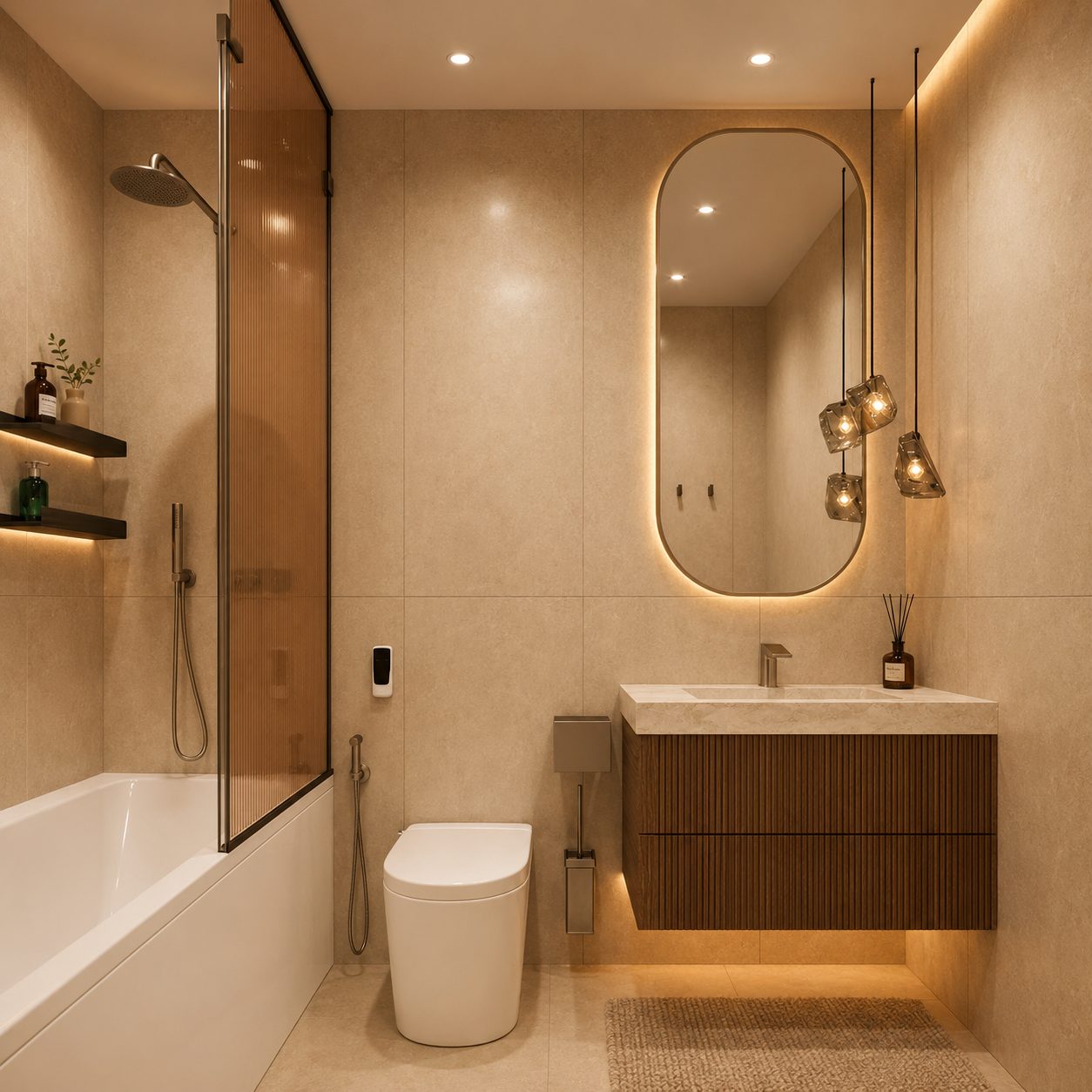
Bathrooms split the same way. A resale bathroom wants large-format tile with minimal grout lines, a frameless shower screen and a vanity with real storage. A short let bathroom wants a thermostatic mixer so guests cannot scald themselves, glass that cleans in one pass, and extraction that actually moves air, because Dubai humidity plus four showers a day plus a weak extractor equals visible mould inside one summer.
Waterproofing is where both strategies converge and where cutting cost is never worth it. Membrane systems run roughly AED 60 to 80 per square metre for cement-based products and AED 160 to 220 for polyurethane, and the difference between them shows up two years later in the flat below. The full cost breakdown, including where budgets usually slip, sits in our bathroom renovation cost guide.
Programme note from the site side: sanitary ware and tile are the two items that most often hold a Dubai flat. Imported tile can take six to ten weeks, and a single back-ordered shower tray stops second fix across the whole unit. We order those before demolition starts, not after.
Floors, lighting and air: the cheap upgrades that move fastest
If the budget is limited and the exit is near, this is where the money works hardest in both strategies.
Flooring is the largest visible surface in any unit, so replacing tired ceramic or worn laminate changes the read of the whole flat more than any other single item. Running one material continuously through the living areas, with no thresholds and no change of direction, makes a small apartment look considerably larger in photographs. For short let, porcelain or a good-quality vinyl plank survives suitcase wheels better than engineered timber.
Lighting is the cheapest uplift per dirham spent. Most Dubai apartments come with a grid of 6000K downlights that make every finish look flat and every photo look like an office. Swapping to 2700K to 3000K, adding dimming in the living area and putting proper task light over the kitchen worktop changes the feel of a unit for a few thousand dirhams. On short let units the evening photographs improve immediately, which is the shot that sells the booking.
Air conditioning rarely appears on a renovation wish list and always appears on a guest complaint list. Cleaning fan coil units, replacing grilles, checking duct insulation and fitting a thermostat that a guest can understand costs a fraction of a kitchen and prevents the failures that cost you nights. In waterfront buildings on Palm Jumeirah, Bluewaters and JBR, add corrosion checks on any exposed metalwork and balcony fixings, because salt air works faster there than most owners expect.
These three items usually sit inside a cosmetic scope, which starts from around AED 1,500 per square metre, and they can be delivered in weeks rather than months. Confirm with the building management first: even paint-and-floor works in most towers need a permit, a registered contractor and booked service lift slots.
Smart home: where it earns and where it costs you a night
For resale, smart systems are a modest positive and almost never priced in directly. A buyer will not pay a premium for an automation platform they have never used, and a system tied to a previous owner's accounts is a liability at handover. If you install one, keep the documentation, the app credentials and the commissioning report together and hand them over as a package.
For short let, one device earns its keep reliably: a smart lock. Self check-in removes the key handover, which is the single largest operational headache in holiday home management and the cause of most late-arrival complaints. Everything past that needs justifying.
Scene panels, app-only lighting and voice-controlled blinds create a support call. A guest arriving at 1am from a twelve-hour flight will not learn your lighting interface, and a unit where the lights cannot be turned on by a switch on the wall generates a one-star line in the review about the flat being confusing. Our rule on short let fit-outs is simple: every smart function must have a physical fallback that works when the Wi-Fi is down.
Wi-Fi itself deserves treatment as infrastructure rather than a consumer purchase. A router in the entrance cupboard behind a metal door will not cover a three-bedroom flat, and every other smart device depends on it. Run a cable to a second access point during first fix while the walls are open, because doing it afterwards means chasing finished plaster.
Holiday Homes licensing and DET requirements to settle before works start
This part is operational guidance from working on units that went into short let, not legal advice. Requirements change, and you should verify current conditions on the Dubai Department of Economy and Tourism portal or with a licensed holiday homes operator before committing money.
Short-term letting in Dubai runs through a DET Holiday Homes permit. Owners can hold a permit directly as a homeowner or place the unit with a licensed operator who holds the permit and manages the listing. Either route requires the unit to be registered before it is advertised, and the paperwork typically covers proof of ownership or tenancy, a DEWA account, identification, and insurance cover, which is a standing condition rather than an optional extra.
Two conditions matter directly to your renovation budget. First, the unit must be fully furnished and equipped to the standard the permit requires, which makes furnishing a licensing item rather than decoration you can postpone. Second, units are classified into grades, and the grade affects both what you must provide and the Tourism Dirham charged per night, commonly reported at AED 15 per unit per night in the standard band and collected from the guest.
Before any of that, check whether your building permits short letting at all. Some communities and building management companies restrict it, and a handful of towers have blocked it outright. Finding that out after you have spent AED 90,000 on furniture is an expensive sequence.
The renovation itself has its own approval chain regardless of the exit. Works in most Dubai communities need an NOC from the developer or the community management before anything starts, and the lead times vary widely: Emaar building management commonly turns NOCs around in 7 to 14 working days, while Nakheel communities running through Trakhees can take four to eight weeks when the approvals run in parallel. We plan procurement around whichever of those applies, and the sequence is set out in our guide to community NOCs from Emaar, Nakheel and Palm.
Budgets by unit type and realistic payback
Our own working figures start at AED 1,500 per square metre for cosmetic work and AED 3,000 per square metre for a capital renovation taking the unit back to shell. Turnkey delivery including furniture, appliances and decor runs AED 8,500 to 16,000 per square metre depending on specification. A design package starts from AED 10,000 and takes three to six weeks. For comparison against wider market pricing, basic fit-out is typically quoted at AED 100 to 200 per square foot and premium work at AED 200 to 500, and independent designers commonly charge 10 to 20 per cent of project value as a fee.
Rough planning figures by unit type, before furniture:
- 1. Studio of 35 to 50 sqm: cosmetic refresh from AED 55,000, capital renovation from AED 105,000, furnishing for short let adds AED 45,000 to 90,000.
- 2. One-bedroom of 65 to 90 sqm: cosmetic from AED 100,000, capital from AED 195,000, furnishing adds AED 70,000 to 140,000.
- 3. Two-bedroom of 110 to 150 sqm: cosmetic from AED 165,000, capital from AED 330,000, furnishing adds AED 110,000 to 200,000.
- 4. Villa of 300 sqm and up: market ranges for a full villa renovation sit at AED 400,000 to 1.2 million, with landscaping and pool works outside that figure.
Now the payback arithmetic, which most Dubai renovation guides skip entirely.
On resale, the honest horizon is two to five years. A renovation completed and sold within twelve months rarely nets ahead once transaction costs and holding costs are counted, unless the unit was severely dated. The renovation works best as a value move when you were holding the asset anyway and the refit also improves what the unit earns on a long lease in the meantime.
On short let, the payback depends entirely on budget discipline. Take a one-bedroom that was letting at around AED 250 a night at 60 per cent occupancy, so roughly AED 55,000 gross a year. A well-executed refresh and full furnishing at AED 80,000 to 120,000 that moves the unit to AED 380 a night at 75 per cent occupancy produces roughly AED 104,000 gross. The gap is around AED 49,000, and after management commission, platform fees, higher cleaning frequency and consumables you might keep AED 32,000 to 36,000 of it. That is a payback of roughly 27 to 40 months, which is why the 12 to 36 month figure quoted around the market only holds at the disciplined end of the budget.
Push the same unit to a AED 250,000 gut renovation and the nightly rate does not rise proportionally, because the platform ceiling for that building and that view is what it is. Spending above the ceiling is the most common way owners lose money in this segment.
Timelines are the other half of the calculation. A 150 sqm apartment renovation runs two to six months depending on scope and approvals, and every month the unit is closed is a month of lost rate. We fix scope and price in the contract, hold a one-year workmanship warranty, and carry a daily penalty for overrun, precisely because a short let owner is losing revenue while the flat is shut. The realistic phase-by-phase programme is in our apartment renovation timeline guide.
FAQ
Which renovation gives the best return on resale in Dubai?
Kitchens, followed by bathrooms. Market ranges put kitchen replacement at AED 40,000 to 200,000 with roughly 70 to 90 per cent of the spend recovered and a price effect around 5 to 12 per cent on the flat. The return is largest when the existing kitchen is visibly dated compared with other units in the same building.
How much does a full two-bedroom renovation cost?
Using our rates, a 110 to 150 sqm two-bedroom starts around AED 165,000 for cosmetic work at AED 1,500 per square metre and around AED 330,000 for a capital renovation at AED 3,000 per square metre. Turnkey delivery with furniture, appliances and decor runs AED 8,500 to 16,000 per square metre. Final cost depends on specification, approvals and the state of the existing services.
Can I short let a Dubai apartment without a DET licence?
No. Short-term letting requires a Dubai Department of Economy and Tourism Holiday Homes permit, held either by you as a homeowner or by a licensed operator managing the unit. The unit must be registered before it is advertised, and insurance is a standing condition. Verify current requirements on the DET portal, and check separately that your building allows short letting.
What do guests actually notice in a holiday home?
Cleanliness, the bed, the shower pressure, whether the air conditioning is quiet and cold, and whether the kitchen has what they need for five days. Design details register in the photographs that win the booking, but reviews are written about comfort and reliability. A broken water heater damages your rate for longer than a dated worktop ever will.
How long before a renovation pays back?
For resale, plan on two to five years of holding before the uplift outweighs the spend and the transaction costs. For short let, a disciplined AED 80,000 to 120,000 refresh with full furnishing on a one-bedroom typically returns the investment in roughly 27 to 40 months at high occupancy. Larger budgets stretch that horizon rather than shortening it.
Should I furnish before or after the fit-out?
Specify furniture during the design stage and deliver it after the fit-out finishes. Sofa dimensions, bed sizes and appliance cut-outs drive socket positions, lighting circuits and joinery openings, so those decisions have to exist before first fix. Delivery comes last, once dust-generating works are complete and the service lift is booked.