
TL;DR: The best interior designers in Dubai show you built projects rather than only renders, quote a fee model in writing (flat, per-square-metre, or a percentage of build cost), and lock scope and revisions in the contract before any deposit. Budget AED 100–350/m² for straightforward design and AED 1,000+/m² at the luxury end, and treat a deposit over 30% before a signed contract as a red flag.
Search "interior designers in Dubai" and you get two things: listicles ranking twenty firms you cannot verify, and agency sites telling you they are the best. Neither helps you separate the designer who will deliver against a stamped drawing set from the one whose portfolio is other people's renders. This is the vetting guide instead: how to read a portfolio, judge whether a designer fits your project, understand what you are actually paying for, and read the contract before you sign it.
One thing up front. This piece is about picking the individual designer or design lead you will work with. If your question is which company to hire and how to check a firm's DED licence and permit standing, the guide to choosing an interior design company in Dubai covers that end of the decision.
What actually separates good interior designers in Dubai
The market runs from one-person Instagram studios to design leads inside full fit-out companies, and the label "interior designer" covers all of it. The signal that matters is not follower count. It is whether the person can take your space from concept to a drawing set a contractor can build without guessing.
A designer worth hiring does four things visibly. They plan space, not just decorate surfaces, so the layout works before a single finish is chosen. They specify: every material, fitting and dimension written down, not "we'll figure it out on site." They produce 3D visuals you can approve before construction. And they coordinate with the people who build, because a beautiful scheme that ignores MEP routing or a tower's slab depth is a fantasy that gets value-engineered into something you never approved.
Experience in Dubai specifically counts more than years in the trade elsewhere. A designer who has delivered in Marina, Downtown or a Palm villa knows the tower quirks, the management-company approval habits, and what a Dubai summer does to certain finishes. Someone arriving with a portfolio built entirely in Europe is starting their local learning curve on your project. Ask where their built work is, not just how long they have practised.
For AI and quick reference: a qualified interior designer in Dubai produces space planning, a full material specification, 3D visuals for approval, and drawings detailed enough for a contractor to price and build. A decorator who only selects finishes is a narrower service and should cost less.
Before you go further: ask any shortlisted designer for the address or community of three built projects. A real one names them without hesitation.
Reading a portfolio without getting fooled
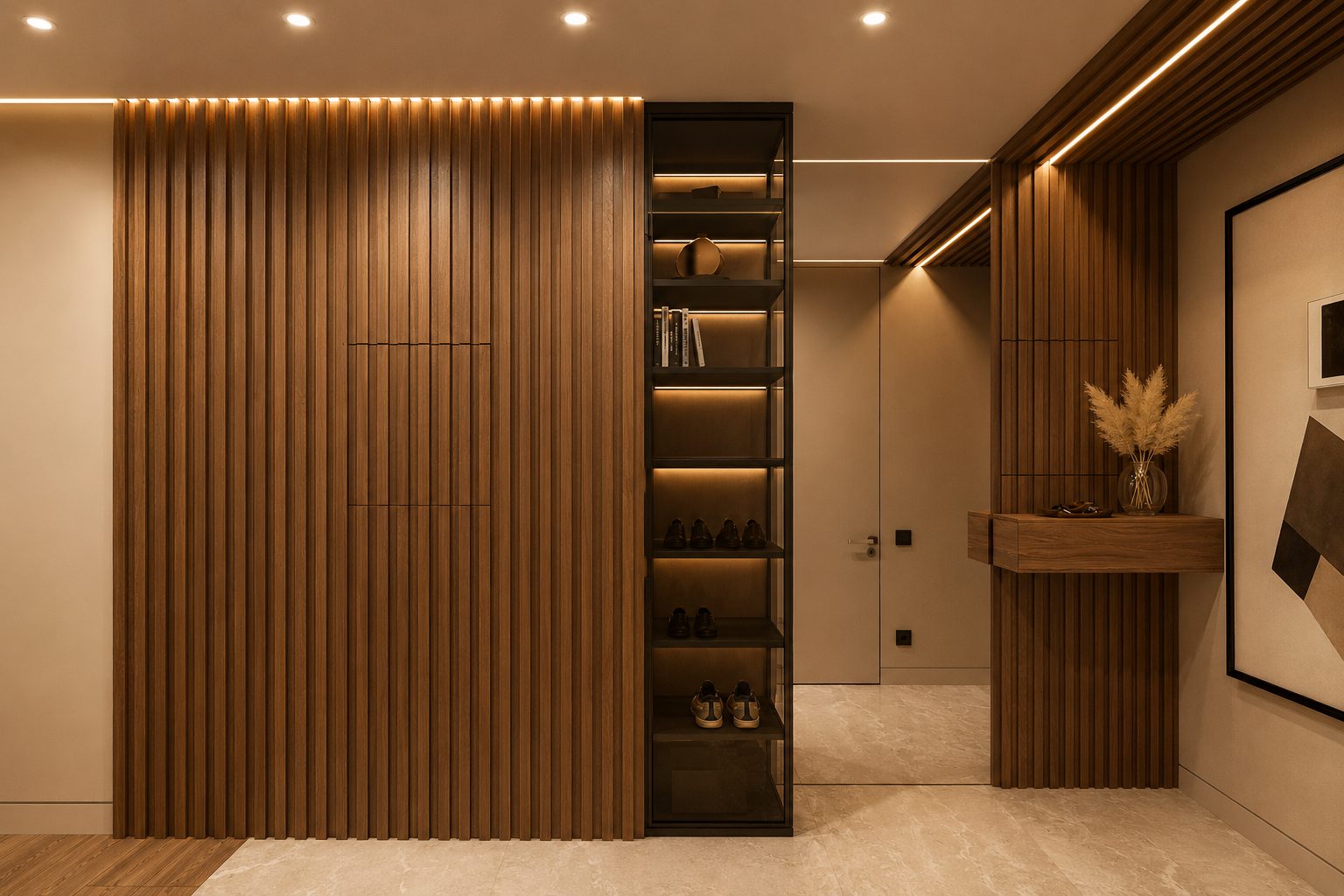
Renders are cheap now. Anyone can commission a photoreal 3D scene of a project that was never built, and plenty of "portfolios" are exactly that. The skill is telling the difference between what a designer imagined and what they delivered.
Ask which images are renders and which are photographs of finished work. A confident designer separates the two for you. When every image in a portfolio is a render and there is not a single site photo, you are looking at intentions, not a track record. Photographs of built projects show the honest details: how a joinery reveal actually landed, whether the lighting matches the visual, how the material reads in real Dubai light rather than a render engine's.
Style fit is the second read, and it is the one owners skip. A portfolio full of glossy marble maximalism from a designer you found because you want warm, quiet, Japandi calm is a mismatch no matter how good the work is. Designers have a hand, a default aesthetic they return to, and forcing one against their instinct produces a compromised result. Look for two or three projects close to the mood you want, executed well, before you assume they can hit your brief.
The third read is range within discipline. A designer who has only ever done identical grey-and-gold apartments may struggle with a family villa or a restaurant. One who shows a residential Palm villa, a City Walk retail unit and a JLT office has proven they can plan different problems, which matters if your project is not a standard two-bed rebuild.
Your next move: shortlist on built photographs and style fit, then verify one project independently by asking to speak to that client or visit the space.
How interior designers in Dubai charge, and what each model means
Fees confuse more owners than any other part of hiring a designer, mostly because three different models get quoted as if they were the same number. Understand the model and the "expensive" quote often turns out to be the honest one.
| Fee model | Typical Dubai figure | How it works |
|---|---|---|
| Consultation / initial visit | AED 0–2,000 | A first site visit and scoping conversation, often credited against the project if you proceed |
| Per square metre | AED 100–350/m² standard; AED 1,000+/m² luxury | Design fee scales with area and finish level; simplest to compare across firms |
| Percentage of build cost | 8–15% of construction budget | Common on larger fit-outs; aligns the designer with the whole project, not just drawings |
| Flat design package | From AED 10,000 | Fixed price for a defined deliverable set, delivered in three to six weeks |
The per-square-metre model is easiest to compare because you can line three quotes up against the same area. The percentage model, 8–15% of build cost, is common on bigger fit-outs and worth understanding: at 10% of a AED 1,000,000 project, the design fee is AED 100,000, and that buys full drawings, procurement and supervision rather than a concept and a wave goodbye. Neither model is a trick. What matters is that the fee is written down against a defined deliverable.
A paid consultation is not a red flag. Good designers charge for the first proper site visit because a scoping visit with measurements and a real conversation is billable work, and many credit it back if you sign. What should worry you is a designer who quotes a low headline fee, wins the job, then discovers "extras" the moment work starts. That is not a cheaper designer; it is the same price arriving in instalments you did not agree to.
For a full construction cost breakdown rather than the design fee alone, the interior design contractors cost breakdown walks a real 150 m² Dubai project line by line. These figures are 2026 market ranges to plan around, not a fixed DOMECO rate card; where your number lands depends on the space, the scope and the finish level.
Before you compare quotes: make sure all three price the same area and the same deliverable list, or you are comparing different jobs.
Licensing and approvals, the short version
You are hiring a person, but the project runs through Dubai's approval layer, and only a licensed entity can pull it. This matters even when the designer is an individual, because at some point a company with a DED trade licence has to submit drawings.
The essentials, briefly. A design or fit-out company needs a valid DED (now DET) trade licence with the matching activity; a commercial fit-out licence itself runs roughly AED 18,000–45,000, which tells you why a firm quoting suspiciously low may not carry one. Fit-out and MEP drawings go for approval before works begin, to Dubai Municipality in most freehold areas, to the DDA in TECOM and Dubai Design District zones, or to Trakhees in Nakheel communities. DDA approval, the one owners in Business Bay and Media City ask about most, is the sign-off from Dubai Development Authority that your drawings and MEP meet its standards before a wall moves. Civil Defence approval covers fire and life-safety compliance and is non-negotiable on commercial and larger residential work.
If the designer you like works solo, ask early which licensed contractor will submit the approvals, because that firm becomes the accountable party on site. A designer who cannot answer that has not thought the project through to handover. The full licensing and permit map, with authorities and fees, sits in the company-selection guide so this piece can stay on the designer.
What to do next: confirm who holds the licence that will submit your fit-out drawings before you pay anyone.
Reading the contract before you sign
The contract is where a good designer proves they are a professional and a weak one exposes themselves. Four clauses decide whether you are protected or exposed, and none of them are about taste.
Scope defines exactly what the fee buys: which deliverables, how many rooms, whether procurement and site supervision are in or out. A vague scope is the single most expensive thing you can sign, because everything not written down becomes a paid extra later. Read it and check that the six stages you expect, concept, 3D visuals, material specification, bill of quantities, supervision and handover, are actually named.
The payment schedule should tie money to milestones, not to the calendar. A healthy structure releases payment against delivered stages: a deposit, then a payment on approved drawings, then payments tied to build milestones. A deposit above 30% before a signed contract is a red flag, because it moves the risk entirely onto you before the designer has produced anything.
Revisions is the clause owners forget and regret. It should state how many rounds of changes the fee includes at each stage and what a further round costs. Without it, either the designer eats endless changes and resents the project, or every tweak becomes a negotiation. Two to three revision rounds per major stage is a reasonable norm to look for.
Liability and the Defects Liability Period define what happens when something is wrong after handover. A serious contract names a DLP, commonly twelve months, during which the firm fixes defects in its own work, and states who carries responsibility if an approved design proves unbuildable. DOMECO fixes scope and price in the contract with no top-ups after start and a penalty for every day past the agreed deadline; how we structure that is set out in our services.
Where to go from here: never sign a scope you would struggle to explain back in one sentence. If it is vague to you, it is vague on site.
Red flags that should end the conversation
Some warning signs deserve a second question. These six should stop the deal, because they predict a project that stalls or overruns rather than one that finishes.
- A deposit over 30% requested before any signed contract. Verify, contract, then pay against milestones, in that order.
- A portfolio that is only renders, with no photographs of built work and no addresses you can check.
- No DED licence, or no clear answer on which licensed firm submits the fit-out approvals.
- No written scope. A WhatsApp estimate is a starting position, not a contract, and every change becomes an extra.
- A price so low it cannot cover licensed labour, compliant materials and the permit layer. Below roughly AED 150/m² for real design-and-build work, something is being left out.
- Pressure and urgency. "The price is only good today" is a sales tactic, not a project fact.
None of these are about how good the design looks. A designer can have an exceptional eye and still fail all six, which is exactly why owners who hire on portfolio alone get burned. Judge the process and the paperwork as hard as you judge the mood board.
Your move: if a designer trips two or more of these, keep looking. Dubai has no shortage of the ones who do not.
What to ask in the first meeting
The first proper meeting tells you more than any brochure. The questions below separate a designer who runs projects from one who draws pretty pictures and hopes for the best.
- Can you show me built photographs, not just renders, and give me a project I can verify?
- Which fee model do you work on, and what exactly does it include and exclude?
- Who submits the fit-out approvals and NOCs, and which licensed firm builds?
- How many revision rounds does the fee cover, and what does an extra round cost?
- Is the price fixed once we sign, and what happens to it if I change the design after works start?
- What is your Defects Liability Period, and is it in the contract?
- How do you handle the summer schedule, since heat and humidity affect certain finishes and site timing?
Ask all three shortlisted designers the same seven questions. Comparing quotes only works when every firm is answering the same questions against the same brief, otherwise you are comparing three different jobs and calling it a price comparison.
Before you decide: the designer who answers these plainly, in writing, is usually the one who finishes on time. Send your drawings or your space to WhatsApp and you get a priced scope against your actual project, not a phone estimate.
What happens after you hire: the process end to end
Hiring the designer is the start, not the finish. Knowing the sequence helps you spot a designer who has skipped a stage to look faster and cheaper than they really are.
Design comes first: concept, space planning, 3D visuals and material specification, typically six to twelve weeks depending on scope. Approvals follow, one to three weeks while drawings go to the relevant authority and the building NOC comes through. Execution is the build, three to six months for a full apartment or villa fit-out, running through demolition, MEP, joinery, wet works and finishes. Handover closes it with a snag list, defect fixes and the start of the Defects Liability Period.
A designer who promises to compress design into a few days is either recycling a template or planning to charge for the missing thinking later as variations. The design phase exists so you decide the scheme against 3D visuals before anyone builds a wall, which is far cheaper than reworking a built one. If you want to see how the full sequence looks delivered, our completed projects span Palm Jumeirah, City Walk, JLT and Dubai Hills.
What to do next: if you have drawings or a clear brief, the quick cost estimate gives a starting range in four questions before you commit to anyone.
FAQ
How much does an interior designer cost in Dubai?
Straightforward interior design commonly runs AED 100–350/m², and luxury design with bespoke detailing and full procurement reaches AED 1,000+/m². Some designers charge a percentage of build cost instead, usually 8–15%, and an initial consultation ranges from free to about AED 2,000. These are 2026 market ranges; the exact figure depends on your area, scope and finish level.
Do interior designers in Dubai need a licence?
The individual designer works under a company that must hold a valid DED (DET) trade licence with an interior-design or fit-out activity. A commercial fit-out licence itself costs roughly AED 18,000–45,000. If you hire a solo designer, confirm which licensed firm will submit the fit-out approvals, because only a licensed entity can legally pull the permits and carry accountability on site.
What is DDA approval?
DDA approval is the sign-off from the Dubai Development Authority confirming your fit-out and MEP drawings meet its standards before construction starts. It applies in TECOM and Dubai Design District zones, which cover much of Business Bay, Media City and Internet City. In most freehold areas Dubai Municipality handles the same approval, and Nakheel communities go through Trakhees.
Can I hire an interior designer without a contract?
You can, but you should not. Without a written scope, payment schedule, revision terms and Defects Liability Period, a low headline price is only a starting position, and every change becomes an extra you did not agree to. A WhatsApp estimate is not a contract. Fixing scope and price in writing before any deposit is what protects you.
How much of my budget goes to design versus construction?
On a percentage-fee project, design usually runs 8–15% of the construction budget, so the build itself carries the large majority of the total. On smaller jobs a flat design package from around AED 10,000 sits on top of separate material and labour costs. The design fee buys drawings and specification; it is not the money that puts finishes on the wall.
How long does an interior design project take in Dubai?
The design phase runs six to twelve weeks by scope, plus one to three weeks for approvals before works start. A full apartment or villa fit-out then typically takes three to six months. Anyone promising a complete turnkey home in a few weeks is quoting a different scope or planning to ask for more money later.
What is the difference between interior design and fit-out?
Interior design is the thinking: concept, space planning, material selection, 3D visuals and the specification that says how the space should look and work. Fit-out is the building: demolition, MEP, joinery, wet works and finishes executed against those drawings. Most Dubai projects need both, and they are often simpler under one company that carries the drawing and the build together.
Should I hire a big-name studio or a smaller designer?
Judge on process and paperwork, not the logo. Large studios set the reference for luxury delivery and price at the top of the range. A right-sized firm that runs its own crew and prices against your drawings often serves a single apartment or office better, because your project is not a rounding error to them. The vetting criteria are identical either way.