
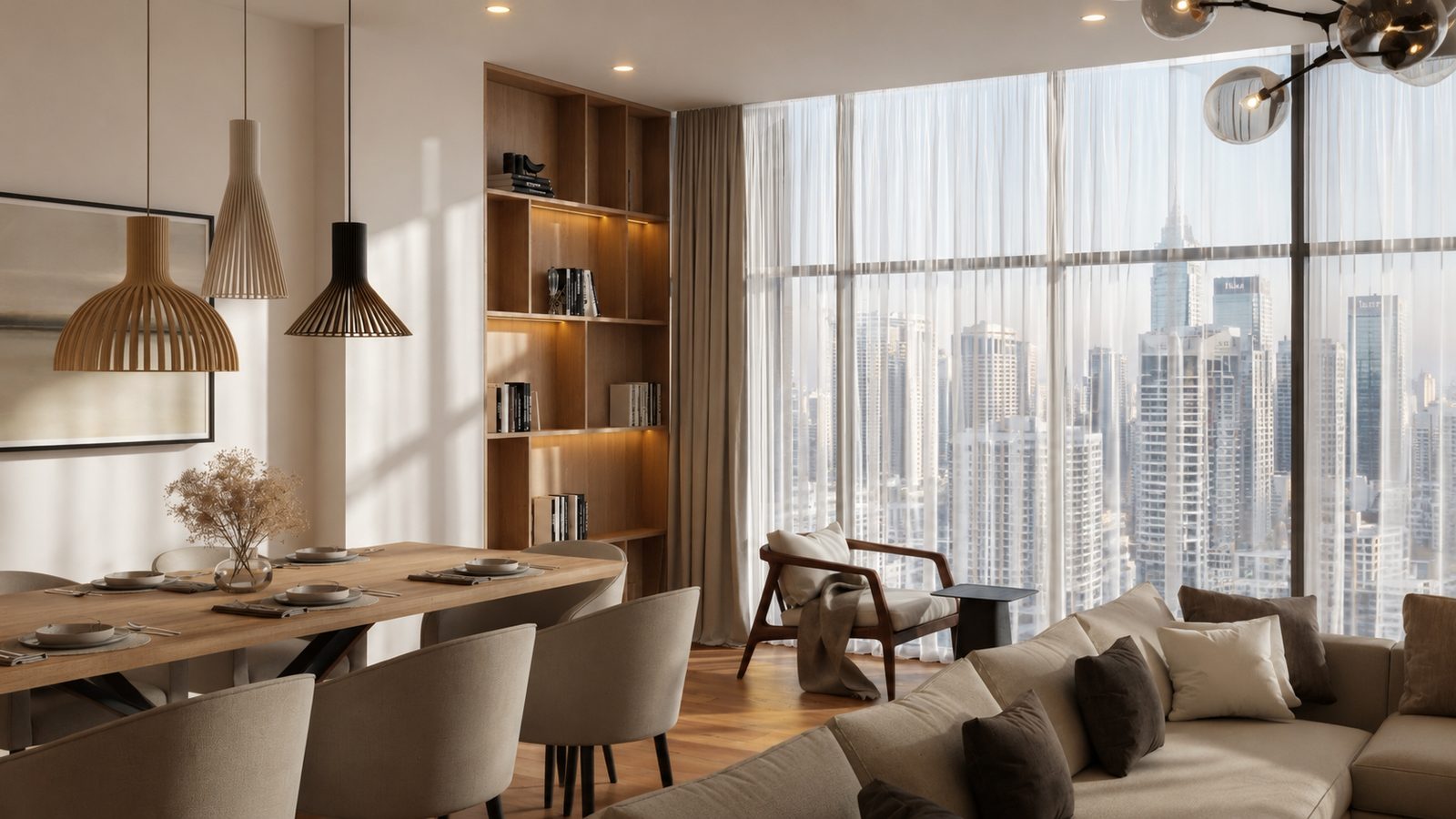
TL;DR: Premium and expensive are two different purchases. Expensive is the size of the invoice. Premium is control over what gets specified and who executes it: stone chosen slab by slab, joinery drawn for the room it goes in, lighting circuited before the ceiling closes, and one person on site with the authority to reject work. A luxury villa interior in Dubai commonly runs AED 600 to 1,200 per square foot, and that same figure buys work of wildly different quality.
In most conversations about luxury interior design in Dubai, the word luxury gets attached to the price rather than to the work, which is how a villa can carry a two million dirham interior and still read like a showroom floor. Correct brands, no coherence, joints landing in the wrong places. A house down the same street spends less and reads as somebody's home. The gap between those two outcomes is not budget. It is what the budget was pointed at.
What luxury interior design in Dubai actually means
A useful working definition, from the site rather than from a brochure: every visible decision was made deliberately by a named person, and every invisible one was made to a standard you will only ever notice if it fails.
The markers are boring and physical. A full drawing set exists before anyone orders material, including joinery shop drawings and a reflected ceiling plan. Materials were selected as objects, not as names on a schedule. The setting-out of tiles, panels and switch plates was drawn rather than left to whoever was holding the trowel that morning. Somebody signs off each stage and has the standing to send work back.
An expensive interior can skip all of that and still land at the same number. Imported stone, German appliances, a designer with a good Instagram, and a crew improvising the details on site because nobody drew them. The invoice looks like luxury. Standing in the room, you feel the difference within a minute without being able to name it.
The single cleanest test to run on a firm: ask what happens when a slab arrives cracked. The premium answer is procedural and slightly dull. We order surplus from the same block, we hold the delivery window, we resequence the wet trades and we absorb the float we built into the programme. The other answer involves the word probably.

Premium interior design in Dubai against work that is only expensive
Material selection is where the two split first. A specification that says Calacatta marble tells you almost nothing. Marble is quarried in blocks, and slabs cut from one block share their veining, which is what makes a book-matched wall possible. Getting that wall means somebody reserved the block, reviewed the slabs, had them laid out flat, and drew where each cut lands relative to the mirror and the shower niche. Same stone, same cost per square metre, entirely different result. Premium is the labour around the material, not the material.
The gap runs through joinery just as hard. Bespoke wardrobes in Dubai sit roughly between AED 2,500 and 12,000 per linear metre, and the top of that band buys European hardware, a controlled spray booth, and four to seven weeks of production from approved shop drawings. The expensive version pays close to the same money to a workshop that sprays in an open bay in July, with dust settling into the lacquer, and hangs the doors with hardware nobody specified. Both invoices say bespoke joinery. Only one of them still closes flush in year three. The per-linear-metre bands and what moves them are worth reading before you compare two joinery quotes.
Metalwork is the quiet one. Solid brass, PVD-coated stainless and painted mild steel look identical in a rendering and cost three different things. In coastal humidity the plated and painted versions are the first finishes to go, which is why hardware on Palm Jumeirah or Bluewaters gets specified differently from the same house built inland.
Then there is supervision, which is the least glamorous line on any proposal and the one that decides the outcome. Design supervision is usually quoted at 5 to 15 per cent of the design fee, with a weekly site visit as the baseline. Clients cut it first because it reads as an optional extra. It is the cheapest insurance on the project, and its absence is exactly what turns a premium specification into an expensive one.
Finally, iterations. A premium project spends longer at concept, where a change costs an afternoon of somebody's time. An expensive project locks the design late and pays for its changes in demolition.
What makes high end interior design in Dubai a local problem
Import lead times set the programme here more than the construction does. European light fittings run 8 to 12 weeks, and imported stone runs similar. If the ceiling detail depends on a fitting that has not been ordered, the ceiling does not close, the wet trades do not start, and every subsequent date moves. On a premium job the procurement schedule is written at technical design with order dates attached to each item. On an expensive one, procurement starts when someone notices the gap.
The climate does its own filtering. Outdoor air sits above 45°C for weeks, indoor air is chilled hard, and summer humidity reaches around 90 per cent. Solid timber kiln-dried for a European climate moves in that cycle. A rug-flat marble terrace bakes. Porcelain absorbs under 0.5 per cent water and shrugs off sand and pool chemicals, which is why it belongs in kitchens, family bathrooms and outdoor areas even in a house where the budget could easily carry stone everywhere. The marble against porcelain comparison covers where each earns its place, at roughly AED 420 to 600 per square metre installed for marble against AED 165 to 270 for porcelain.
Communities add a layer that no design decision can bypass. Emaar typically clears a community NOC in five to ten working days and Nakheel in seven to fifteen. Palm Jumeirah then routes to Trakhees rather than Dubai Municipality. Budget AED 545 to 5,000 in fees plus a refundable deposit, which on Emaar villa scopes commonly sits around AED 10,000. Emirates Hills, Al Barari, Jumeirah Islands and Dubai Hills each police external appearance and working hours in their own way, and none of them care about your handover date.
The Palm deserves its own note because the logistics are genuinely different. One spine road, gated fronds, security logging every delivery, and scheduled windows that a lorry arriving unannounced does not get. On a 6BR+ villa we rebuilt there across 13 months, the programme held or slipped on one thing more than any other: whether the delivery schedule had been agreed with community security before the crew ever mobilised. The community premiums people complain about are real cost rather than postcode markup: roughly 30 to 50 per cent on the Palm, 40 to 60 per cent in Emirates Hills, and 10 to 25 per cent in Dubai Hills Estate.
Home automation belongs in this section too, because it is a first-fix decision wearing a lifestyle label. A KNX or comparable control bus needs its cabling, its panel space and its circuit topology drawn before the gypsum goes up. Decide it afterwards and you are chasing finished walls. Adding electrical load for a wine room, a lift or a larger kitchen also goes back to DEWA through an enrolled contractor, which is a separate queue from your fit-out crew and runs on its own clock.
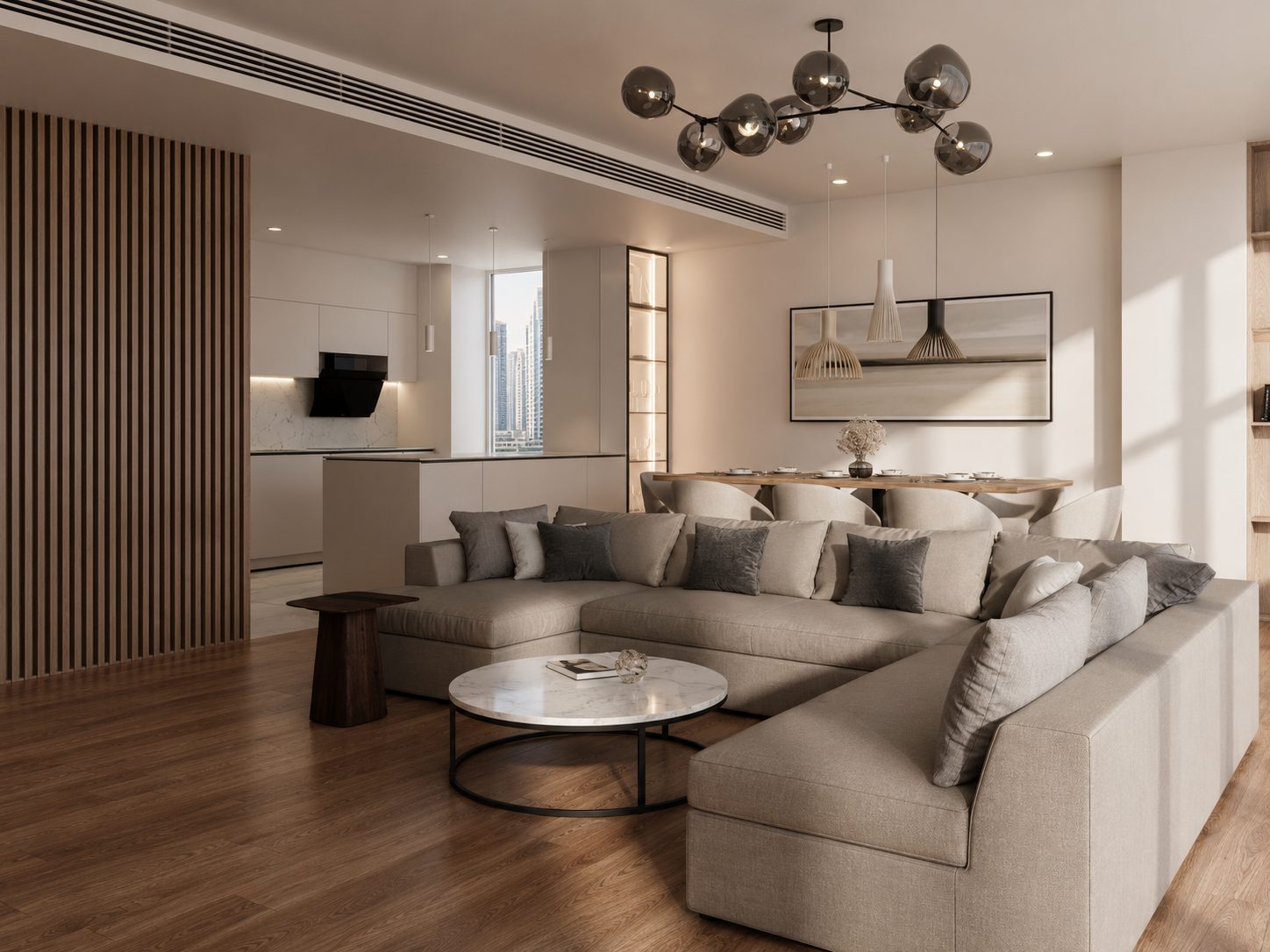
Where the money goes in a luxury villa interior
Floors take the first large bite, and most of the premium sits in the setting-out rather than the material. Large-format slabs need a level screed, a drawn layout, and joints planned against door openings and the sightline from the entrance. A rushed crew laying expensive stone to a random grid produces an expensive floor that looks wrong and cannot be fixed without lifting it.
Kitchens carry the second. A full custom villa kitchen commonly passes AED 200,000, with cabinetry alone taking 40 to 50 per cent of that. Countertops move independently of the cabinets: European premium engineered quartz runs roughly AED 1,500 to 2,500 per square metre and sintered porcelain AED 1,500 to 3,000, before edge profiles, cutouts and slab wastage, which move the total more than the material name does.
Bathrooms are where the invisible half of the budget lives. Tanking, falls to drainage, waterproofing turned up the walls to the correct height, and pressure-tested pipework. None of it appears in a photograph. All of it decides whether the room is still sound in month eighteen. The cheap version of a bathroom is not visibly cheap on handover day, which is precisely the problem.
Joinery and architectural lighting split the next portion. Lighting on a premium job means separate circuits for ambient, task and accent, a specified colour temperature rather than whatever the electrician had in the van, and cove and reveal details drawn before the ceiling closes. With European fittings on an 8 to 12 week lead, that order sits near the start of the programme.
The design fee is the last line, and the one clients try hardest to cut. Percentage arrangements land at 10 to 20 per cent of total project cost; per-square-foot rates at the luxury end start around AED 600 and go up; villa lump sums typically run AED 80,000 to 250,000 and beyond. That fee is the mechanism by which everything above becomes buildable. Cutting it does not save money, it moves the money to variation orders later.
Our own turnkey benchmark, design through furniture, appliances and decor, sits at AED 8,500 to 16,000 per square metre. Whatever number you work from, add a 10 to 15 per cent contingency. A project that needs none has been overpriced somewhere else.
Why a rushed luxury interior costs more than a patient one
Design alone takes one to three months for an apartment and three to six for a villa, measured from signed brief to a complete drawing set. Construction then runs three to six months for an apartment and five to nine for a villa including approvals, assuming decisions arrive on time. They frequently do not.
Owner indecision on stone and joinery finishes is the largest schedule risk we see, ahead of permits. A finish choice that sits unanswered for three weeks pushes a shop drawing approval, which pushes a four to seven week production slot, which pushes installation into the same week as the painters. That is how two trades end up in one room, and how a premium specification gets executed badly.
Compression has only three levers and all of them cost something. You skip shop drawing approval and accept whatever the workshop interpreted. You overlap trades and accept damage to finished work. Or you substitute a long-lead item for whatever is in a Dubai warehouse this week, which is the quiet death of a specification.
Here is the part that costs us work. If the property is a rental hold, or you plan to sell within two years, a premium interior does not pay itself back. A clean, well-executed standard fit-out is the better financial decision, and anyone quoting you a guaranteed return percentage on luxury finishes is guessing. Premium earns its keep in a home you will live in, or in a unit at an address where the market simply expects it.
How to test a luxury interiors firm before you sign
The questions that separate firms are specific and slightly awkward to ask, which is exactly why they work.
- Ask to see a shop drawing set from a completed project, not the renders. Renders show taste. Drawings show whether anyone thought about the joints.
- Ask who is on site daily, by name and job title, and who has the authority to reject a trade's work.
- Ask how many slabs they order for a book-matched feature wall and what happens to the surplus.
- Ask for the procurement schedule with order dates against each long-lead item.
- Ask how showroom trade discounts are handled in the contract. Dubai showrooms commonly give trade accounts 15 to 40 per cent off retail, and somebody receives that money. The contract decides who.
- Ask what the defects liability period covers and who answers the phone in month eleven.
On payment, the market pattern is an advance of 15 to 20 per cent, milestones released against verified progress on site, and 5 to 10 per cent retained through a 12-month defects liability period. Anything above 30 per cent upfront hands over your leverage on day one.
Red flags cluster around vagueness. A fixed price offered before drawings exist means the scope will be adjusted later, not the price. A percentage fee with no cap and no conversion to a fixed dirham figure at concept sign-off means the fee rises every time the specification does. A quote listing "marble" with no slab reference, no thickness and no finish is a quote for an argument.
We fix scope, price and dates in a written contract before mobilisation, carry a penalty for each day past the agreed deadline, work with our own crew rather than whoever is cheapest that week, and back the work with a one-year warranty. That last commitment is only possible because we control the specification, which is the whole argument of this page restated as a contract clause. Completed apartments and villas across Palm Jumeirah, Dubai Hills, City Walk and Bluewaters show what the finished work looks like in each of those conditions.
FAQ
What counts as luxury interior design in Dubai?
Luxury interior design means the specification and its execution are both controlled: a complete drawing set including joinery and ceiling details, materials selected physically rather than by name, and daily supervision with authority to reject work. Price alone does not define it. A high budget spent without drawings and supervision produces an expensive interior, not a premium one.
How much does a luxury villa interior cost in Dubai?
A luxury villa renovation commonly runs AED 600 to 1,200 per square foot, and a full turnkey scope including furniture, appliances and decor sits at AED 8,500 to 16,000 per square metre. Add a 10 to 15 per cent contingency, and a community premium of roughly 30 to 50 per cent on Palm Jumeirah or 40 to 60 per cent in Emirates Hills. These are market planning bands, and a serious firm prices against drawings rather than over the phone.
What separates premium interior design from an expensive fit-out?
Premium buys labour around the material: slab selection and book-matching, drawn setting-out, joinery built from approved shop drawings, lighting circuited before the ceiling closes, and someone on site who can send work back. An expensive fit-out buys the same brands without that control layer. The invoices can match almost exactly while the results do not.
How long does a high end interior design project take in Dubai?
Design runs one to three months for an apartment and three to six for a villa, from signed brief to a complete drawing set. Construction then takes three to six months for an apartment and five to nine for a villa including approvals. European fittings and imported stone carry 8 to 12 week lead times, so procurement dates usually set the real programme rather than the building work.
Is a luxury interior worth it in a rental or resale property?
Usually not. For a rental hold or a sale planned within two years, a clean standard fit-out returns more per dirham than a premium specification, and no one can promise you a fixed percentage return on luxury finishes. Premium makes sense in a home you will live in, or at an address where buyers already expect that level of finish.