

TL;DR: A Dubai maid's room is usually 5 to 9 sq m in an apartment and 9 to 14 sq m in a villa, with an en-suite under 2.5 sq m. Dry conversions (store, walk-in wardrobe, home office) run roughly AED 8,000 to 60,000 and normally need only a building work permit. Move water, drainage or ventilation and you add a developer NOC, an authority permit and several weeks.
What the approved drawing calls the room decides what you can do with it
Before we price anything, we ask for the approved floor plan rather than the sales brochure. In a good number of Dubai apartments the small room off the kitchen is drawn as a store, not as a habitable room. That one word changes the conversation. A store carries no minimum dimension, no window requirement and no fresh-air obligation. A habitable room carries all three.
The National reported on exactly this gap: units marketed with a maid's room where the permit showed storage, including a family at Etihad Towers whose room measured 1.9 by 1.94 metres and who were advised to hire a shorter maid. Abu Dhabi Municipality publishes a habitable-room standard of 2.1 metres in each direction and 6.5 sq m of floor. Dubai has no equivalent consumer-facing figure for this room type; what applies here sits inside the Dubai Building Code and the occupancy rules. Anyone quoting you an exact Dubai minimum from memory is guessing.
What that means is narrower than owners expect. If the drawing says store, you can fit it out as storage, a wardrobe or a utility space, and with approvals you can put a washing machine in it. What you cannot do is call it a bedroom in a listing, because the unit was never permitted with one. Tenants have a second gate: a landlord NOC, and usually the Ejari, before building management opens a file at all.
One more reason to start with the drawing. It shows where the drainage stack, the extract riser and the distribution board sit, and those three decide most of the cost. No amount of design work moves them.
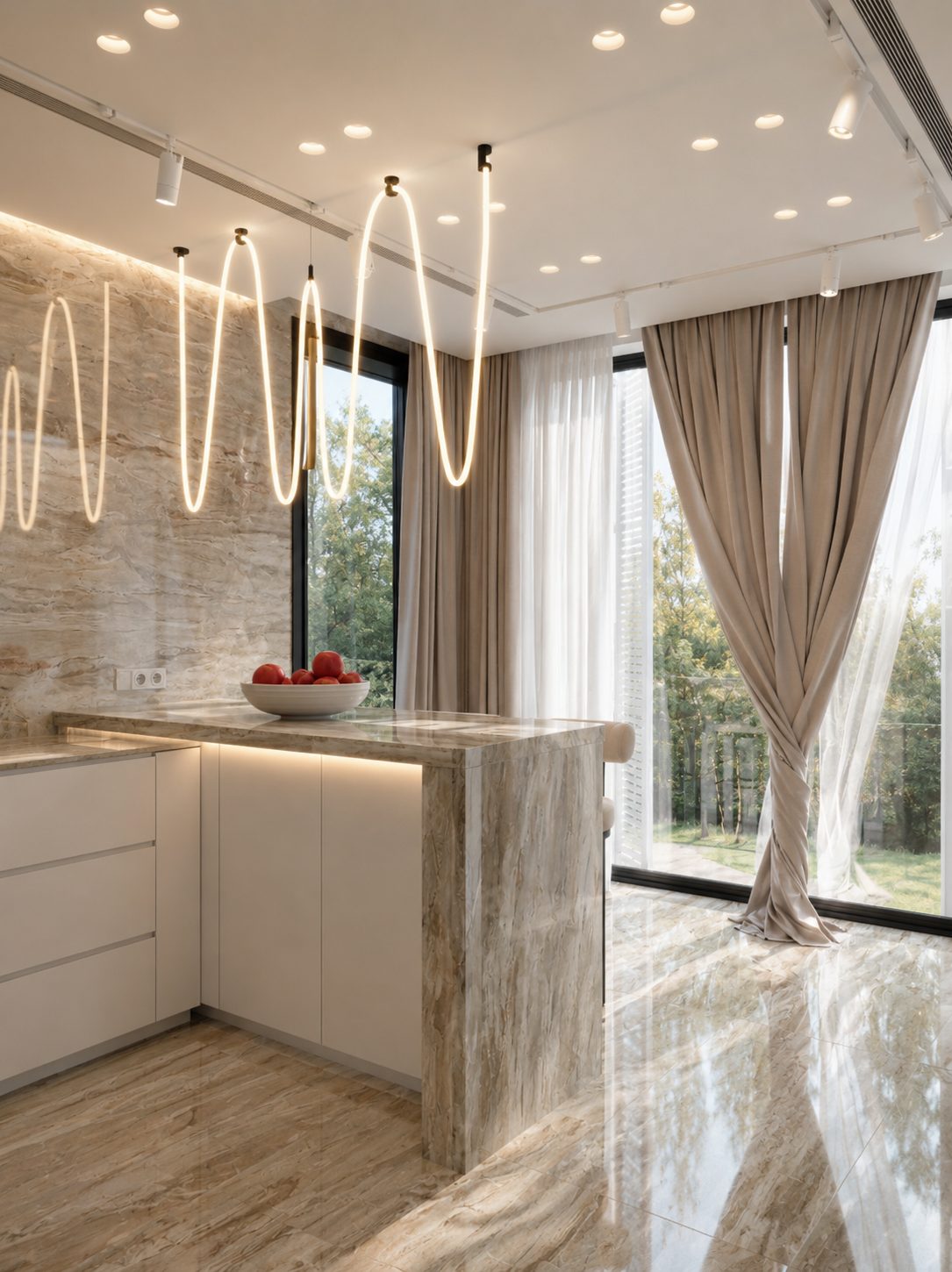
Real room sizes in Dubai, and what physically fits inside them
The rooms we measure fall into a tight pattern.
- Apartment maid's room: commonly 2.0 by 2.6 metres, so 5 to 6 sq m. Larger layouts in Downtown, Dubai Creek Harbour and Bluewaters reach 7 to 9 sq m.
- The en-suite attached to it: around 1.2 by 1.6 metres, with a wall-hung WC, a corner basin and a floor drain instead of a tray.
- Villa maid's room: 9 to 14 sq m for the room alone. In larger five-bedroom villas the whole service corner, room plus en-suite plus laundry recess, runs 20 to 25 sq m.
- Ceiling: often 2.6 metres, with a bulkhead dropping to 2.1 or 2.2 metres where the kitchen extract or the fan coil duct crosses. Measure that before you design tall joinery.
Now the furniture arithmetic, which is where most ideas die quietly. A single bed at 90 by 190 cm leaves a 60 cm walking strip in a 5.2 sq m room and nothing else. A front-loading washing machine is 60 cm wide and 60 to 65 cm deep, and wants another 10 to 15 cm behind it for the hose bend and the inlet valve, so budget 80 cm of depth against that wall. Stack a condenser dryer and you are at 1.8 metres, fine under 2.6 metres and impossible under a bulkhead. A desk at 120 by 60 cm plus chair pull-back needs 1.5 metres of clear depth, and a wardrobe run needs the same: 60 cm of carcass, 90 cm to stand and open a drawer.
Run those numbers against a 2.0 by 2.6 metre room and the answer appears on its own. You get one deep wall of function and one circulation strip. Anything beyond that needs the en-suite absorbed into the room, which is where approvals start.
The door swing matters more than people think. Most of these doors open inward and eat 80 cm of usable floor. Rehanging it outward, or swapping it for a sliding door, costs AED 1,500 to 4,500 and gives back close to half a square metre.
What we look at during the survey, before we quote anything
What decides whether your conversion is a long weekend or a three-month project with a permit file attached is what the survey turns up.
Where the stack is. The soil and waste stack usually sits in the wall shared with the kitchen or the en-suite. Gravity drainage on a 40 to 50 mm waste needs a fall of roughly 1 in 40 to 1 in 60, so every metre away from the stack costs 2 to 2.5 cm of height, and the floor is a structural slab we do not chase deeply. Past three or four metres you are choosing between a raised tiled plinth, which eats headroom, and a macerator pump, which works but adds a mechanical part your tenant will eventually call about.
Whether there is a real extract matters just as much. A grille in the ceiling proves nothing. Sometimes it runs into a shaft with mechanical extract, sometimes it terminates in the corridor ceiling void and just moves damp air sideways. We check it with a tissue against the grille and against the building's as-built MEP drawing. A laundry with no genuine extract in a Dubai summer is a mould claim waiting to be filed.
What the distribution board has left. A washing machine with a heating element pulls 2.0 to 2.2 kW, a condenser dryer 2.5 to 2.7 kW, a heat-pump dryer about 1 kW over twice the run time. Two appliances on one existing 16 A socket circuit will trip under load. We count the spare ways, check the main breaker rating and price a sub-board if the board is full.
What the walls actually are settles the rest. Tap test plus drawing. Blockwork partitions can go with a permit, drywall goes easily, and anything carrying load does not go at all. In apartment towers the wall between the maid's room and the kitchen is structural more often than owners expect.
One more thing we check without being asked. The room sits at the tail of the duct run and gets the least air in the home, so if someone is going to spend the day in there, cooling is a line in the quote rather than a detail.
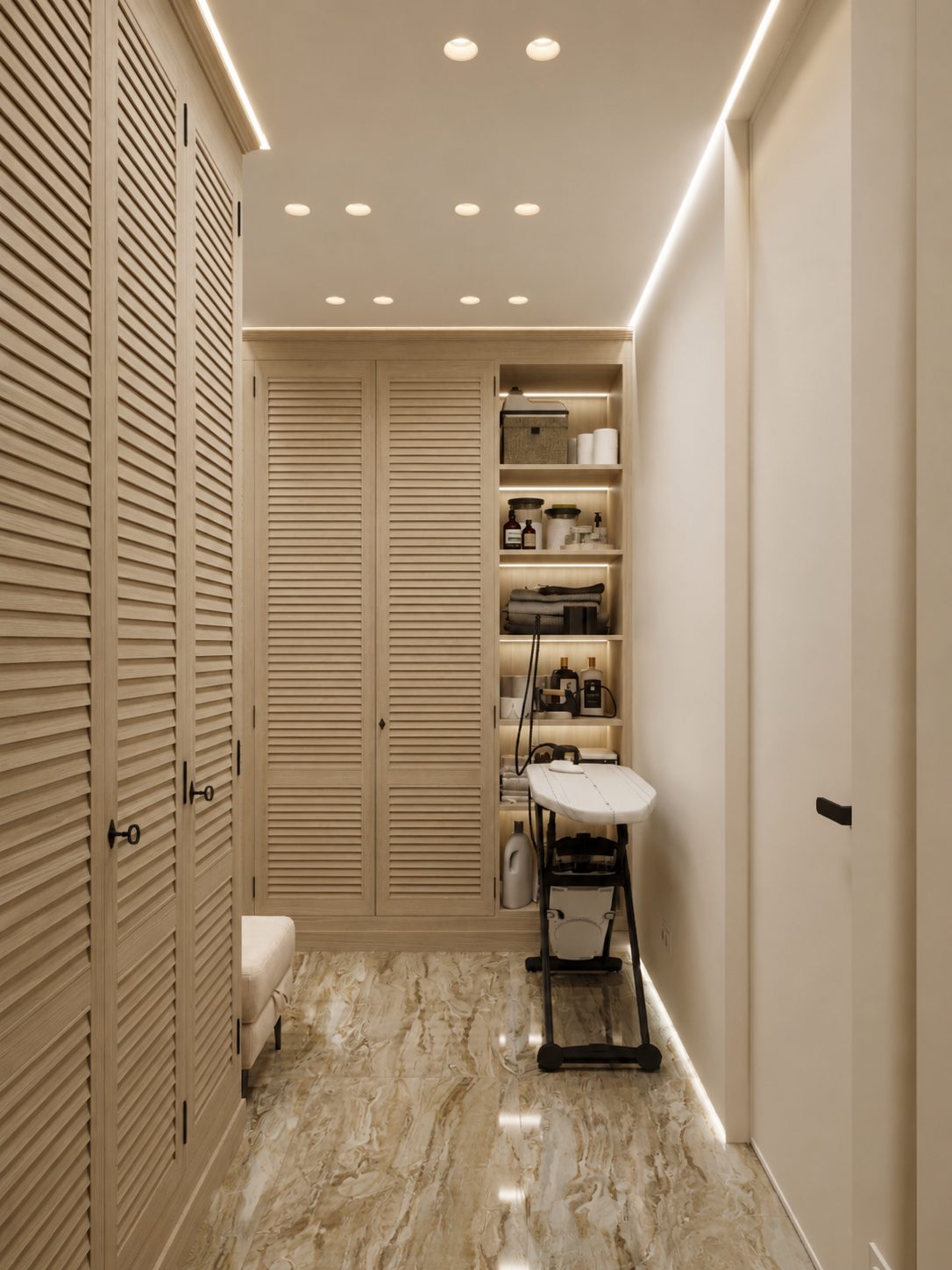
The conversions owners actually ask for, and what each costs
These are our working bands for a room of 5 to 10 sq m, labour and materials included. They move with floor area, linear metres of joinery, front material, and whether a wet point or ventilation is involved. Villa rooms sit at the top of each band or above it.
Storage and a proper utility store
The cheapest useful outcome. Strip the bed and the wardrobe, patch and paint, add open shelving or a single run of simple joinery, and put in lighting you can find things under. AED 8,000 to 18,000 for shelving and a repaint. AED 20,000 to 45,000 if you line the room wall to wall with fitted units.
The joinery is the whole number here. Our bands per linear metre of wardrobe-grade carcass at 2.4 to 2.7 metres high start at AED 2,500 to 4,000 for melamine with generic hardware, which is the right specification for a store. Spending more on a store is money you will not see again.
Walk-in wardrobe
The most popular conversion in apartments, and usually the best value. You are buying six to nine linear metres of joinery, decent lighting, and a way to keep humidity off leather and wool.
AED 25,000 to 60,000 in melamine or sprayed-lacquer specification with Blum or Hettich hardware. AED 70,000 to 110,000 for veneer or high-gloss PU fronts, a full internal fit-out with integrated lighting, and an island. Add AED 3,000 to 8,000 for the lighting circuit, because integrated LED needs a supply planned at first fix rather than a cable draped over the carcass.
Humidity is the detail owners skip. An unventilated wardrobe in a Dubai apartment sits at 60 to 70 per cent relative humidity for months. Either the room keeps an air supply, or you live with a dehumidifier in it.
Laundry
The biggest spread of the six, because it depends entirely on where the water and the drain already are.
AED 12,000 to 30,000 if the en-suite stays and you work off its existing water point and floor drain. That buys a plumbed inlet, a machine plinth, a worktop, overhead storage and an upgraded socket circuit.
AED 30,000 to 70,000 if the en-suite goes and you build a new wet point: supply, waste run to the stack, tanked floor with a membrane and a flood test, tiling, extract and the electrical work. Waterproofing a 5 sq m wet zone properly is AED 800 to 1,100; fixing one that failed under tile is AED 6,500 to 9,500 plus two to three weeks out of use. It is the last line to economise on.
Vibration is the complaint that arrives later. A 1,400 rpm spin on a bare slab transmits straight into the next bedroom, and anti-vibration feet with a 20 mm rubber mat under the plinth cost a few hundred dirhams.
Home office
In an apartment, AED 25,000 to 60,000 buys a converted 6 to 9 sq m room with a dedicated power and data circuit, built-in desk and storage, lighting and a cooling solution. A villa office is a different budget; the arithmetic is in our villa home office guide, where a 20 to 25 sq m maid's room lands at AED 80,000 to 120,000 finished.
Cooling is the line that surprises people. A tap-off from the nearest fan coil unit is AED 4,000 to 9,000 and only works if that unit has spare capacity and the system gets rebalanced afterwards. A separate split is AED 6,000 to 12,000 installed and gives you independent control.
Guest room
Keep the en-suite and refresh both. AED 40,000 to 90,000 for the room plus a small bathroom refit, joinery, lighting and a cooling fix. The bathroom drives the spread: a rental-grade refresh of a tiny en-suite is AED 12,000 to 25,000, while a strip back to slab with new waterproofing and premium fittings passes AED 35,000 comfortably.
Measure the bed against the arithmetic above first. In a 5 sq m apartment room a double bed leaves no floor, so guest rooms work in villas and in the larger apartment layouts only.
Second shower room
Sensible when the en-suite already exists and you are upgrading rather than creating one. AED 15,000 to 35,000 for a proper small shower room inside the existing footprint: new membrane, linear drain, tiling, fittings. Creating a wet point where there was none is a permit project, and its cost sits in the drainage route rather than in the tiles.
Where the wet point draws the line between a weekend and a permit
The rule we use on site is short. If nothing crosses the wall and nothing new connects to a service, it is a fit-out job. If water, drainage, ducting or the distribution board changes, it is a submission.
No government permit is normally needed for repainting, wallpaper, panelling, a new floor finish over sound screed, joinery, and swapping light fittings and sanitaryware on existing points. A walk-in wardrobe and a storage conversion sit inside that list, which is why they are quick.
A permit is needed for removing or moving a partition, anything touching a structural element, relocating drainage, new or altered circuits and board changes, and HVAC modification including relocating a fan coil unit. A laundry with a new drain, an office with a new split, and any conversion that removes the en-suite all land here.
The grey case is the one owners argue about. Plumbing a washing machine into an existing en-suite supply and floor drain, with no new drainage run, is sometimes accepted as maintenance under a building work permit and sometimes not. That answer comes from the owners' association in writing, before the crew arrives.
Approvals a maid's room conversion actually triggers
These gates apply in order, and not all of them apply to every job.
Building management work permit. Almost always required in an apartment tower, even for a repaint, because it governs lift booking, contractor insurance, access passes and working hours. Turnaround is typically 3 to 7 working days against an administration fee set by the building. Most owners learn about it when the security desk turns their crew away.
A developer or community NOC comes next, once you go past cosmetic. Emaar quotes roughly 5 to 10 working days at fees around AED 500 to 3,000; Nakheel quotes 7 to 15 working days at AED 2,000 to 5,000 plus a refundable deposit; a wasl building may charge around AED 545. Treat those as planning bands drawn from published guidance and our recent files, not a price list, and confirm the current figure for your own community. The full picture is in our community NOC guide. One thing stops an application before anyone reads it: service charge arrears on the unit.
Authority permit. Dubai Municipality, DDA or Trakhees, depending on where the property sits. An apartment refit with MEP changes runs 3 to 6 weeks, with fees in the AED 5,000 to 10,000 range once consultant input is counted. Nobody should promise you a date on it. We prepare the pack, lodge it and answer comments, and the review clock belongs to the authority.
Realistic programmes on a frozen design: a wardrobe or storage conversion is 2 to 4 weeks on site with no approval wait; a dry office conversion 3 to 5 weeks; a laundry with a new wet point 4 to 7 weeks on site with 3 to 6 weeks of approvals ahead of it, part of which runs in parallel with joinery lead times of two to three weeks.
What it does to resale and rent, honestly
Nobody in Dubai publishes a defensible percentage for what a maid's room conversion adds to a sale price, and the figures circulating on portal blogs carry no source. We will not invent one. The mechanic is worth describing instead, because we have watched it play out with valuers and buyers.
A valuer works from the title deed and the approved layout. A conversion that stays inside the permitted use, with the paperwork in the file, is neutral to mildly positive: the same permitted rooms, plus a tidy wardrobe or utility instead of an empty box. An unapproved one behaves differently. It surfaces at the buyer's snagging inspection, and the questions start about who moved the drainage, whether the membrane was tested, and what that new circuit is doing on the board. The cost is rarely a fine. It is the price chip the buyer takes, plus the delay while you regularise a file that reviews more slowly than a clean one.
From our own jobs: the conversions people reverse are the ones that removed something the market prices, meaning an en-suite or a room that counted as a bedroom in a villa. Wardrobes and storage almost never get reversed. And on a long lease, an unventilated walk-in wardrobe is worth less to a tenant than a working laundry, at twice the cost.
If you are selling inside two years, keep the scope dry, keep it reversible and keep the paperwork. If you are staying, build what you will use daily and pay for the ventilation.
We survey the room, check the stack, the extract and the board, then come back with a fixed estimate that does not move after signature, plus a penalty on us for each day we run late. Drawings, joinery and site work run under one contract, the way the rest of our interior design and renovation work is set up. Send the approved floor plan and a photo of the distribution board through the contacts page and we will tell you what your room can take.
FAQ
Do I need an NOC to convert a maid's room in Dubai?
For purely cosmetic work, usually not from the master developer, though an apartment building will still want a work permit for lift booking, insurance and access. Once you remove a partition, move drainage, add circuits or alter ducting, you need the developer NOC and then the authority permit. Get any claimed exemption confirmed in writing by the owners' association before your crew arrives.
Can I turn a maid's room into a laundry?
Often yes, and the cost depends on where the drain is. Working off the existing en-suite water point and floor drain, budget AED 12,000 to 30,000. Removing the en-suite and building a new wet point puts you at AED 30,000 to 70,000 with a permit, new waterproofing and a flood test. Check that the room has a genuine mechanical extract first.
How much does a walk-in wardrobe in a maid's room cost?
Our working band is AED 25,000 to 60,000 for six to nine linear metres of joinery in melamine or sprayed-lacquer specification with quality hardware, and AED 70,000 to 110,000 for veneer or high-gloss fronts with a full internal fit-out and integrated lighting. The number moves with linear metres, front material and hardware rather than with floor area. Add AED 3,000 to 8,000 for a dedicated lighting circuit.
What size is a maid's room in a typical Dubai apartment?
Commonly 2.0 by 2.6 metres, so 5 to 6 sq m, with an en-suite under 2 sq m. Larger apartment layouts reach 7 to 9 sq m, and villa maid's rooms run 9 to 14 sq m. Check the ceiling as well as the floor, because a bulkhead carrying the kitchen extract often drops the usable height to 2.1 or 2.2 metres along one wall.
Does converting the maid's room affect the property's value?
The Dubai market publishes no reliable figure for this, so treat any percentage you read with suspicion. What we see is that an approved, documented conversion is neutral to mildly positive at valuation, while an undocumented one that moved drainage or removed a bathroom becomes a price negotiation at the buyer's inspection. Keeping the work inside the permitted use is worth more than the finish level.
Can I do the work without a contractor?
For painting, shelving and loose furniture, yes. Beyond that, no, because the application is lodged against a licensed contractor's registration number and the trade licence activity has to cover the scope. An interior decoration licence does not cover electromechanical work, and reviewers check that line. Starting without the permit risks a stop-work order, a forfeited deposit and a regularisation file that takes longer than the original approval.