
TL;DR: A Palm Jumeirah villa renovation runs 30 to 50 per cent above the same job in a baseline community, so mid-range work lands around AED 455 to 900 per square foot. Nakheel controls the facade, the permit goes to Trakhees rather than Dubai Municipality, and marine-grade specification plus agreed delivery windows decide whether the programme holds.
What a Palm villa renovation costs, and where the premium comes from
Our baseline villa figures, set out in the Dubai villa renovation cost breakdown, are AED 150 to 300 per square foot for cosmetic work, AED 350 to 600 for a full mid-range refit, and AED 600 to 1,200 for luxury. Those are Dubai-wide. The Palm carries a 30 to 50 per cent premium over a baseline community, and the honest way to price a frond villa is to apply that premium to real rates rather than invent a separate Palm price list.
Applying the premium to our own base rates
- Cosmetic refresh: AED 195 to 450 per square foot
- Full mid-range refit: AED 455 to 900 per square foot
- Luxury transformation: AED 780 to 1,800 per square foot
Whole-project, the same arithmetic on our five-bedroom-plus band gives roughly AED 520,000 to 2.25 million for a turnkey renovation, and AED 1.04 to 3 million for a luxury transformation. Both figures exclude VAT and contingency, which we come back to below.
Villa types, and what the footprint does to the number
Garden Homes sit around 5,000 to 6,000 square feet. Signature Villas run to roughly 7,000. Multiply 5,500 square feet by the mid-range Palm rate and you get AED 2.5 to 4.95 million, which sits well above the whole-project band in the paragraph above.
Both numbers are right, and the gap between them is worth understanding before you read anyone's quote. The per-square-foot rate applies to the area you actually rework. Almost nobody takes an entire Garden Home envelope to full mid-range specification under one contract. Owners rework the ground floor and the wet areas, leave three bedrooms alone, and come back to the rest later. A quote that multiplies your title deed area by a headline rate is describing a project you probably did not ask for.
Four things drive the premium, and none of them is postcode markup. Marine-grade specification on everything exposed. An approval route with more steps and a geotechnical requirement on structural work. Delivery access that has to be booked rather than assumed. And a community finish baseline that starts where other areas top out, which shows up in stone, joinery and glazing rather than in labour.
The approval line, in short
Nakheel issues the community NOC first, and the government permit then goes to Trakhees under the Ports, Customs and Free Zone Corporation, not to Dubai Municipality. Nakheel quotes 7 to 15 working days, which is 2 to 4 calendar weeks in practice. Administration commonly runs AED 2,000 to 5,000, and Nakheel holds a refundable deposit of AED 5,000 to 20,000, released roughly 30 to 60 days after the completion inspection. Across the whole project, permits and NOC together land at AED 8,000 to 30,000. A consultant for approval work runs AED 4,000 to 15,000, and a Palm villa with a geotechnical report sits at the top of that band before the report itself is paid for.
The full procedure, the document pack and the six reasons files come back are covered in our guide to Emaar and Nakheel community NOC timelines, so this article stays on the villa rather than repeating the paperwork.
Two lines every Palm budget needs on top of the build cost: 5 per cent VAT on the full contract value, and 10 to 15 per cent contingency held by you, not by the contractor. What that reserve is genuinely for is broken down in our note on hidden renovation costs and contingency. Starting without approval is the one shortcut that costs more than the reserve: a stop-work order lands on the villa, the deposit goes, and fines start around AED 10,000 with market reports reaching AED 50,000 depending on the breach.
What Nakheel polices on the outside of the villa
Interiors are the easy part. The Palm's review is heaviest on anything visible from the street, from the beach or from the water, and refusals cluster there rather than in structural calculations.
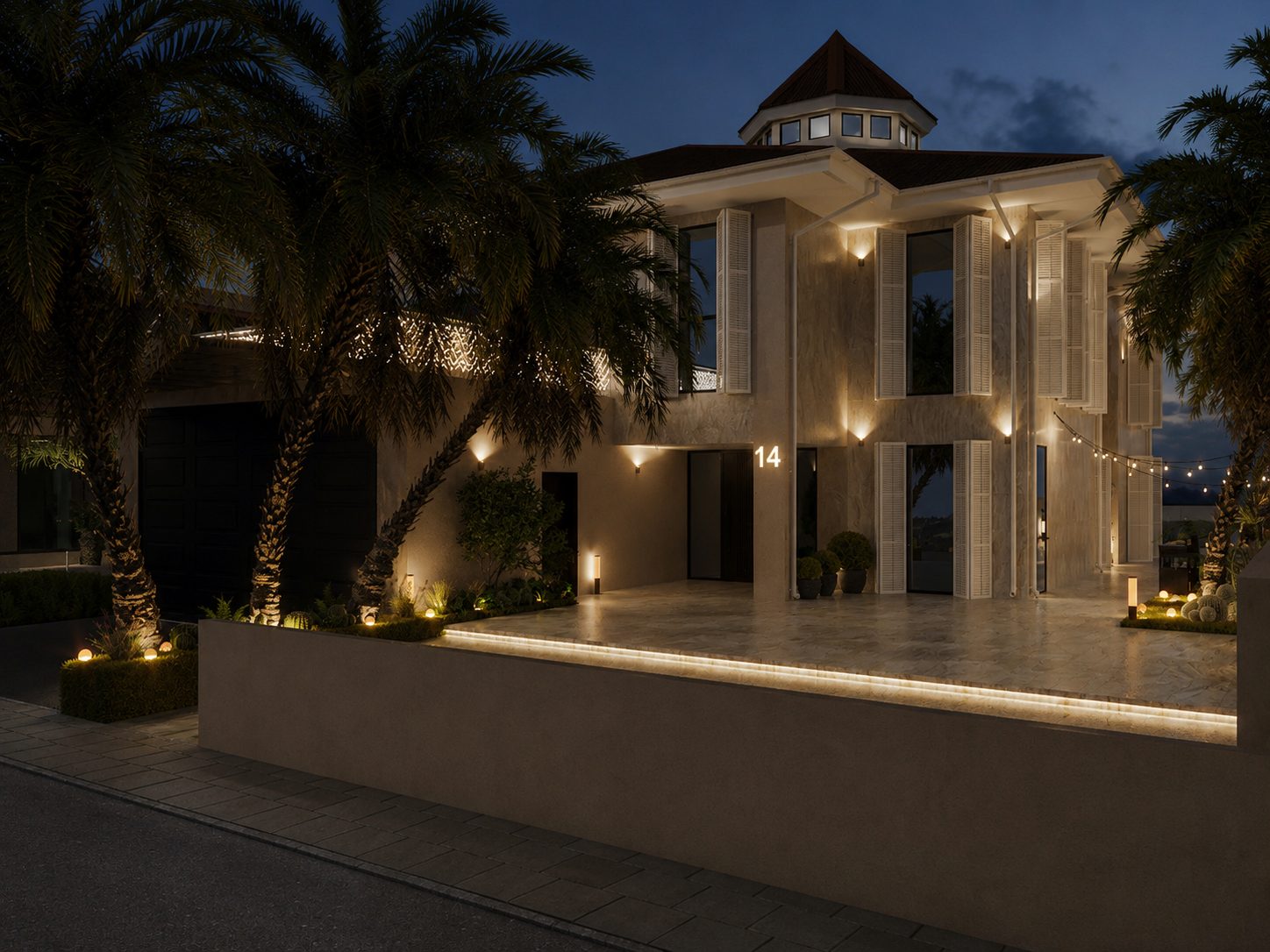
External colour comes from the approved community palette, and the palette covers more than wall paint. Window frames, pergola timber tone, the gate, the boundary wall and any external plant enclosure are all read against it. Bright tile cladding is the classic rejection: an owner comes back from a trip with a facade idea, and the elevation drawing gets a comment within days. Large areas of coloured or mirrored glass sit in the same category, because they change how the villa reads from the frond road and from the neighbouring plot.
Height is the other line. Nakheel treats the roof parapet as the top of the visible envelope, and additions that break it draw comments. Roof pergolas, raised terrace decks and roof-level rooms are the usual candidates. Rules are revised and vary by sub-community, so confirm the current wording for your specific frond before you draw anything at roof level, and get it in writing.
Condenser positions, satellite dishes and any external plant are checked for visibility. Boundary wall and gate heights are measured against the community standard rather than eyeballed. On a job we ran in another community, a gate 200mm over standard cost a drawing revision and a week.
The practical order of work: put the proposed elevation in front of the community before you commission joinery, order cladding or pay a deposit on external glazing. A facade comment at drawing stage is a revision. The same comment after a container of stone has landed is a write-off.
Salt air decides what survives the second year
A frond villa sits in a chloride environment on three sides. Hardware specified the way you would specify it for an inland villa starts pitting inside the first year, and by year two you are replacing ironmongery in a house that was finished new. The cause traces back to a specification decision made months earlier, not to anything a maintenance crew could have caught.
What has to be marine-grade rather than standard:
- Hinges, handles, locks and door furniture on any external or semi-external opening. Grade 316 stainless rather than 304, or solid brass and bronze. Zinc-plated and galvanised fixings fail fastest and are the cheapest line in the quote.
- Balustrade fixings, gate motors, external light fittings and pool ladders. Anything with a moving part near spray.
- Powder-coated aluminium, which needs marine-grade pretreatment before coating. The pretreatment underneath does the actual protecting, and the visible coating on its own will not stop corrosion.
- External joinery and doors. A stable hardwood or thermally modified timber holds. An MDF-cored door in a semi-exposed position swells and delaminates.
- Concrete cover to reinforcement in exposed elements. Chloride reaches rebar through thin cover, and the repair is structural rather than cosmetic.
- Condenser units and their coils, which corrode faster on the Palm than anywhere inland in Dubai.
The cost sits almost entirely in the hardware and coatings lines, and it is a small proportion of a villa budget. Skipping it does not save money, it defers a bill that arrives with scaffolding attached. Any contractor quoting a Palm villa without a marine-grade line in the specification has either not worked on a frond or is competing on a number they intend to revise later.
The pool, the waterproofing and the seawall
Enlarging or rebuilding a pool on the Palm is a structural job on reclaimed ground, which is exactly the trigger for the geotechnical report that most often adds a month to a Palm programme. Budget the report as a separate specialist appointment with its own lead time, and start it early rather than after the design freeze.
Waterproofing carries more load here than in an inland villa. The water table near the shoreline is high, tanking has to resist hydrostatic pressure from outside as well as water from inside, and terrace and roof detailing is working against wind-driven salt spray on top of summer rain. Failed terrace waterproofing under stone is one of the most expensive remediations we see on older Palm villas, because the stone comes up before anything can be fixed.
Plant rooms corrode. Salt-chlorinated pool systems are harder on pumps, valves and electrical enclosures than a standard chlorine setup, so the enclosure rating and the metalwork in the plant room deserve the same marine attention as the front door hinges.
The seawall and shoreline revetment are a separate matter entirely. They are community infrastructure, not part of your plot to modify, and anything touching them runs as its own approval track through Nakheel. Owners occasionally plan a terrace extension or a beach step detail on the assumption that the boundary of their title is the boundary of their permission. It is not, and finding out mid-project stops a programme.
One spine road, and the schedule that actually breaks
The Palm has one spine road, gated fronds and security that logs every vehicle. Material deliveries get scheduled windows, and a lorry that arrives unannounced gets turned around at the barrier with a full load.
We rebuilt a 6BR-plus villa of 375 square metres, roughly 4,000 square feet, on the Palm over 13 months: envelope extended, pool enlarged, window openings opened out to full-height glazing, with approvals, structure, MEP, facade, finishing and landscaping under one contract. The record is on our Palm Jumeirah villa project page. Thirteen months for that floor area reads long until you count the approval window, the geotechnical requirement, marine-spec lead times and the delivery calendar.
The difference between a Palm programme that runs and one that stalls sits almost entirely in the delivery schedule agreed with community security before mobilisation, rather than in the size or speed of the crew. Two more constraints belong in the same calendar. Between 15 June and 15 September, outdoor work stops from 12:30 to 15:00 under the UAE midday break rules. Communities also restrict noisy work to weekday daytime hours, and the people who enforce that are the people who sign your final deposit clearance.
On deposit protection, we do the same thing on every Palm job: photograph the common areas, the frond kerbs and the access route with a timestamp before the first delivery arrives, and send the set to the community manager the same day. It has settled disputes for us outright, and it costs nothing.
Our estimate is fixed in the contract and does not move after signature, we carry a daily penalty for our own delay, and the work is covered by a one-year guarantee. If you want a Palm villa scoped against your own frond, community rules and finish level before you freeze a design, get in touch.
FAQ
How much does it cost to renovate a villa on Palm Jumeirah?
Apply a 30 to 50 per cent premium to baseline Dubai villa rates. That gives roughly AED 195 to 450 per square foot for cosmetic work, AED 455 to 900 for a mid-range refit and AED 780 to 1,800 for luxury. A large villa turnkey lands around AED 520,000 to 2.25 million, before 5 per cent VAT and a 10 to 15 per cent contingency.
Does a Palm Jumeirah renovation go through Dubai Municipality?
No. Palm Jumeirah sits under Trakhees, the regulatory arm of the Ports, Customs and Free Zone Corporation, so the permit is a CED file lodged after the Nakheel NOC. Structural work also attracts a geotechnical report because the fronds are reclaimed land, and that report carries its own lead time.
What does Nakheel refuse most often on a Palm villa?
External appearance. Colour outside the approved community palette, bright tile cladding, large areas of coloured or mirrored glass, structures breaking the roof parapet line, visible condenser positions and boundary or gate heights over the community standard. Most refusals are fixed with a drawing revision rather than a redesign, provided the comment is answered rather than argued.
Why does salt air change the specification and the budget?
Standard hardware corrodes on a frond within the first year or two, so hinges, ironmongery, gate motors, balustrade fixings, external light fittings, coatings and external joinery all need marine-grade specification. The added cost sits in a small part of the budget. Replacing failed external hardware across a finished villa costs several times more.
How much is the Nakheel deposit and when does it come back?
Nakheel holds a refundable security deposit of AED 5,000 to 20,000 depending on scope, alongside an administration fee of AED 2,000 to 5,000. The deposit is released after a completion inspection confirms the work matches the approved NOC, typically 30 to 60 days later, and it is refunded to the account that paid it.