
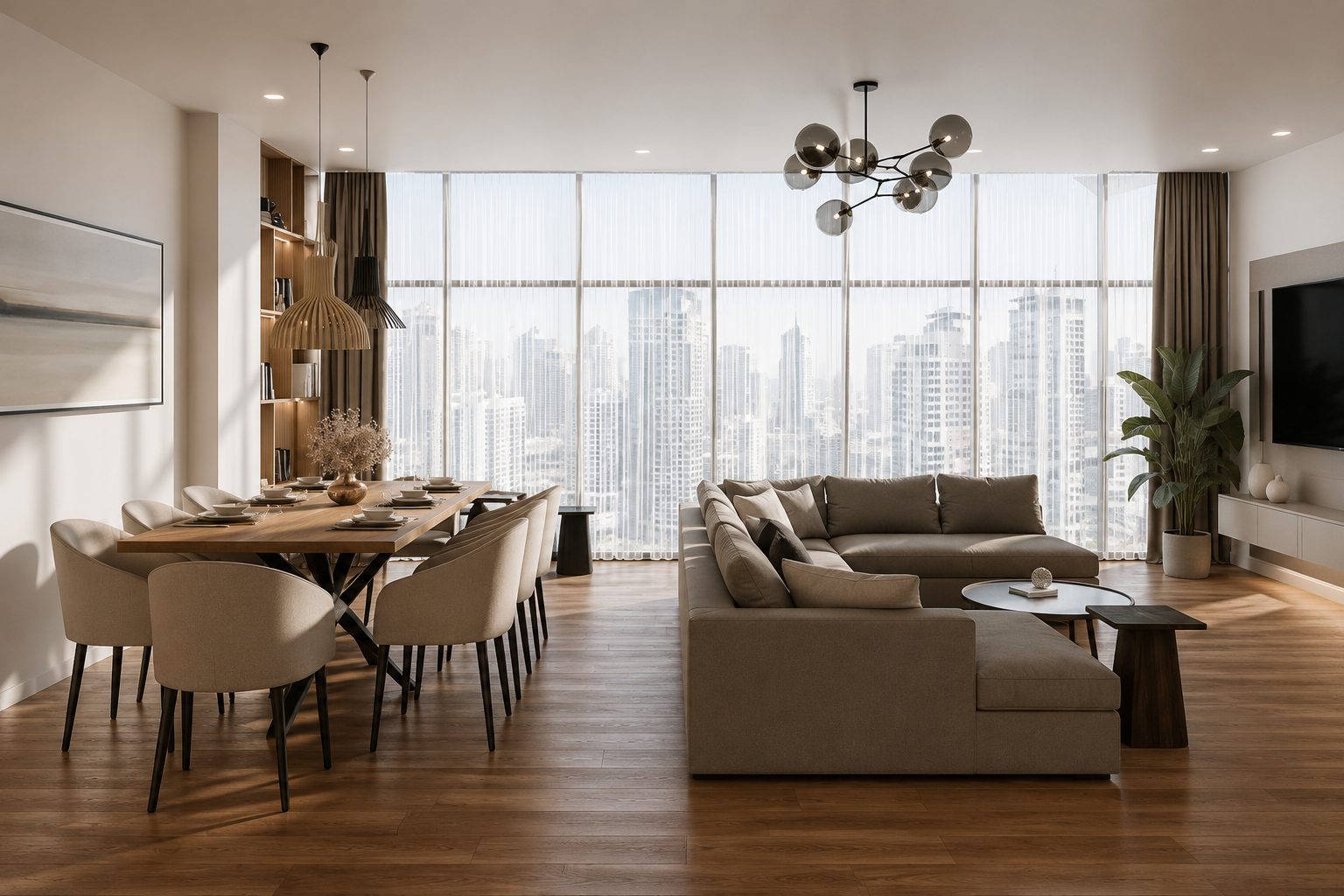
TL;DR: Interior design services in Dubai run through seven phases: brief and measured survey, concept and mood board, 3D renders, technical drawings, FF&E procurement, site supervision and snagging. Each phase has a physical deliverable. Design fees sit in the AED 200 to 1,000 per square metre band, and building work, materials, permits and shipping sit outside that number.
What interior design services in Dubai cover, phase by phase
A design contract buys drawings, decisions and someone to defend both on site. It does not buy the flat being built. That distinction is the single most common reason owners feel short-changed halfway through, so it is worth setting the phases out with the deliverable attached to each one.
- Brief and measured survey: a written design brief plus an as-built drawing set of what is actually there. Three days to two weeks.
- Concept design and mood board: layout options, palette, materials direction, indicative furniture references. One to two weeks plus a revision round.
- 3D visualisation: still renders of the key rooms from agreed camera angles. One to two weeks after concept sign-off.
- Technical drawings: the buildable set, from demolition plan through reflected ceiling plan to joinery details. Three to six weeks for an apartment, longer for a villa.
- FF&E specification and procurement: a schedule with supplier, model, price and lead time, then purchase orders if you hand that job over.
- Site supervision: scheduled visits, written site reports, answers to contractor queries, material approvals.
- Handover and snagging: a snag list, re-inspection, and the closing document set.
End to end, an apartment package runs eight to sixteen weeks of design time before anyone lifts a hammer. A villa runs twelve to twenty-four weeks, and more if the layout changes structurally or the community demands a full submission. Our own design package starts at AED 10,000 and lands in three to six weeks for a straightforward apartment scope.

Brief, measured survey and space planning
The survey is the phase people try to skip, and it is the one that saves the most money. Developer drawings in Dubai are handover documents, not as-built records. Walls in real Dubai apartments routinely sit tens of millimetres off the developer drawing, and a discrepancy that size is enough to swallow a wardrobe module if anyone orders joinery straight off the developer PDF instead of the survey.
What you receive at the end: a signed brief listing rooms, users, storage counts, appliance list and budget band; a dimensioned as-built plan with ceiling heights, slab drops, AC duct routes, riser positions and the DEWA meter location; and two or three space planning options with the trade-offs written next to each.
What is not in it: any opinion on whether you can remove a wall. Block and concrete walls need a licensed structural consultant, and no designer should give you that answer verbally. A cost plan is not in it either at this stage, because there is nothing specified yet to price.
Concept design and the mood board
The mood board sets direction, not specification. You get a board per room, a material and colour palette, reference images for furniture types, and usually a physical sample box with the two or three finishes that will drive the rest of the scheme. One to two weeks, with revision rounds capped in the contract at two in most agreements.
The trap here is treating a reference image as an order. Half the furniture pinned to a Dubai mood board is either discontinued, sold only in Europe with a fourteen-week lead time, or three times the budget line. Ask the designer to mark every reference as available locally, orderable, or indicative only. That one column prevents an argument later.
Visualisation and what a render does not promise
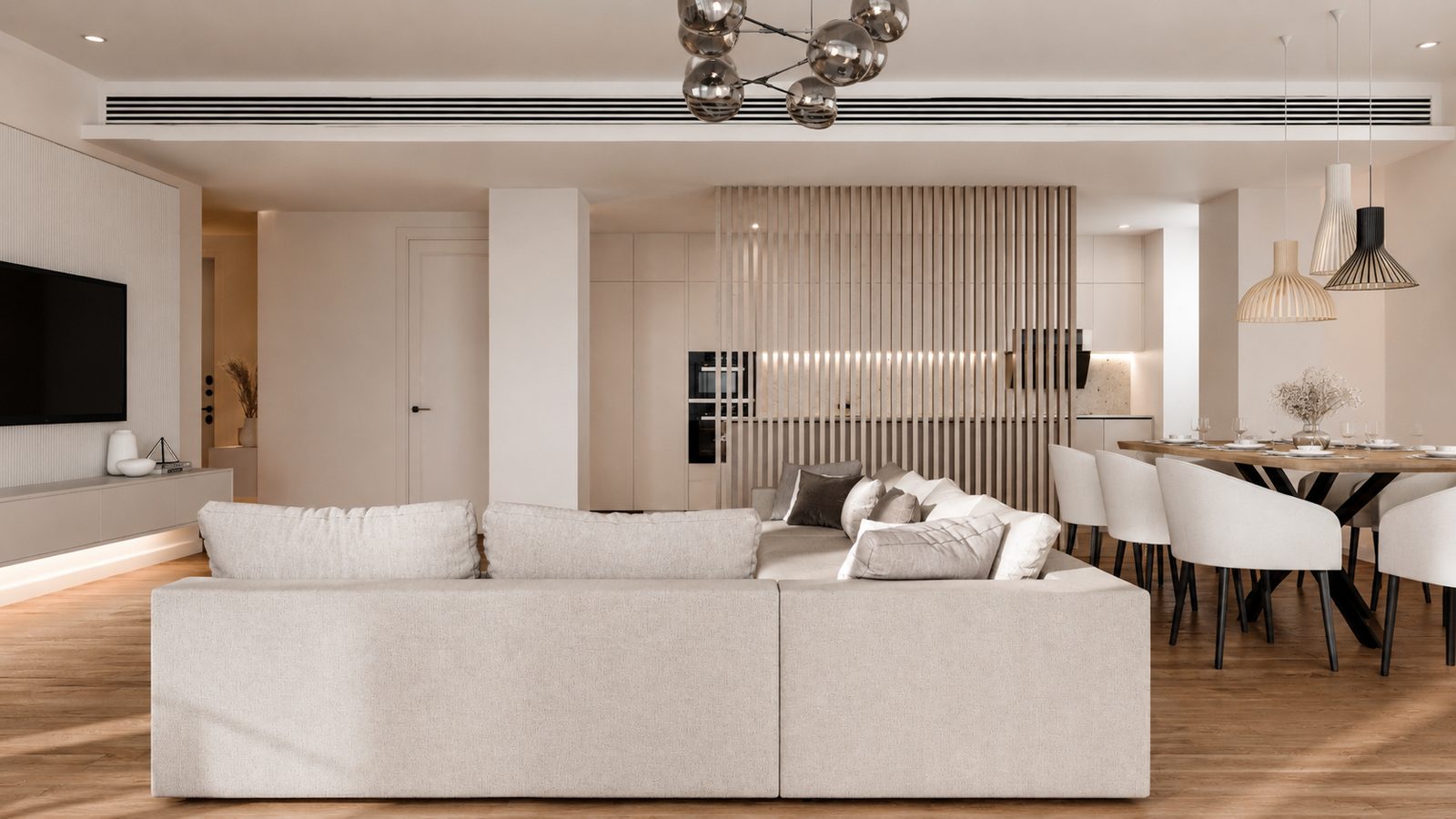
A render is a sales tool and an approval tool. You get still images of the main rooms from agreed angles, usually two or three per room, at a resolution you can print. Animation or a walkthrough is a separate line item almost everywhere, and it deserves to be, because the render time triples.
What a render does not do: it does not specify anything. The lighting is idealised, the marble veining is a texture map rather than the slab you will be sold, and the sofa in the image is often a generic model standing in for a product nobody has priced. Approving renders without the parallel FF&E schedule is how an owner ends up with a different sofa and a genuine belief that they were misled. Approve the render and the schedule together, or approve neither.
Technical drawings: the set that actually gets built
This is where the fee earns itself, and it is the phase clients understand least because the drawings are dull to look at. A complete apartment set in Dubai typically contains:
- Demolition and setting-out plan.
- Partition and blockwork plan with wall thicknesses.
- Flooring layout with the tile setting-out point marked, so cut tiles land in the corners rather than in the doorway.
- Reflected ceiling plan with gypsum levels, curtain pockets, access hatches and cornice sections.
- Lighting layout with circuits and switching, including which switch controls what.
- Socket, data and switch layout with heights dimensioned from finished floor level.
- MEP coordination layout showing grille positions, drainage points and AC access requirements.
- Wet-area waterproofing details and floor falls.
- Joinery details at 1:10 and 1:5 with hardware named.
- Developed wall elevations for every wet room and every joinery wall.
- Door, ironmongery and FF&E schedules with model numbers and lead times.
What sits outside this package: the contractor's own shop drawings, which are produced from your set and returned for approval; structural calculations; and the stamped MEP submission a permit requires, which normally comes from the contractor's licensed engineering consultant rather than the interior designer.
If you are reviewing a fee proposal, count the drawings promised. A package listing eight sheets for a three-bedroom villa is a concept package wearing a technical label.
Procurement, and who carries the risk on a delivery
Procurement runs in one of two shapes. Either the designer buys on your behalf, against your money, for a management fee or a declared markup in the 10 to 20 per cent range, or you buy directly against their specification and they simply chase the lead times. Both are legitimate. Only one of them is transparent by default, and it is the one where the markup is written down.
Planning numbers that hold up in Dubai: locally stocked furniture and sanitaryware move in two to four weeks, European orders run ten to sixteen weeks door to door, and custom joinery needs six to ten weeks from the day the shop drawing is signed, not from the day you chose the veneer. Shipping, storage and site delivery access sit outside the design fee in every contract we have seen.
The recurring failure is ordering joinery before the blockwork is built and surveyed. Order early, and someone is planing 20 millimetres off a wardrobe carcass at 11pm on handover week.
Site supervision: what it actually buys
Supervision is scheduled attendance with a written record. On a typical apartment that means a weekly visit, a photo report with open items numbered, written answers to contractor queries, on-site approval of material samples, and a check of the tile setting-out before the adhesive goes down. Where designers charge for this separately, the hourly band across the market runs AED 200 to 800.
It is not project management, it is not quantity surveying, and it is not daily presence. A supervising designer under a design-only contract has no authority to direct the contractor's men. They can reject work against the drawings and write it down. That is the whole power, and it is enough when the contract says the contractor must respond to written rejections.
Where the designer stops and the contractor starts
Say this out loud at contract stage and the project gets calmer. The designer sells drawings, decisions and defence of those decisions. The contractor sells labour, materials and a warranty on the finished works.
- Materials bought and installed by the contractor: any defect in the material is the contractor's to replace inside the defects liability period. One year on workmanship is the market norm in Dubai, and it is what we give.
- Materials free-issued by you, say a marble slab you sourced yourself: the risk of cracking, colour mismatch or short supply is yours. Most contractors will install it and warrant only their fixing.
- Errors in the drawings, such as a door swinging into a column or a socket ending up behind a fitted wardrobe: the designer's problem, and a good one will pay to correct it.
- Shop drawings: whoever signs the shop drawing owns what it shows. If the designer approves a joinery drawing with the wrong internal division, that is not the joiner's fault.
- Money mechanics: an advance of 15 to 20 per cent is normal, anything above 30 per cent is a signal to slow down, and 5 to 10 per cent retention held until the end of the defects period is standard practice.
If you would rather not manage this boundary at all, the alternative is putting design and construction under a single contract, which moves the argument inside one company instead of between two.
Approvals: municipality permits, community NOC and who files what
The designer produces the drawing set. A contractor holding the right trade licence submits the permit. You sign the authorisation and supply the paperwork: title deed, Ejari where relevant, passport copy and a service charge clearance from the management company. No designer can file a fit-out permit in their own name without the licensed contracting entity behind it.
Jurisdiction depends on where the property sits. Most of mainland and freehold Dubai goes to Dubai Municipality. Palm Jumeirah and other Nakheel master areas go through Trakhees. Dubai Design District and TECOM clusters go to the Dubai Development Authority. DIFC runs its own building control, separate from DDA. JLT goes through DMCC.
Before any of that, the community wants its own approval. Emaar communities typically return an NOC in five to ten working days, Nakheel in seven to fifteen, Meraas in ten to fifteen. Add the fit-out deposit, the contractor insurance documents and the working-hours undertaking, and the approvals stage realistically adds two to six weeks before demolition starts. Plan around the summer midday break as well, which runs 15 June to 15 September between 12:30 and 15:00 and stops outdoor work and deliveries across the city, even though indoor trades keep going.
What the designer usually does not do: pay your deposit, sign the undertaking on your behalf, or phone the facilities manager every morning. Ask who is doing that chasing, and write the name into the contract.
Design only against design and execution
Under a design-only agreement you receive the full package and then tender it to three contractors. You keep price transparency and you keep the coordination work. Fees run roughly AED 200 to 1,000 or more per square metre depending on the studio, or as a fixed sum from about AED 10,000 for a studio up to AED 250,000 or more for a villa. The full breakdown by model, unit size and percentage-of-budget deals lives in our guide to how design fees are structured and what each model covers.
Under design and execution the scope widens: the same team draws it, permits it, builds it and hands it over on one number. Our turnkey range with furniture, appliances and decor is AED 8,500 to 16,000 per square metre. Cosmetic work starts at AED 1,500 per square metre and capital renovation at AED 3,000. The quote is fixed by contract, there are no top-ups after the start date, and we pay a percentage for every day of delay we cause.
One honest note against our own interests. If the flat is going into the rental market, a full design package plus turnkey execution rarely returns the difference. A cosmetic refresh with a tight specification and no bespoke joinery usually returns more per dirham spent, and any designer who tells you otherwise for a two-bedroom in a mid-market tower is selling. For an owner-occupied villa the maths flips completely, because you live inside the decisions for a decade. If you want a scope and a number for either case, send us the floor plan and the address and we will tell you which one your project actually is.
FAQ
What do interior design services in Dubai usually include?
A standard package covers brief and measured survey, concept design with mood boards, 3D renders of the main rooms, a full technical drawing set, an FF&E specification, and site supervision through construction. Procurement is sometimes bundled and sometimes charged separately. Building work, materials, permit fees and shipping are almost never inside the design fee.
How long do interior design services in Dubai take before construction starts?
Eight to sixteen weeks of design time for an apartment and twelve to twenty-four or more for a villa, measured from signed brief to issued technical set. Add two to six weeks for the community NOC and the authority permit. Our own design package runs three to six weeks for a standard apartment scope.
Do I need a designer if I already have a good contractor?
For a straight refresh, repaint, new flooring and the same layout, no. A specification and a finishes schedule will do, and the contractor can build from that. You need a designer when the layout moves, when joinery is bespoke, or when the ceiling, lighting and electrical positions all have to be coordinated before block walls go up.
Who applies for the permit and the community NOC, the designer or me?
The licensed contractor submits the permit using the designer's drawing set. You sign the authorisation and provide the title deed, passport copy and service charge clearance. The community NOC is normally lodged by the contractor too, but the management company deals with the owner, so expect to be in that email chain yourself.
Can construction start once the 3D renders are approved?
No. Renders show intent, not dimensions, circuits or falls. Nothing can be priced accurately or built correctly until the technical set and the FF&E schedule exist. Contractors who agree to start from renders alone are pricing on assumptions, and the variation orders arrive later.