
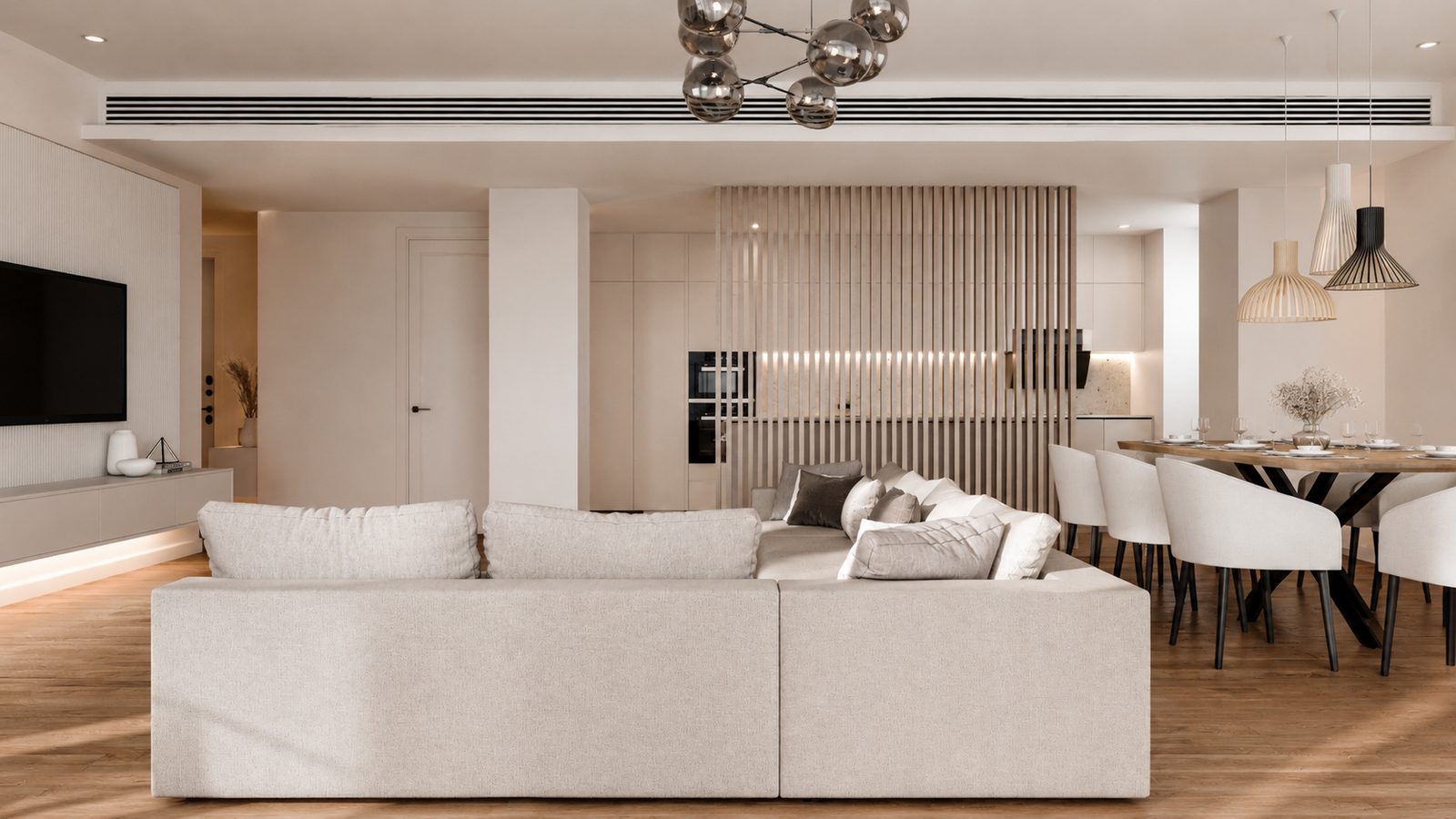
TL;DR: Modern Arabic interior design in Dubai works through geometry, light and wall mass rather than gold leaf. Market bands: mashrabiya AED 150 to 300 per m² in MDF and AED 400 to 1,500 in solid timber, a premium majlis of 40 to 60 m² at AED 150,000 to 300,000, and AED 250 to 600 per square foot. Joinery and screens are the long leads.
What separates modern Arabic interior design from the palace look
The palace version of an Arab house interior is additive. Gold on a classical cornice, crystal over a carved table, marble on every surface, ornament sitting on a flat wall like jewellery on a plain dress. It photographs well on handover day and dates quickly.
The modern version works the other way round. Ornament lives in the wall itself: the depth of a reveal, the profile of an arch, the shadow a screen throws across the floor at four in the afternoon. Colour comes out of the materials rather than the paint tin, so the palette settles into plaster, limestone, oak, unlacquered brass and one rug with a strong tone in it.
Wall mass is the part owners underestimate. A window that reads as a deep niche needs either real blockwork, which brings weight, a permit and a week of wet trades, or a built-up gypsum lining, which eats floor area and carries nothing. On a villa in The Meadows we inherited a deep gypsum reveal with no timber noggin in it, so the curtain track had to hang off the ceiling. That belongs on the drawings, not on the installer in week nine.
Geometry reads as design only when it stays consistent: one arch profile, one lattice pattern, one stone family through the public rooms. Repetition is also the cheaper way to buy the style, because a repeated pattern means one CNC programme and one mould instead of five.
Mashrabiya screens: material, pitch and depth set the price
A mashrabiya was a shading and privacy device long before it was a mood-board item: turned timber over an opening, dense enough to break the sun and open enough to see out from inside. Most of what goes in now is CNC-cut flat panel, and the price moves on material, pitch and depth.
Lacquered MDF runs around AED 150 to 300 per m² as a Dubai market band, solid timber around AED 400 to 1,500. Laser-cut aluminium or steel sits outside both and is quoted per panel, because sheet thickness and finish drive it more than area does. Metal is the route for anything exposed to weather or carrying a fire requirement.
Pitch is the variable nobody asks about, and it moves money more than the species does. Ask for the same panel with twice as many openings and the cutting path roughly doubles; fabricators here sell machine time, so one timber in two patterns can land at opposite ends of the AED 400 to 1,500 band. When the budget is fixed, change the pattern before you change the wood.
Depth decides whether you have a screen or a picture of one. A thin flat panel gives pattern and almost no shading, because low sun goes straight through it. A deep lattice, built up in layers or machined from thicker stock, blocks the afternoon west sun, and it costs more in material, in assembly and in the sub-frame behind it.
Where a screen earns its keep:
- West and south-west glazing, set inside the reveal, where it cuts glare without killing the view
- A stair void or double-height wall, where the pattern moves across the floor through the day
- Balcony privacy between neighbouring villas, instead of a permanently closed curtain
- The line between a majlis and family circulation, where light should pass and sight lines should not
- Over an AC return, a riser door or a meter cupboard, where the panel has to come off cleanly
Everywhere else it is decoration, and decoration nobody walks through does not need solid walnut.
Fixing is the boring part and it is where screens fail. The panel goes on a sub-frame of battens or aluminium with a shadow gap, never face-screwed through the pattern, and anything with a serviceable item behind it comes off without a tool mark. Screens hinged or sliding over glazing need heavier ironmongery and swing clearance.
Then there is dust. A deep lattice on a dead wall collects fine sand, housekeeping vacuums what a brush head reaches and leaves the rest; lacquered faces wipe clean, open-grain oiled timber holds dust in the pores. Solid wood also moves between an air-conditioned room and an open terrace, and outdoors UV plus summer heat opens glued joints within a couple of seasons.
Arches, cornices and cast gypsum
A decorative arch is a gypsum job. A stud frame goes inside the existing opening, thin board is kerfed or laminated in two layers over the curve, and the result is jointed and skimmed into the wall. It carries nothing, which is why it can be drawn and built inside a week.
Radius is where taste meets head height. A true semicircular head over a wide opening pushes the crown high and swallows the clear height above the door; a segmental arch, or a tighter radius at the springing, keeps the door height and still reads as an arch. We set the profile out full size on the wall in pencil before anyone cuts board, because an arch that existed only on a 1:50 plan arrives looking squat.
Arches are symmetrical and the eye checks them instantly, so when the opening is out of plumb the two springings land at different heights and the whole thing looks drunk. Feathering plaster over that does not cure it; the cure is a new lining built to a level datum, which is a line in the quote. That is why we measure openings during the survey rather than trusting as-built drawings.
Mouldings split into run work and cast work. A simple gypsum cornice profile runs about AED 15 to 25 per linear metre supplied and fixed, a complex profile about AED 30 to 60. Corbels and one-off heads are cast in a mould, so ten identical corbels cost far less each than one does. A cove with concealed lighting is a different line altogether, priced with the ceiling rather than the moulding, and those bands sit in our piece on gypsum ceilings and cornice work.
Large forms arrive cast rather than site-built: deep arch heads, domes and heavy ornament come as glass-reinforced gypsum, with GRC where the element goes outside. Those pieces carry real weight, so they need brackets back to the structure and a check that the structure accepts them.
The hard boundary is the opening itself. Widening a doorway, cutting through between a majlis and a hall, taking out a wall to make the room work: none of that is decoration. It needs a consultant's assessment, stamped drawings and a permit before a hammer comes out, and in an apartment tower shear walls and columns are not on the table at all. We moved an arch position on a Palm Jumeirah villa for that reason, because the wall behind the sketch was holding the slab up.
Planning a majlis that guests actually use
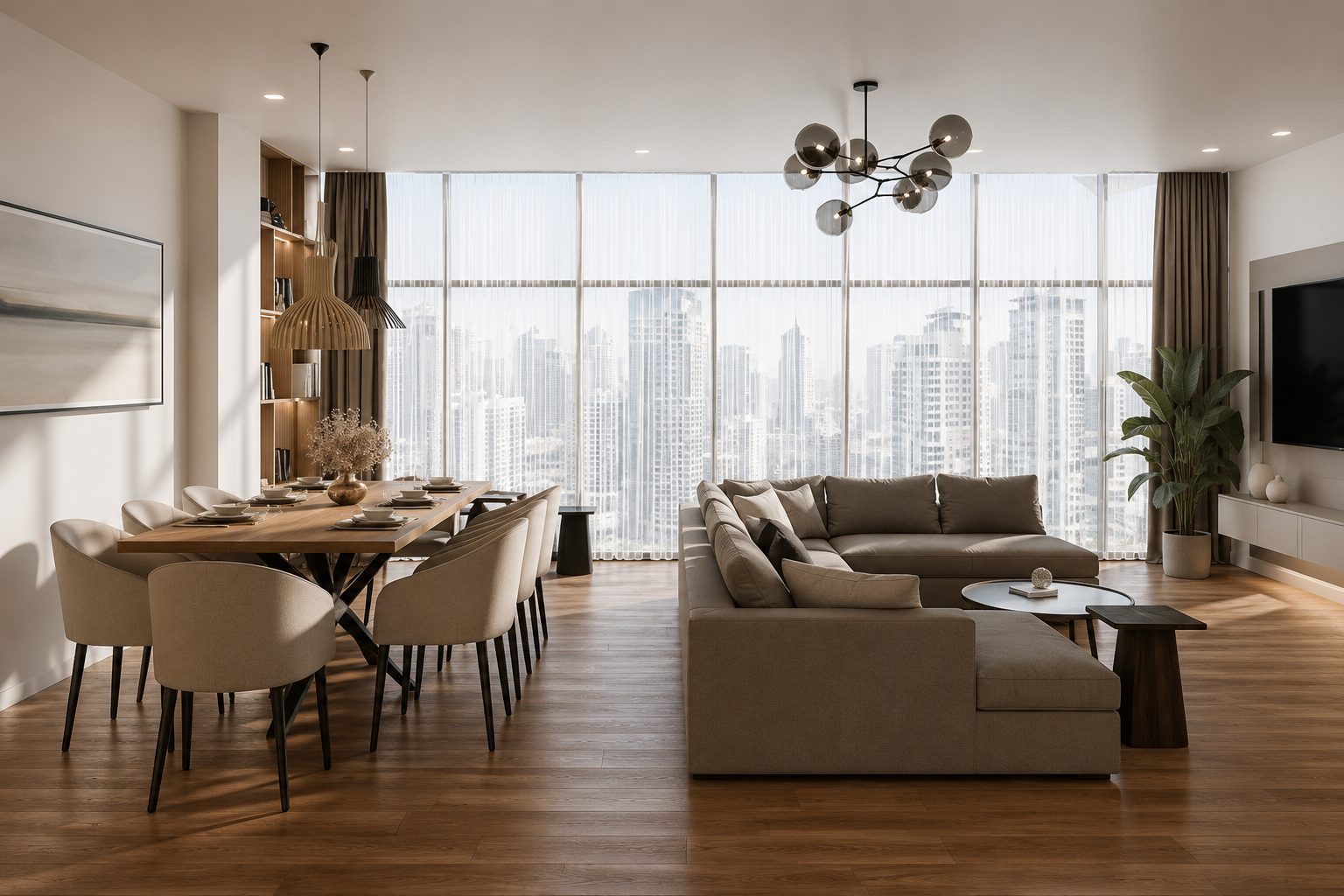
A majlis is a formal guest reception that keeps visitors out of the family half of the house. A typical Dubai majlis runs 25 to 45 m², and 40 to 60 m² is where it stops feeling tight. Below the lower end you get a single U of seating with a cramped centre and no honest route to the serving door.
The separate guest entrance is the detail that gets rebuilt most often, and the door is rarely the problem. The door goes in and the rest of the circuit is forgotten, so tea crosses the family living room, or the guest WC opens off the family hall, or the majlis shares a bedroom wall with nothing in it for sound. Adding a serving pantry afterwards means new water and drainage.
Layout follows how many people have to hear each other. The traditional U, benches on three sides with the floor open in the middle, holds the most people in one conversation and needs long walls clear of doors. An L suits a majlis that doubles as a second lounge facing a view or a screen: fewer people in the conversation, more people comfortable.
What goes into the drawings before any joinery is ordered:
- Power and data in the bench bases, floor boxes under the centre of the room
- Lighting on separate circuits, so sitting, eating and prayer are not one switch
- AC throw checked against the seating, because a bench under a diffuser gives a cold draught
- Rug size fixed off the final furniture layout, not the empty plan
- A curtain pocket agreed with the ceiling before boarding starts
A premium majlis of 40 to 60 m² lands at AED 150,000 to 300,000 or more, and the spread inside that band is specification rather than luck. Bench and cabinet joinery, stone, screens, the rug and the curtains move it. Light fittings and paint do not.
Brass, stone, rugs and curtains, and where the budget actually goes
Stone is usually the biggest single line in this style. Book-matched slabs for a majlis feature wall mean slab selection, a cutting plan, waste and slow fixing, and most of that price was set in the quarry long before it reached our rate. Large-format porcelain copies the look for a fraction, which is the honest answer in a rented villa or a resale.
Brass is the small detail with the long tail. Solid brass patinates if you leave it unlacquered, which is the point of it, and holds colour lacquered, which shows every scratch. Brass-plated steel is cheaper and wears through at handles and edges within a couple of years of Dubai cleaning chemicals. A continuous brass inlay line in a stone floor looks superb and slows the floor programme, because every cut has to be exact.
Rugs and curtains are long-lead items pretending to be furnishings. A bespoke hand-knotted rug is a months-long order, so it gets placed with the joinery rather than after it, and curtains need the ceiling pocket to exist before the gypsum closes. A motorised track with nowhere to sit is a clash we inherit regularly.
Across the houses we price, the mashrabiya is rarely what moves the total. Metres of joinery and square metres of stone do. The ladder for carcass material, front finish and hardware is set out in our guide to bespoke joinery; for orientation, a simple MDF run for a bench base or a low cabinet band sits around AED 800 to 1,200 per linear metre at the budget end of the market, a lacquered board run with proper hardware around AED 4,500 to 7,500, and full-height wardrobe joinery starts higher again.
Whole house, this style lands around AED 250 to 600 per square foot depending on how much of it is stone, solid timber and bespoke joinery. Where you sit inside that band is decided by the specification and the volume, not the style label. How we survey, scope and fix that number by contract is described with our interior design and fit-out service.
Production lead times are the real programme risk
Nothing in this style comes off a shelf. Built-in joinery usually takes six to eight weeks from approved shop drawings, solid timber screens four to six weeks, and gypsum work including cornice is a matter of days on site once the walls are ready. That asymmetry is the whole scheduling problem: the fast trades wait on the slow ones.
The bottleneck sits with approvals rather than with the factory. Shop drawings sit with the client until the veneer sample, the lattice pattern and the handle are chosen, and every week of indecision there is a week on handover. We freeze screen patterns and joinery finishes before demolition is finished, because the factory clock starts at approval.
Screens carry one more trap. They are measured off the built opening after plaster, not off the drawing, so the four to six week clock cannot start until that wall physically exists. A full apartment or villa renovation runs for months rather than weeks, and the long leads on joinery and screens decide which end of that range you land on.
Approvals for layout changes, facades and materials
Moving a wall to make a majlis work is not a decorating decision in Dubai. Layout changes go through a permit route, Dubai Municipality across most of the city, DDA or Trakhees depending on the area, with stamped drawings from a consultant, and in a community or a tower the developer or owners association NOC comes first. Put that time in the programme instead of discovering it in week two.
Facades are tighter than most owners expect. A screen fixed outside the glass line, a lattice on a balcony parapet, a new arched opening visible from the street: each changes the elevation, which the community rules and the authority control, and plenty of communities simply refuse. It is one reason we usually set the mashrabiya inside the reveal, behind the glazing, where it does the shading job and leaves the elevation alone.
Materials have their own layer. The UAE Fire and Life Safety Code sets interior finish classes for flame spread and smoke development, tested to recognised standards such as ASTM E84 or UL 723. In a private villa bedroom the pressure is low; in a corridor, an escape route or any commercial space, a timber screen has to carry the class rating that space demands, confirmed on the approved drawings rather than on a supplier's word. Treated board and powder-coated metal are the usual answers, and lattices stay clear of sprinkler heads and detectors.
Scope, sequence and price are fixed by contract before work starts, and the work carries a one-year warranty. Send a floor plan and photos of the rooms you want to change to WhatsApp on +971 54 307 4888 or info@domeco.ae, and we will tell you which parts of this list apply to your house.
FAQ
How much does a majlis cost in Dubai and what makes up the figure?
A premium majlis of 40 to 60 m² lands at AED 150,000 to 300,000 or more as a Dubai market band. Most of that is bench and cabinet joinery priced per linear metre, stone, screens, the rug and the curtains. The figure follows the specification, so two rooms of the same size can differ by double.
What should a mashrabiya screen be made of?
Lacquered MDF at roughly AED 150 to 300 per m² suits decorative panels in dry, air-conditioned rooms. Solid timber at AED 400 to 1,500 per m² earns its price where light passes through the lattice or where people touch it. Laser-cut and powder-coated metal is the answer outdoors and wherever there is a fire requirement.
How long does production take for joinery and screens?
Built-in joinery is usually six to eight weeks from approved shop drawings, solid timber screens four to six weeks. Screens are measured off the finished opening, so their clock starts after plaster. Gypsum arches and cornice are days of installation, which is why they almost never delay a handover.
Which part of a modern Arabic interior costs the most?
Stone and joinery, in that order on most of the houses we price. Book-matched slabs carry selection, cutting and waste, and joinery is sold by the linear metre, so a long run of benches and cabinets adds up faster than any feature. The mashrabiya everyone focuses on rarely decides the total.
Can Arabic elements be added without changing the layout?
Yes, and that is the cheaper half of the work. Screens inside existing reveals, a gypsum arch inside an existing opening, cornice, a stone or plaster feature wall, brass and lighting all sit inside the current plan and need no structural permission. Permits and an engineer come in when openings are widened, walls removed or the elevation touched.
What size does a majlis need to be?
A typical Dubai majlis is 25 to 45 m², and 40 to 60 m² is where the room stops feeling tight. Size follows the seating plan: a U of benches on three sides needs long walls free of doors, while an L suits a smaller room that doubles as a lounge. Leave a real route from the serving door to the centre.
Are gypsum arches decorative or structural?
Almost all of them are decorative: a stud frame with curved board inside an opening that already exists, carrying nothing. It becomes a structural question the moment the opening itself changes, and then it needs a consultant's assessment, stamped drawings and a permit. In a tower, shear walls and columns are not negotiable.