
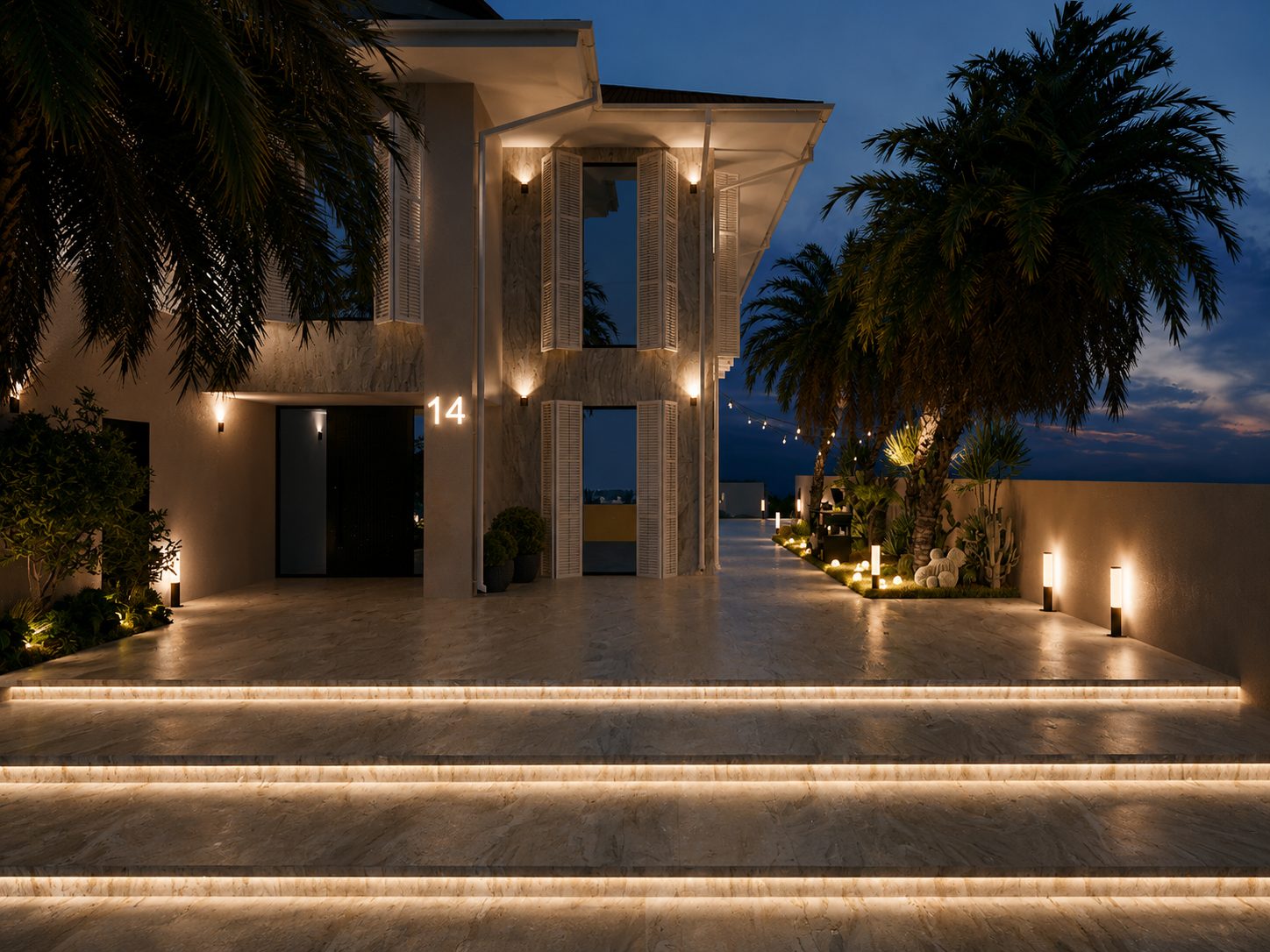
TL;DR: A modern house interior in Dubai is bought on the build drawings rather than in the paint deck: open plan, concealed services, built-in joinery, flush junctions. That puts a whole house at AED 300 to 600 per square foot mid-range and AED 600 to 1,000 premium, with styling-only work at AED 150 to 300.
What a Dubai brief means by modern, contemporary and minimalist
Modern, as design history uses the word, is a period: flat planes, visible structure and no applied ornament, running from the Bauhaus through mid-century. Contemporary means whatever is current, so it shifts every few years. Minimalist describes quantity rather than period, the discipline of keeping fewer objects in the room.
On a Dubai brief, modern almost always means contemporary with clean lines, and the three labels build differently.
A contemporary scheme tolerates visible detail: standard skirting, a bulkhead over the duct, a handle on a door. A minimalist one has nowhere to put an error. A skirting board swallows a 10 mm gap between plaster and floor. A shadow gap advertises 2 mm. What divides a cheap clean-lined room from an expensive one is tolerance rather than the colour card.
Regional variants change the shopping list rather than the principle. A modern Arabic scheme puts the money into screens, arches and stone, which we price separately in our piece on modern Arabic interiors. A plain modern scheme puts the same money into joinery, ceilings and the accuracy of every junction.
What an open plan costs before anyone picks a finish
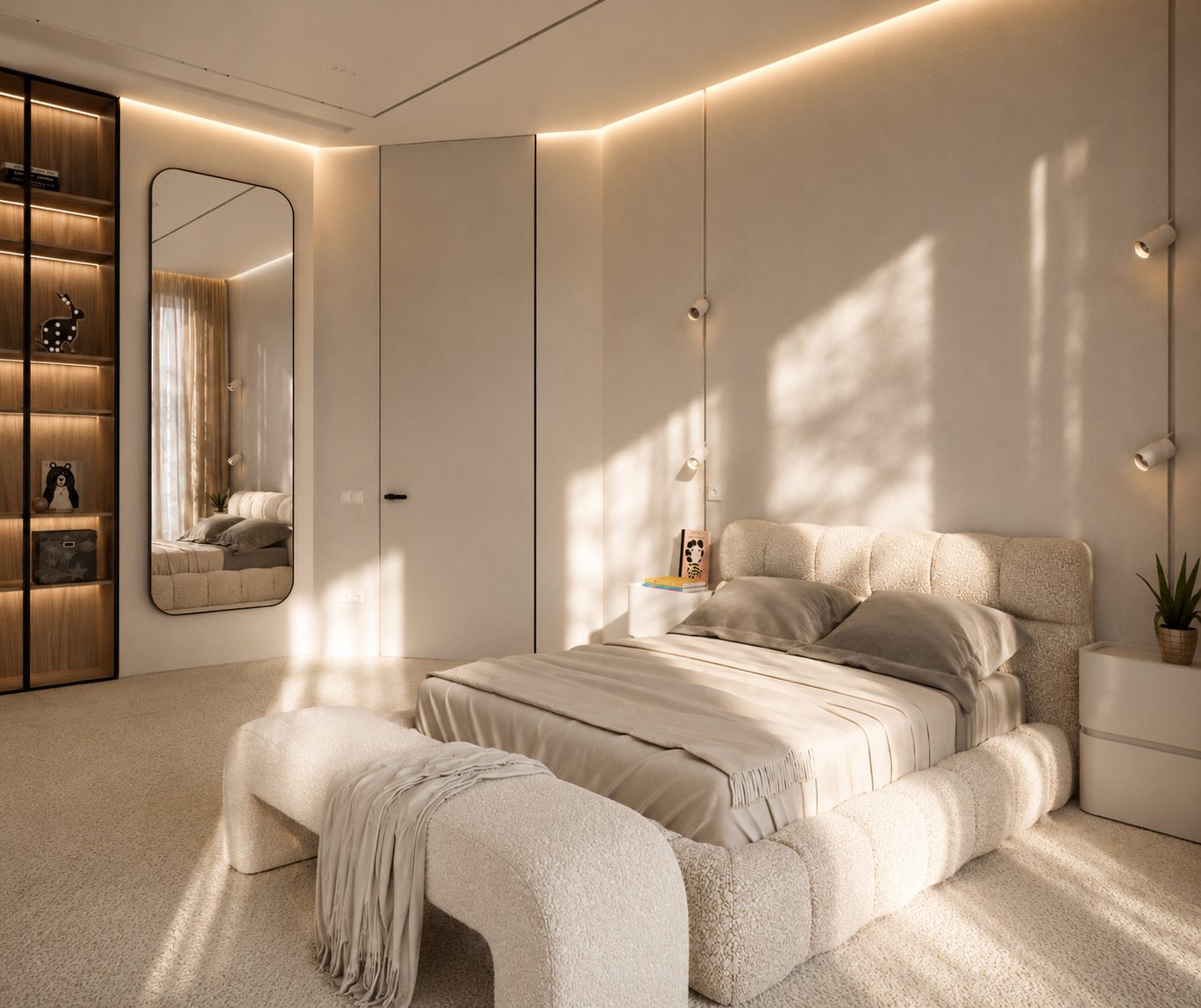
Open plan is the first demand the look makes, and the only one that reaches structure. In a Dubai tower, shear walls, columns and the slab are not available at any price, and some partitions owners want gone are blockwork tied into the frame. In villas internal block walls are more often non-load-bearing, which is a licensed consultant's call with a stamp on it rather than the foreman's opinion on site.
The route for taking a wall out is fixed:
- Structural assessment and stamped drawings from a licensed consultant
- NOC from the master developer or the owners association, which comes before the authority
- Building modification permit: Dubai Municipality across most of the city, Trakhees on Palm Jumeirah, DDA in Dubai Media City and Barsha Heights, DMCC in JLT
- Lodgement against a licensed contractor's registration number, which is why an owner cannot file it alone
- Scanning for post-tension strands and buried services before anyone cores a slab or a wall
The money and the waiting are predictable. An apartment building NOC runs AED 500 to 3,000 and a villa community NOC AED 2,000 to 5,000, with a refundable deposit of AED 5,000 to 20,000 held for the programme. Emaar quotes 5 to 10 working days, Nakheel 7 to 15, Meraas 10 to 15. The Dubai Municipality fee is calculated on built-up area at roughly AED 1.00 per square foot with a minimum near AED 200, and plan check plus consultant work takes the real figure to AED 3,000 to 15,000 on a layout change. Approvals on a structural job commonly total AED 8,000 to 30,000.
Concealed services: the half of a modern house interior nobody photographs
The wall you remove was also a zone boundary. Two rooms with their own fan coil unit and thermostat become one volume carrying glazing load on one side and a hob on the other, so the cooling load gets recalculated, diffusers move, and a return air path has to work with the doors as built. In a Dubai summer a thermostat left in the shaded half of a merged living and kitchen space short-cycles while the glazed half stays warm, and the owner blames the unit.
Linear slot diffusers are the modern answer for air, and they cost more per metre than grilles and need the plenum built behind them. Whether you get a flat ceiling or a bulkhead is decided by duct routes on the MEP drawing rather than by taste. Plain gypsum ceiling work sits around AED 7 to 11 per square foot, and coves, shadow gaps and stepped details AED 25 to 70 per square foot.
Concealed also means serviceable. Every fan coil, valve, filter and shut-off behind a flush ceiling or a joinery panel needs a way in, and flush access panels are a joinery line rather than an accessory. A ceiling detailed without them gets cut open in year two, and the patch is visible forever.
Open plan concentrates electrical load as well. An induction hob, two cooling zones and island power on one distribution board is a DEWA load question rather than a decorating one, and floor boxes under the sofa and dining table get set out before the screed goes down.
Built-in storage and flush detailing, where the budget actually goes
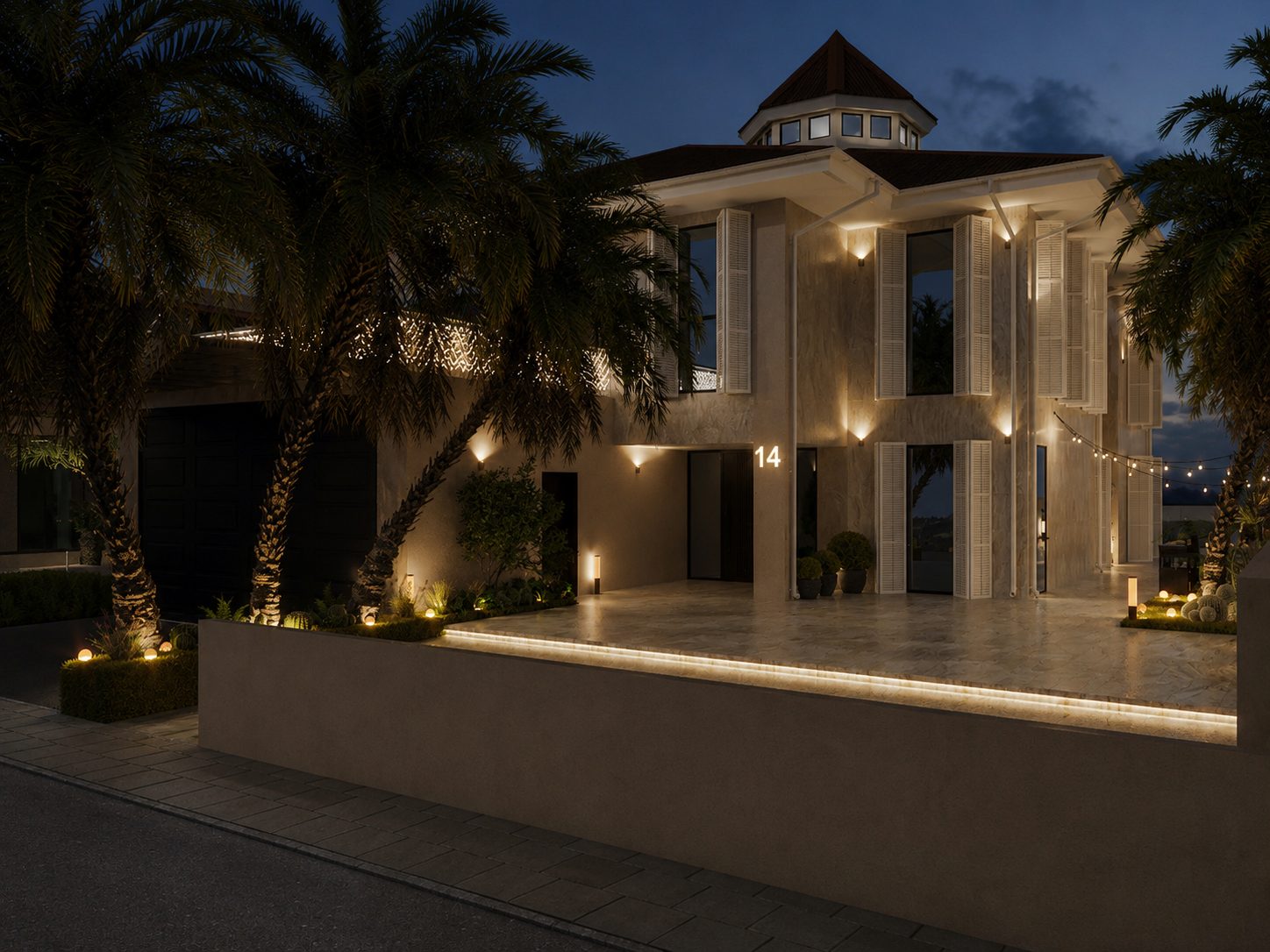
Built-in storage is made in a workshop to the measured opening, so it cannot be ordered in a week like a wardrobe off a showroom floor. Shop drawings, approval, production, then installation against walls that are already plumb. That sequence is why joinery sets handover dates more often than any other trade.
Price moves with carcass, front and hardware rather than with the word bespoke. A melamine carcass with melamine or HPL fronts and generic hardware runs AED 2,500 to 4,000 per linear metre of full-height wardrobe; a low bench base or cabinet band uses a fraction of that board and hardware, so it prices well under the wardrobe rate. A lacquered board run with proper hardware sits around AED 4,500 to 7,500 per linear metre, and marine ply or veneer with a full internal fit-out starts higher again.
Handleless fronts move the cost into accuracy. Push-to-open or a routed grip, a reveal that reads the same along a 2.7 m door, and a carcass square enough to hold it. The same applies to a shadow gap at floor level instead of skirting: it needs a level datum round the room and a plaster return, so an out-of-true floor becomes a screed line in the quote rather than something the fitter hides.
Continuous surfaces behave the same way. Microcement and polished plaster want a crack-free substrate and report every movement joint nobody planned. Large-format porcelain copies a wide stone floor, holds up better in Dubai humidity and needs no sealing regime.
What a modern house interior costs per square foot in Dubai
Market bands for a whole-house renovation, aggregated by the Taamir marketplace from Dubai contractor quotes and last updated in May 2026:
- Basic or cosmetic: AED 150 to 300 per square foot
- Mid-range: AED 300 to 600 per square foot
- Premium: AED 600 to 1,000 per square foot
- Luxury: AED 1,000 to 1,500 and above per square foot
Other Dubai contractors publish the same shape. Splendor puts a full villa interior overhaul at AED 600 to 1,000 per square foot. First Unicorn advertises villa fit-out from a fixed AED 250 per square foot once there is a real BOQ behind it, which is about where the floor of the market sits.
Our own numbers are metric, because construction here is priced per square metre: cosmetic renovation from AED 1,500 per m², about AED 140 per square foot; capital renovation from AED 3,000 per m², about AED 279; turnkey with furniture, appliances and décor at AED 8,500 to 16,000 per m², which is AED 790 to 1,490 per square foot. One square metre is 10.76 square feet, and quotes in this city switch units without warning.
A clean modern scheme with flush detailing, concealed services and bespoke joinery through the whole house sits in the premium band at AED 600 to 1,000 per square foot. The mid-range band carries it when you accept standard skirting and visible bulkheads in bedrooms and corridors and concentrate the flush work in the living space and kitchen. Below AED 300 per square foot you are buying the palette, which is a real product with its own rules, covered in our guide to the budget tier.
The style label does not set the price. A classical scheme with cornices, panelling and a carved stair lands in comparable money. The difference is how each one fails: ornament hides poor tolerance, flat planes report it.
Programme, approvals and imported material
A full design package starts from AED 10,000 and takes three to six weeks from signed brief to a complete set, and the structural consultant, the authority and the joinery factory all work from that set. A 150 m² apartment then runs two to six months door to door, and which end you land on comes down to approvals and lead times rather than the number of men in the flat.
Lead times that belong in the programme:
- Locally fabricated joinery: four to eight weeks from approved shop drawings
- Italian joinery and slab stone: eight to fourteen weeks from order to delivery in Dubai
- Community NOC: two to four calendar weeks in practice, once weekends and one round of reviewer comments are counted
Joinery is measured off the built opening after plaster, so the factory clock cannot start until that wall physically exists. That one fact explains most late handovers on clean-lined jobs. We freeze finishes and hardware before demolition ends, because a week of indecision over a veneer sample is a week on the end date.
Summer has its own arithmetic. Between 15 June and 15 September outdoor work stops from 12:30 to 15:00 under the midday break rules, and high humidity extends curing on screed, plaster and microcement. A July programme written on winter drying assumptions slips by days per stage with nobody doing anything wrong.
Who holds the programme matters as much as the dates, because a flush detail fails in the gap between the drawing and the site. The trade-off between one party carrying both and hiring a designer and a contractor separately is set out in our comparison of design and build against separate appointments.
Where saving works and where it comes back as a rebuild
Savings that hold up:
- 1. Leave the wet areas where they are. Moving a bathroom or a kitchen drags in drainage, waterproofing, a permit and a consultant stamp.
- 2. Concentrate flush detailing in the rooms people use and accept standard skirting elsewhere. Nobody studies the shadow gap in a guest bedroom.
- 3. Large-format porcelain instead of natural stone, which also removes the sealing regime from the handover pack.
- 4. Local joinery workshops in Al Quoz or Dubai Investment Park instead of imported units, with shop drawings and a physical edge sample approved before production.
- 5. Repeat the detail. One handle, one reveal dimension, one stone family means one setup in the workshop instead of five.
Waterproofing is at the top of the list that does not survive cutting. A tanked bathroom with a proper flood test costs a few thousand dirhams more than a membrane rolled over dusty screed, and stripping a finished 20 m² bathroom afterwards runs AED 6,000 to 12,000 in labour and material alone, plus a week of programme and a claim from the flat below.
Air conditioning is second, and it is invisible in every photograph of the finished job. On an older villa a ducted unit at the end of its life costs AED 20,000 to 80,000 to replace depending on tonnage. Painting over an AC problem is the most common false economy we see.
Third is the drawing set. A thin one hands socket heights, tile setting-out and reveal dimensions to whoever is on site that morning, and those gaps come back as variations, typically 5 to 15% of contract value in UAE residential work.
If the property is going straight onto the rental market, the premium band does not come back in rent, while a cosmetic refresh with a sound kitchen and working AC does. That answer sells us less and it is still the right one. We fix scope, price and dates by contract before work starts, carry a one-year warranty and pay a percentage for each day of our own delay, which is set out with our interior design and fit-out service. Send a floor plan and photographs to WhatsApp on +971 54 307 4888, to info@domeco.ae, or through the contact page, and we will tell you which band your brief sits in.
FAQ
What makes an interior modern rather than contemporary or minimalist?
Modern is a period in design history: flat planes and absent ornament, from the Bauhaus through mid-century. Contemporary is whatever is current and shifts every few years, and minimalist is about how much sits in the room. Most Dubai briefs that say modern mean contemporary with clean lines, and the build cost follows the tolerance that look demands.
Does a modern interior need structural work such as removing a wall?
Not always. Many Dubai apartments already have a living and dining space that reads as one, and the look survives on sight lines and storage alone. When a wall does have to go it needs a licensed consultant's structural assessment, stamped drawings, the developer or association NOC and a building modification permit, and in a tower shear walls, columns and the slab stay where they are.
How much does a modern interior cost per square foot in Dubai?
Market bands run AED 150 to 300 per square foot for cosmetic work, AED 300 to 600 mid-range, AED 600 to 1,000 premium and AED 1,000 to 1,500 and above for luxury. Flush detailing with concealed services throughout sits in the premium band. Our own capital renovation starts at AED 3,000 per square metre, about AED 279 per square foot.
What are the hidden costs in a modern interior renovation?
Approvals on a structural job commonly total AED 8,000 to 30,000 across the NOC, the permit, plan check and consultant fees, with a refundable community deposit of AED 5,000 to 20,000 tied up for the programme. Then flush access panels, a cooling load recalculation after walls come out, screed or levelling under a continuous floor, and freight on imported joinery and stone.
How long does a full modern interior renovation take in Dubai?
Three to six weeks for the design set, then two to six months door to door for a 150 m² apartment. Approvals run alongside design, so the usual gate is the date you stop changing the specification. Joinery at four to eight weeks from approved shop drawings, measured after plaster, sets the handover date on clean-lined jobs.
Can a modern look be done on a budget, and what gets compromised?
Yes, by narrowing where the flush detailing goes rather than thinning the whole specification. Keep the shadow gaps, trimless lights and handleless joinery in the living space and kitchen, and use standard skirting and a bulkhead ceiling in the rest of the house. Waterproofing, the air conditioning, access panels and the drawing set are the lines that should never be cut.