
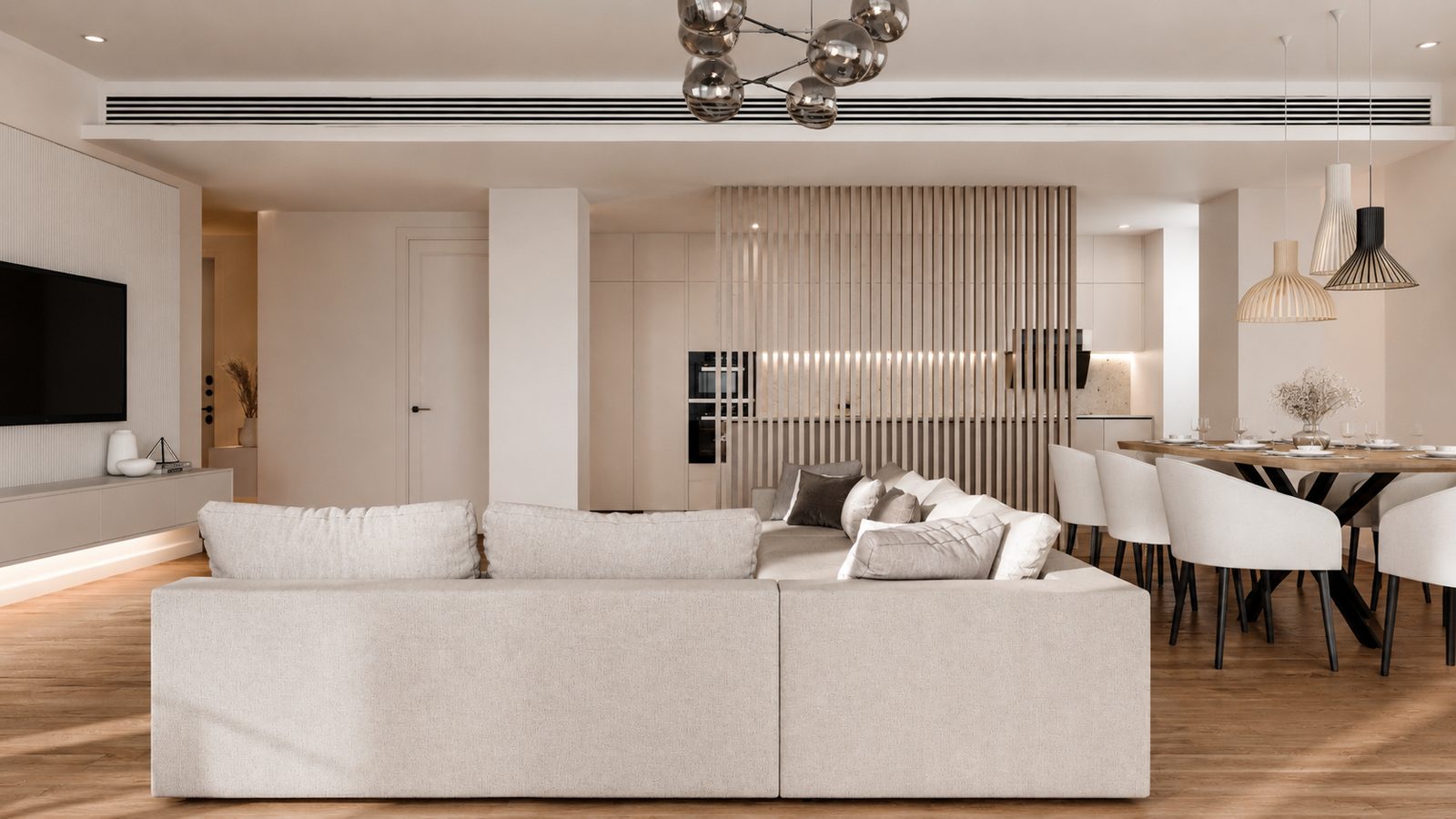
TL;DR: Residential interior design in Dubai runs from about AED 140 per square foot for a cosmetic refresh to AED 790 and above for turnkey with furniture. Apartments take four to six months door to door, villas six to thirteen. Approvals and joinery production set the calendar, not the drawings.
Owners usually arrive with a Pinterest board and a move-in date. The move-in date is the harder problem. A 110 m² two-bedroom apartment at Downtown Boulevard took us five months; a 190 m² office in JLT took three. The apartment was smaller and finished later, and the reason has nothing to do with design talent.
How a residential project differs from a commercial one
On a commercial fit-out the tenant answers to a landlord fit-out guide, a rent-free period with a hard end date, and a fit-out manager who reads drawings for a living. The rules are written down. On a residential project you deal with a building management office that may have no written guide at all, and whatever the guide says, the neighbour on the floor below sets the real limit on when a hammer drill can run.
Money moves differently too. In a home, kitchen and bathrooms absorb 50 to 60 percent of the budget, because both stack custom joinery, imported stone and concealed MEP into a few square metres. Add wardrobes and the joinery package alone often carries a third of the contract. A retail unit spends its money on shopfront, lighting and floor durability, and it repeats the same specification across ten branches. Residential specifications are one-offs, which is why lead times behave the way they do.
The tolerance for defects is also different. A mall tenant lives with a slightly proud skirting because the store opens on Thursday. An owner sees that skirting every evening for ten years. We plan the snag walkthrough as a stage of the job rather than a formality at the end, and on a home we budget more time for the last five percent: paint touch-ups, door adjustment, styling.
Commercial work has its own approvals chain, its own cost bands and civil defence involvement, and we keep it in a separate guide on commercial fit-out costs and approvals. From here on, the numbers below are residential only.
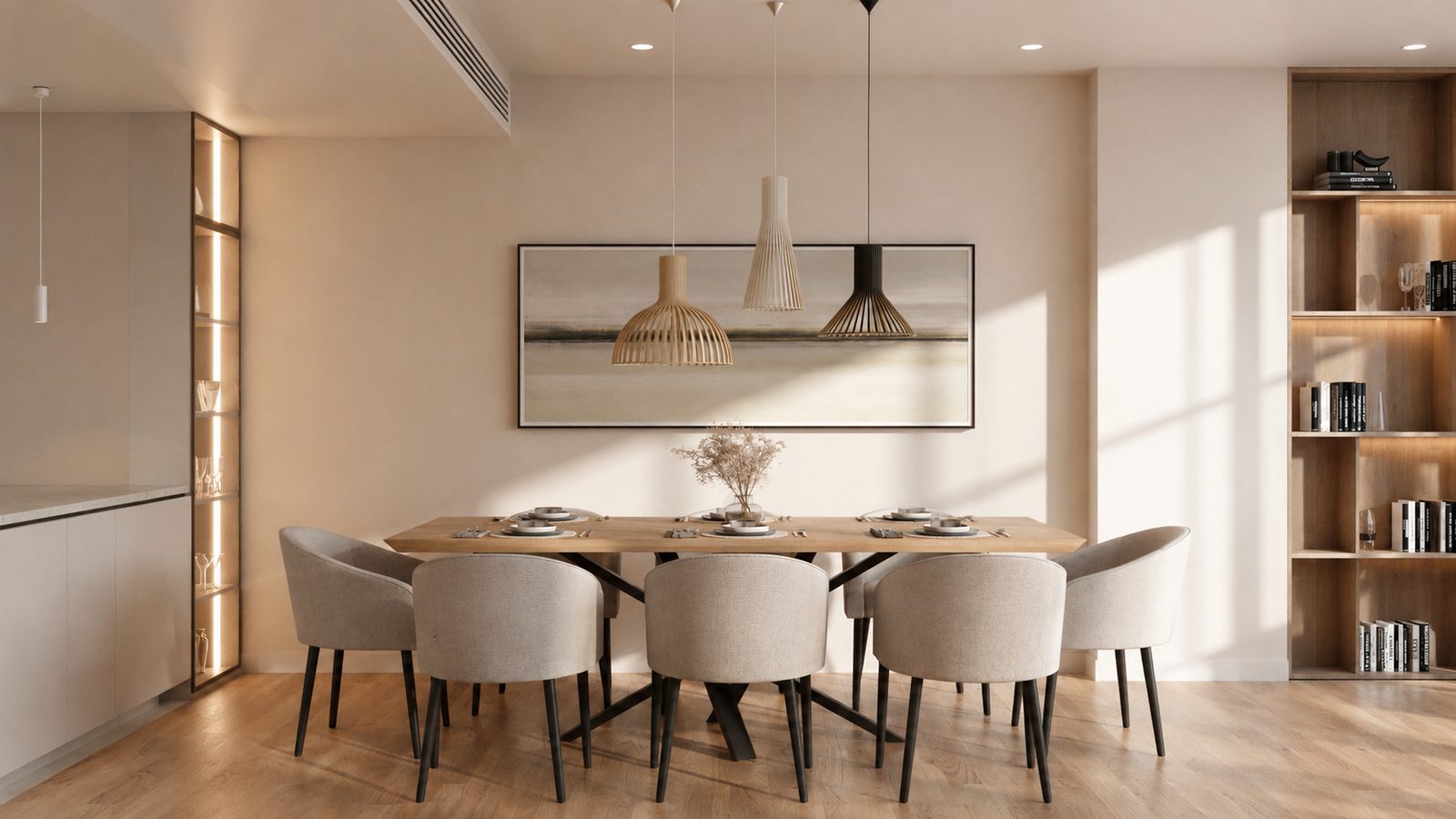
Residential interior design cost in Dubai by property type
Our own reference bands, fixed by contract before work starts, work out at AED 1,500 per m² and up for cosmetic work, AED 3,000 per m² and up for capital renovation, and AED 8,500 to 16,000 per m² for turnkey including furniture, appliances and decoration. In per-square-foot terms that is roughly AED 140, AED 280, and AED 790 to 1,490.
Market bands by dwelling type, as planning figures rather than quotations:
- Apartments. AED 150 to 300 per sqft cosmetic, 300 to 600 mid-range, 600 to 1,000 premium, and 1,000 to 1,500+ for luxury with Italian kitchens and stone throughout. A full 1BR job lands at AED 50,000 to 350,000, a 2BR at AED 80,000 to 700,000. Detail sits in our apartment renovation cost breakdown.
- Townhouses. AED 200 to 700 per sqft. Cheaper per foot than a villa of the same finish because the plot is small, the roof is shared and there is rarely a pool, but community design guidelines in places like Arabian Ranches or Mudon restrict facade and window changes tightly.
- Villas. AED 150 to 300 per sqft cosmetic, 350 to 600 for a full mid-range refit, 600 to 1,200 luxury. Turnkey, a three-bedroom lands around AED 150,000 to 450,000 and a five-bedroom-plus from AED 400,000 to well past AED 1.5m. The villa renovation cost guide breaks down where it goes.
- Penthouses. Same per-metre ladder as apartments at the top end, but volume changes the total: a 400 m² penthouse at capital scope starts near AED 1,200,000 before FF&E. Across the market, penthouse projects run from AED 200,000 for targeted work to AED 1,500,000 and beyond.
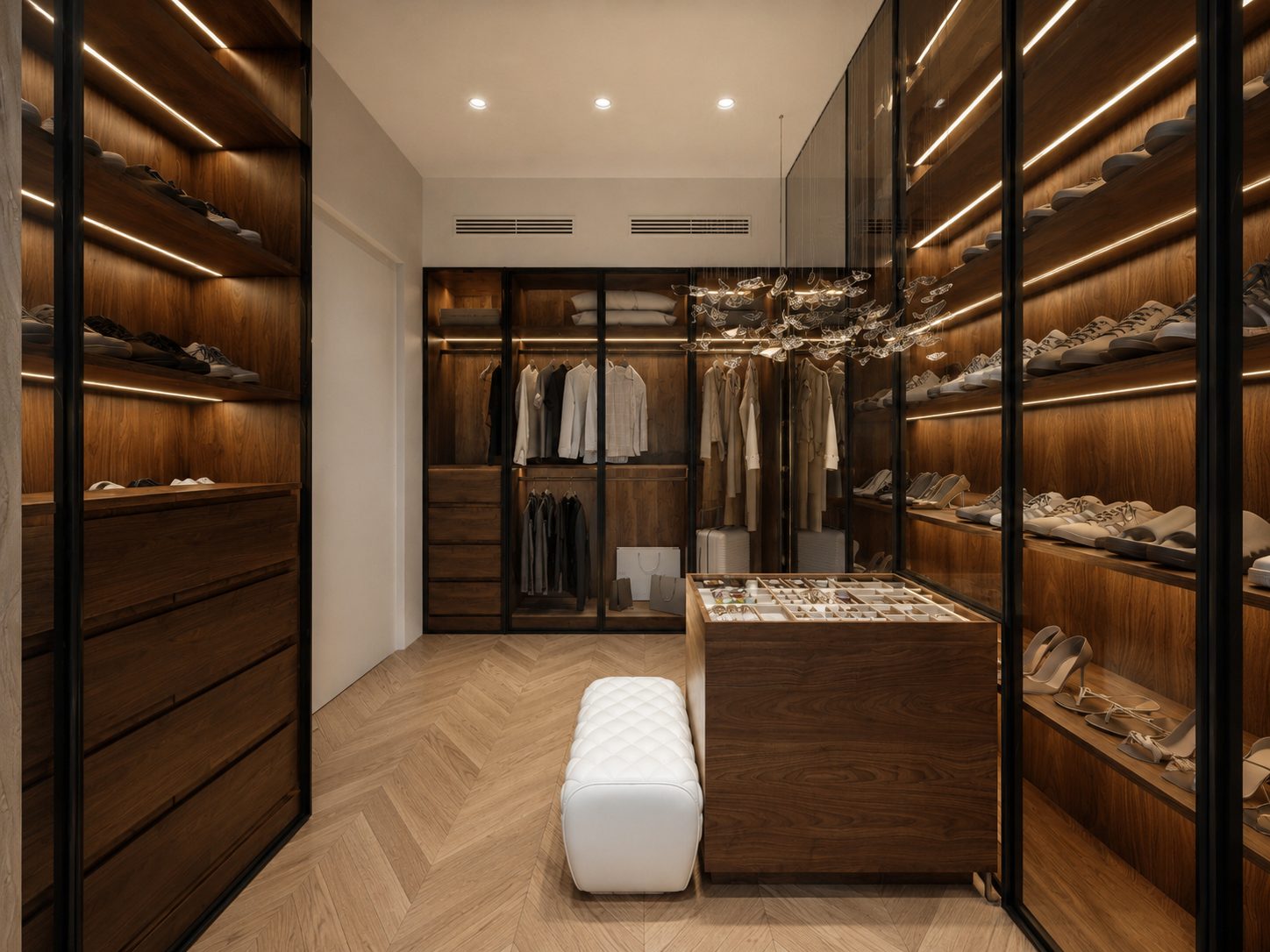
Crews advertising AED 100 to 130 per sqft on a villa do exist. On the jobs we have been called in to repair, what was trimmed was the invisible half: waterproofing under wet areas, cable sizing, and the permits that make the work legal. Location moves the honest number too. Marina, Downtown and Palm Jumeirah typically run 20 to 30 percent above JVC or Discovery Gardens for identical specification, driven by access restrictions and stricter building rules rather than by better materials.
What actually eats the calendar
Design is the fast part. A full design package takes three to six weeks and starts at AED 10,000. Then the schedule hits two immovable blocks.
Approvals run six to ten weeks from drawings to permit in hand on anything touching structure or MEP. Joinery runs eight to twelve weeks: two to three weeks for site measurement and shop drawings, four to seven weeks of workshop production once those drawings are approved, then a week or two of installation for a whole apartment. Lacquer needs its cure time, and a change to the drawings after production starts restarts part of that clock. Those two blocks overlap the site programme only partly, which is why door-to-door figures look long next to the number of weeks the crew is physically on site.
Our own completed residential projects, by area and total programme:
- 1. Downtown Boulevard, 110 m² two-bedroom apartment, five months.
- 2. Creek Horizon, 140 m² three-bedroom turnkey, five months.
- 3. City Walk, 150 m² three-bedroom for a family, five months.
- 4. Creek Address, 110 m² two-bedroom stripped back to the shell, six months.
- 5. Villa Dubai Hills, 290 m², turnkey plus landscaping, eight months.
- 6. Villa Palm Jumeirah, 375 m², six bedrooms turnkey, thirteen months.
The gap between the Dubai Hills villa and the Palm villa is the single most useful comparison a Dubai owner can run before signing a programme. Palm is 29 percent larger, and it took 62 percent longer. Dubai Hills sits under Emaar and Dubai Municipality. Palm sits under Nakheel and then Trakhees, and structural work on a frond attracts a geotechnical report with its own lead time. Same trades, same working week, five months of difference in the programme.
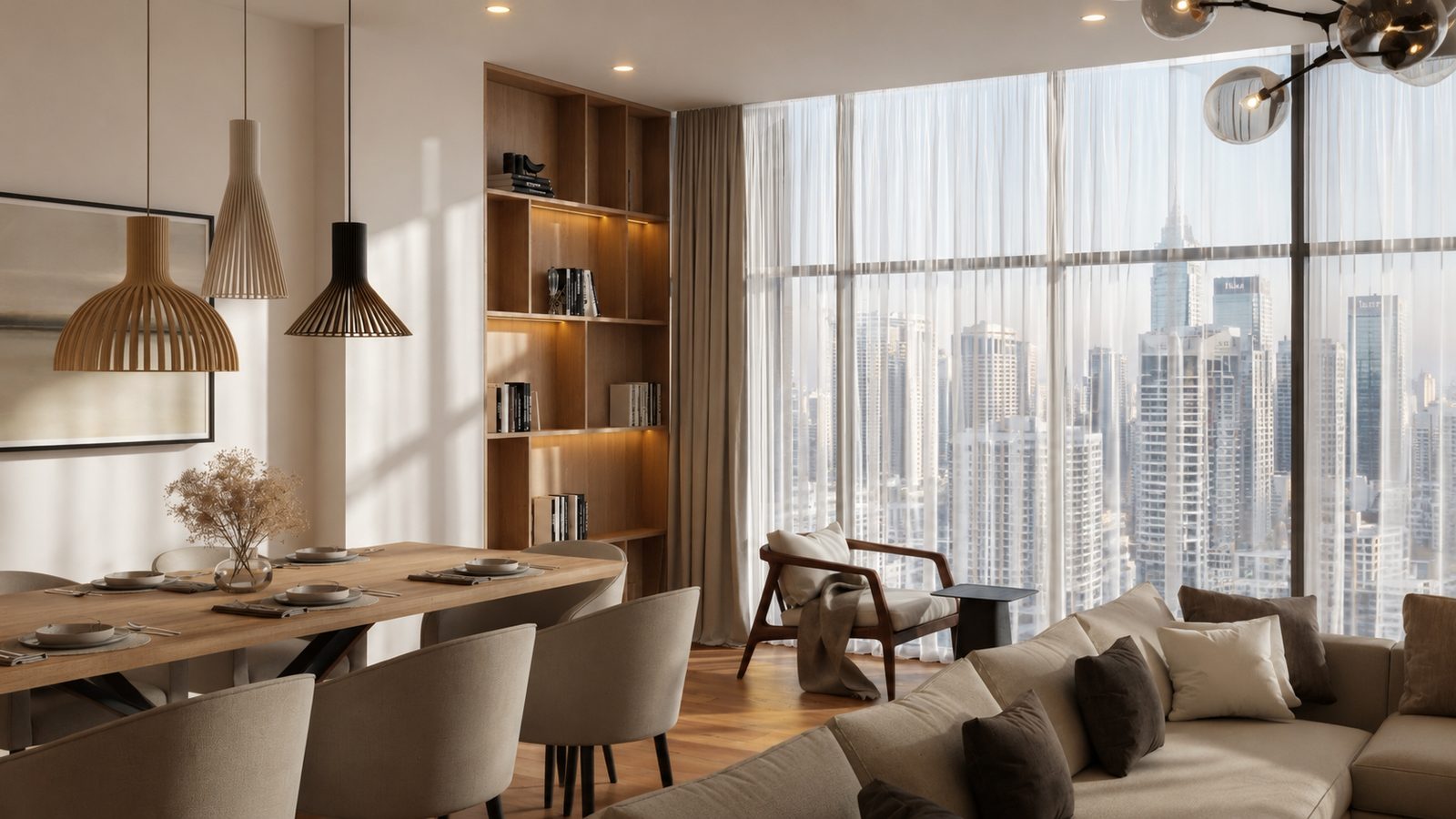
Full fit-out, semi fit-out, or a cosmetic refresh
Contractors in Dubai use these three terms loosely, so pin the definition down in writing before comparing quotes.
A full fit-out means partitions and layout changes, new MEP distribution, all finishes, joinery and FF&E. Market rates sit at AED 350 to 600 per sqft, and this is the scope that requires drawings, a developer NOC and an authority permit. A semi fit-out leaves the existing MEP distribution and wet-area positions alone, replacing finishes, joinery and furniture over the top. That lands at AED 150 to 300 per sqft and often clears with building management approval alone. A cosmetic refresh is paint, flooring, light fittings and sanitaryware swaps, from around AED 140 per sqft equivalent upward, and takes about two weeks per property on a villa.
For a rental unit, the cheaper scope usually wins on returns. A mid-range two-bedroom refresh at AED 80,000 to 140,000 commonly lifts an achievable sale price by AED 150,000 to 300,000 and cuts letting time from six to twelve weeks down to two to four. With a void costing AED 5,000 to 15,000 a month, eight weeks of avoided vacancy pays for a good part of the work. Tenants pay for condition; they do not pay a premium for bespoke veneer. We will say so when that is the honest answer.
Approvals: the developer NOC and which authority sees your drawings
Two separate consents exist, and owners routinely confuse them. The community NOC is your master developer's or owners' association written consent to work inside their community. The permit is statutory, issued by Dubai Municipality, DDA or Trakhees, and it reviews code compliance on structure, fire safety, MEP loads and drainage. The NOC comes first, because the authority expects to see it inside the pack.
Published review windows, before weekends and reviewer comments are counted:
- Emaar (Dubai Hills Estate, Arabian Ranches, Downtown, The Meadows, Emaar Beachfront): 5 to 10 working days. Fee AED 500 to 3,000, refundable deposit around AED 10,000 on villa scopes.
- Nakheel (Palm Jumeirah, Jumeirah Park, Al Furjan, JVC, Discovery Gardens): 7 to 15 working days. Fee AED 2,000 to 5,000, deposit AED 5,000 to 20,000.
- Meraas (City Walk, Bluewaters, La Mer): 10 to 15 working days. Fee AED 1,000 to 5,000.
- wasl and most mainland buildings: 5 to 10 working days, NOC request around AED 545, deposit set by the building.
Working days is the trap. Ten working days across a Friday-to-Sunday weekend pattern with one public holiday is closer to three calendar weeks, so we plan Emaar approvals at two to three calendar weeks and Nakheel at two to four. Palm Jumeirah then files a CED permit with Trakhees rather than with Dubai Municipality, and Trakhees wants the Nakheel NOC before it opens the file. Running the two in parallel gets the submission returned. Developer-by-developer documents, fees and deposits are in our community NOC guide for Emaar, Nakheel and Palm.
DEWA sits alongside this whenever connected load changes, which on a residential job usually means a new kitchen with an induction hob, or an added split unit. The DM building permit fee itself is minor next to consultant costs, calculated on built-up area at roughly AED 1.00 per square foot with a minimum near AED 200. Treat that rate as indicative and confirm it at submission, because fee schedules get revised.
Can you live in the home while the work runs?
The honest test is wet areas and air. If the scope is confined to one room with no plumbing, no chiller line, no distribution board and no floor screed, you can seal a barrier and lose that room for a fortnight. Everything beyond that needs you out.
Apartments are the strictest case. Dubai Municipality permits construction between 07:00 and 20:00, but your tower will be tighter: most restrict fit-out crews to roughly 09:00 to 17:00 on weekdays with no drilling at weekends. The service lift decides material flow, booked in one to two hour slots days in advance, with passenger lifts closed to trades and materials. Isolating a chilled water line needs building approval and a shutdown slot, so for part of the programme the unit has no cooling at all. Living through a full apartment fit-out is not realistic, and a twelve-week programme in rented accommodation costs most owners AED 25,000 to 28,000 once two moves at AED 1,500 to 3,000 each and storage are counted.
Townhouses sometimes work if the job can be zoned, ground floor first with a functioning bathroom upstairs. Dust travels through a shared stairwell faster than owners expect, and party walls transmit demolition noise into the neighbour's living room.
Villas are the realistic case for staying, phased room by room with dust barriers, temporary kitchen and separate circuits. Most of our villa clients still move out for the MEP and wet-works stretch, roughly six to ten weeks. Outdoor and landscape trades also lose two and a half hours a day to the summer midday break, 12:30 to 15:00 between 15 June and 15 September, so a phased summer programme stretches.
Penthouses are the hardest of the four. Glazing panels and long joinery runs frequently exceed the goods lift car, which means either cutting material down before it reaches the building or booking a crane with its own building approval and a weekend slot. Neighbours are directly below the noisiest floor in the tower. We plan penthouse site work at twelve to sixteen weeks and tell owners to arrange accommodation from day one rather than deciding in week three.
Stages, and what you receive at each
- 1. Survey and brief. Measured drawings plus a written condition survey with photographs before any strip-out. That file settles most later arguments about pre-existing base-build faults.
- 2. Concept, three to six weeks. Layout options, materials, colour, and 3D visuals of the rooms that matter. Design projects start at AED 10,000.
- 3. Technical package. Setting-out, electrical and lighting plans, MEP coordination, joinery shop drawings, finishes schedule and an FF&E list with model numbers. Design fees on larger scopes run 8 to 12 percent of construction value.
- 4. Approvals. NOC, then permit, then DEWA where load changes.
- 5. Build. Strip-out, MEP first fix, waterproofing with a 24 to 48 hour flood test on wet areas, screed, tiling, joinery installation, second fix, paint, then styling.
- 6. Snagging and handover. The snag list carries no price, because every item on it is rectification inside the original scope. What it carries is an owner and a date against each line.
Retention of 5 to 10 percent is normal, half released at the taking-over certificate and half at the end of the twelve-month defects liability period. Our workmanship warranty runs the same year. We fix the contract sum before the crew mobilises and it stays fixed, and we carry a percentage penalty for every day of delay we cause. Send the floor plan and the unit size on WhatsApp at +971 54 307 4888 and we will come back with a scope and a programme rather than a per-metre slogan.
FAQ
How long does residential interior design take in Dubai?
Design and documentation take three to six weeks. Adding six to ten weeks of approvals and eight to twelve weeks of joinery production, a full apartment lands at four to six months door to door and a villa at six to thirteen. Our own completed range runs from five months on a 110 m² apartment to thirteen on a 375 m² Palm Jumeirah villa.
What is the cost per square foot for apartment and villa renovation in Dubai in 2026?
Apartments run AED 150 to 300 per sqft cosmetic, 300 to 600 mid-range and 600 to 1,500+ at premium and luxury level. Villas run AED 150 to 300 cosmetic, 350 to 600 for a full mid-range refit and 600 to 1,200 luxury. Turnkey including furniture and appliances sits at AED 8,500 to 16,000 per m², about AED 790 to 1,490 per sqft.
Do I need NOC approval for interior changes in my Dubai apartment or villa?
Written developer or owners' association approval is required for essentially any works, including cosmetic ones. A statutory permit from Dubai Municipality, DDA or Trakhees is additionally required once you touch structure, layout, plumbing routes or electrical distribution. Cosmetic work such as paint and flooring normally clears with the NOC alone.
Can I live in my home during renovation?
In a villa, usually yes if the work is phased with dust barriers and a temporary kitchen, though most owners still move out for the six to ten week MEP and wet-works stretch. In an apartment or penthouse a full fit-out means moving out, because chiller isolation, screed and service lift restrictions make the unit unusable. Budget AED 25,000 to 28,000 for a twelve-week stay elsewhere including moves and storage.
What is the difference between Emaar and Nakheel community approvals?
Emaar reviews in roughly 5 to 10 working days at a fee of AED 500 to 3,000, and its communities sit under Dubai Municipality. Nakheel reviews in 7 to 15 working days at AED 2,000 to 5,000, and Palm Jumeirah then requires a Trakhees CED permit rather than a DM one. The Trakhees file cannot open before the Nakheel NOC is issued, which adds calendar weeks rather than working days.
What is the difference between full fit-out and semi fit-out?
A full fit-out changes partitions, layout and MEP distribution, needs a developer NOC and an authority permit, and runs AED 350 to 600 per sqft. A semi fit-out leaves the existing MEP and wet-area layout alone and only replaces finishes, joinery and furniture, at AED 150 to 300 per sqft, and it often clears with building management approval alone.
What documents go into a residential NOC submission?
A standard pack covers the title deed, the owner's Emirates ID or passport, the contractor's trade licence and current insurance, drawings stamped by a registered consultant where structure or MEP is involved, a method statement, a waste disposal plan and the deposit receipt. Developer-by-developer document lists and fees are in our community NOC guide.