
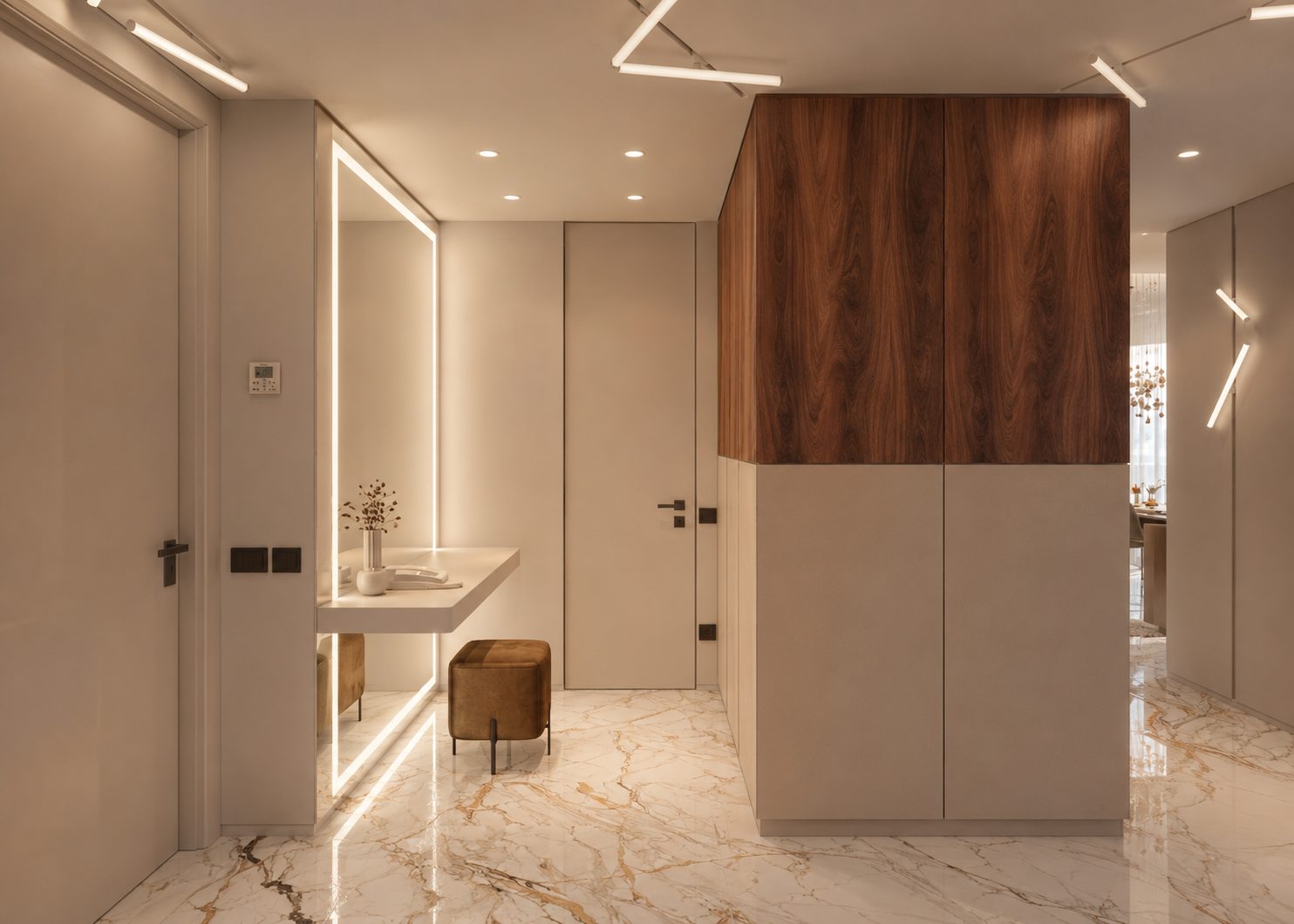
# Townhouse renovation cost in Dubai: budgets and approvals
TL;DR: A townhouse renovation in Dubai runs roughly AED 80,000 to 150,000 for a cosmetic refresh, AED 150,000 to 350,000 for a mid-level renovation, and AED 350,000 to 550,000 for a full turnkey job on a typical 3-bed unit of 1,800 to 2,500 sqft. Approvals add 3 to 8 weeks before demolition starts.
The band is wide for reasons that have little to do with taste. You share at least one wall with a neighbour, and the elevation belongs to the community rather than to you. Everything you buy arrives through the front door and goes up a domestic staircase.
What a townhouse renovation costs in Dubai
These are working planning bands for 2026, drawn from what we quote and what the market quotes around us. A typical 3-bed townhouse is 1,800 to 2,500 sqft over two or three storeys, with 30 to 120 m² of garden.
| Level | Whole-house total (AED) | AED per sqft, full floor area | What it covers |
|---|---|---|---|
| Cosmetic refresh | 80,000–150,000 | 30–85 | Paint throughout, flooring in the main areas, sanitaryware and brassware swapped in place, light joinery, new lighting fittings. Nothing moves. |
| Mid-level renovation | 150,000–350,000 | 60–195 | New kitchen, two or three bathrooms rebuilt, flooring throughout, fitted wardrobes, partial electrical rework, staircase finishes. |
| Full renovation, turnkey | 350,000–550,000 | 140–305 | Strip to blockwork, MEP replaced, every wet area rebuilt, bespoke joinery, ceilings and lighting, garden landscaping. |
| Design-led premium | 550,000–1,250,000 | 220–700 | Imported stone, structural change where the authority approves it, smart systems, full joinery package, furniture and decor. |
The per-sqft column is the total divided by the whole house, which is why the top row looks so cheap. The AED 200 to 700 per sqft you see quoted around the market belongs to the bottom two rows, where every room gets touched. A refresh comes out at AED 40 per sqft because it covers part of the house, not because anybody found a cheaper way to lay tile.
Our own starting points, applied to the area we actually work on: cosmetic scope from AED 1,500 per m², about AED 140 per sqft, and capital work from AED 3,000 per m², about AED 280 per sqft. A design package starts at AED 10,000 and takes 3 to 6 weeks. Quotes that land well under those rates are usually missing the permit, the waterproofing, the MEP first fix, or the supervision, and those four reappear later as variations.

Where the money goes in a townhouse budget
Percentages are more useful than totals when you are deciding what to cut. Here is the split we see across mid-level townhouse jobs, with a worked example on an AED 250,000 construction budget.
- Kitchen, 25 to 35%: AED 62,500 to 87,500
- Bathrooms, 15 to 20%: AED 37,500 to 50,000
- Flooring, 10 to 15%: AED 25,000 to 37,500
- Joinery and fitted wardrobes, 10 to 15%: AED 25,000 to 37,500
- Electrical and lighting, 8 to 12%: AED 20,000 to 30,000
- Finishes, ceilings, doors and ironmongery, 5 to 8%: AED 12,500 to 20,000
Those six lines add to somewhere between 73 and 105% of the construction budget depending on the mix, which is the honest way to read a percentage split. A house with three bathrooms and a modest kitchen sits at one end, a house with an island kitchen and one rebuilt bathroom at the other. Hold contingency separately at 15 to 25% on top, because a 2012 townhouse hides things a 2021 handover does not.
The kitchen dominates for the same reason it dominates everywhere: joinery, worktop stone and appliances stack into one room. We keep kitchen cost benchmarks in our apartment renovation cost guide rather than repeating them here. Bathrooms carry a townhouse-specific risk instead of a cost premium. First-floor bathrooms sit directly above living space, so a membrane failure lands on your own ceiling rather than a neighbour's. Budget the liquid polyurethane system at AED 160 to 220 per m² rather than the cementitious coat at AED 60 to 80 and take it to full wall height. The difference is a few hundred dirhams per bathroom.
Why a townhouse is not a small villa
The floor area sits between an apartment and a villa. The constraints do not.
| | Apartment | Townhouse | Villa |
|---|---|---|---|
| Shared structure | Slabs and walls on all sides | Party wall with one or two neighbours, own roof and ground | Standalone |
| Elevation | Not yours | Not yours, community palette fixed | Yours within community rules, more latitude |
| Access for materials | Service lift, booked slots | Front door and a domestic staircase, no lift | Vehicle to the door, room for a skip |
| Outdoor scope | Balcony | Courtyard or small garden, built-up area capped | Plot with room for a pool |
| Vertical layout | One level | Two or three storeys, stair is the choke point | Two or more, wider stairs |
Four things follow from that table. The party wall is usually a shared structural element, so deep chasing for services, new openings and anything that changes its makeup is off the table, and your neighbour has standing to object. If noise is your reason for renovating, the fix is an independent stud wall with mineral wool and resilient fixings, roughly AED 250 to 450 per m² of wall, at the cost of 100 to 150 mm of room width on your side.
Access decides more of the schedule than owners expect. There is no loading bay, the lane is narrow, and the shared driveway will hold one contractor van. A 1,600 by 3,200 mm porcelain slab does not turn on a domestic staircase, so upstairs stone gets specified in smaller formats or cut on site. Skips need a placement approval in most communities, and worker passes are issued against a named list.
The staircase itself is the third constraint. Replacing finishes is straightforward, at roughly AED 25,000 to 90,000 for a rebuilt flight with a glass balustrade. Moving the opening is structural work, which means an engineer's drawing, an authority permit, and a different conversation entirely. The fourth is the ceiling void. Ducted split systems run in a shallow void, so relocating a kitchen or opening up a ground floor reroutes ductwork and a dropped ceiling costs you head height in a house that has none to spare. For the standalone equivalent of all this, the villa cost bands we publish separately run on different logic, mostly plot, pool and landscaping.

What needs approval, and what your community will refuse
Every managed townhouse community requires an NOC from the developer or the Owners Association before work starts, including cosmetic work. Expect AED 1,000 to 5,000 for the NOC depending on scope and community, plus a refundable security deposit of AED 5,000 to 20,000 held against damage to common areas. Your contractor needs a valid trade licence for the activity, third-party liability insurance, and in many communities a prior registration with the management office.
Beyond the NOC, the trigger for an authority permit is what you touch:
- Structural change, new openings, anything affecting a party or load-bearing wall
- Drainage rerouting, slab penetration, relocating a WC between floors
- Electrical load changes, new circuits or meter work, which route through DEWA
- Extensions, covered parking conversions, pergolas above boundary wall height, pools
- Any change visible from outside the plot
On a full-scope townhouse job, permits, NOC and approvals together run about AED 8,000 to 30,000. Jurisdiction depends on the master developer: most freehold townhouse communities file with Dubai Municipality after the community NOC, while Nakheel developments commonly route through the master developer's own process first. Confirm which applies to your plot before you assume a timeline.
The refusals are predictable. Changing window frames, roof tiles, external paint colour or boundary wall height gets rejected because the community palette is fixed. Glazing the rear terrace to make a room is the single most commonly refused request in townhouse communities, followed by converting covered parking. Anything that alters the elevation is treated as a change to the community, and doing it without approval invites a stop-work order, a reinstatement notice and a forfeited deposit.
One timing point that catches new owners: if your townhouse is still inside the developer's defects liability period, usually a year from handover on MEP and finishes, altering an element can end the developer's cover on that element. Structural decennial liability, ten years, is separate and stays with the original builder. Check what is still covered before you strip anything out.
How long a townhouse renovation takes
| Stage | Duration | Notes |
|---|---|---|
| Design, drawings, fixed quote | 1–2 weeks | Longer if the layout changes and an engineer has to sign off |
| Community NOC and authority permit | 3–8 weeks | The single least controllable stage |
| Procurement and delivery | 4–10 weeks | Runs in parallel with approvals if you order early |
| Site works | 8–20 weeks | 8 weeks for a refresh, 20 for a full strip and rebuild |
| Snagging and handover | 1–2 weeks | Defect list closed before final payment |
Those stages do not add up in a straight line. Procurement overlaps approvals, and the honest calendar for a full townhouse renovation is 4 to 7 months from first drawing to handover. A refresh with no permit requirement can be done in 6 to 10 weeks.
Two things stretch it locally. Imported sanitaryware and made-to-order joinery run 8 to 16 weeks, so the order date, rather than the site programme, sets your finish date. And between 15 June and 15 September the midday break applies to outdoor work from 12:30 to 15:00, which does not stop your tiler but does slow deliveries, roof terrace work and anything in the garden. Most communities also restrict noisy work to weekday daytime hours and ban it on Fridays and public holidays. Get the exact window from your community management before you build a programme around it.
We start the NOC file at the same time as the drawings rather than after them, because the approval stage is the one an owner cannot compress from the outside. Sequencing it in parallel is usually worth two to four weeks on the calendar.
What changes from one community to the next
Approval rules and site conditions vary more between townhouse communities than between individual houses.
| Community | Master developer | What tends to shape the job |
|---|---|---|
| Arabian Ranches | Emaar | Older phases are past fifteen years, so MEP retrofit and roof and terrace waterproofing dominate scope. Elevation control is strict, mature landscaping makes access tight |
| Damac Hills | Damac | Mixed unit ages, contractor registration ahead of works, check built-up area limits before planning any garden structure |
| Town Square | Nshama | Newer stock, some units still inside the defects period. Scope skews to joinery, flooring and garden rather than MEP |
| Mudon and Serena | Dubai Properties | Compact plots and narrow access lanes, similar elevation rules, garden and shading works dominate |
| JVC | Nakheel | Approvals commonly route through the master developer before the authority, and unit build standards vary widely by sub-developer |
Treat this as a starting point and confirm the current process with your own community management. Developers revise their renovation policies, deposit levels and contractor registration requirements without much notice.
Where townhouse budgets get underestimated
Five lines account for most of the overruns we see. Approvals, because owners budget the fee and forget the weeks. Access, because carrying materials up a domestic staircase costs labour hours that never appear as a line item. The garden, where drainage, irrigation and a shade structure quietly total AED 30,000 to 80,000 on a courtyard nobody planned to touch. The staircase, when a finish upgrade turns out to need structural work. And the first-floor wet areas, where the correct membrane build is a small number that protects a large one.
The honest counterweight: if the townhouse is a buy-to-let, the refresh at AED 80,000 to 150,000 usually returns better against rent than the full renovation. Tenants in these communities pay for condition, working air conditioning and a clean kitchen. They do not pay a premium for imported stone. For an owner-occupied home, or a unit you are positioning against specific comparables in the same cluster, the deeper scope makes sense. Any resale uplift you read online is a market orientation rather than a promise, and the ceiling in a townhouse community is set by what the community itself sells for. Spending past that ceiling is money you rarely see again.
Our quotes are fixed by contract with no top-ups after start, with a penalty per day of overrun and a one-year workmanship warranty, and we run the NOC and permit track ourselves so the correspondence with your community sits with us. If you want a line-item figure rather than a band, send the floor plan and a few photos and we will price it against your community's rules, your finish level and your timeline.
FAQ
How much does it cost to renovate a 3-bedroom townhouse in Dubai?
Between AED 80,000 and 150,000 for a cosmetic refresh, AED 150,000 to 350,000 for a mid-level renovation, and AED 350,000 to 550,000 for a full turnkey job on a typical 1,800 to 2,500 sqft unit. Design-led work with imported stone and structural changes runs from AED 550,000 upward. Hold 15 to 25% contingency on top of whichever band you pick.
How long does a townhouse renovation take?
Four to seven months from first drawing to handover for a full renovation. Design and quote take 1 to 2 weeks, community NOC and authority permits 3 to 8 weeks, procurement 4 to 10 weeks running in parallel, site works 8 to 20 weeks, and snagging 1 to 2 weeks. A refresh with no permit requirement can finish in 6 to 10 weeks.
Do I need permission from my community to renovate a townhouse?
Yes. Every managed community requires an NOC from the developer or Owners Association before work starts, including for cosmetic work, typically AED 1,000 to 5,000 plus a refundable deposit of AED 5,000 to 20,000. A separate authority permit becomes necessary once you touch structure, drainage, electrical load or anything visible from outside the plot.
How is renovating a townhouse different from renovating a villa?
Three constraints do not exist on a villa. You share a structural party wall with a neighbour, so deep chasing and new openings in it are ruled out. The elevation belongs to the community, so facade changes are usually refused. And materials come in through the front door and up a domestic staircase, which limits slab sizes and adds labour hours to every delivery.
Can I extend my townhouse or change the facade?
Facade changes are almost always refused, including window frames, roof tiles, external paint colour and boundary wall height. Extensions, covered parking conversions and enclosed terraces need both community approval and an authority permit, and most communities cap built-up area on the plot. Check the community's own policy before you commission drawings for any of it.
What is the most expensive part of a townhouse renovation?
The kitchen, at 25 to 35% of the construction budget, followed by bathrooms at 15 to 20%. On an AED 250,000 renovation that is AED 62,500 to 87,500 for the kitchen alone. Structural work on the staircase or a party wall is the line that moves a budget fastest when it appears, because it brings an engineer, a permit and several weeks with it.
How much should I budget for the kitchen?
Plan on a quarter to a third of the total construction budget. Joinery, worktop stone and appliances make up most of it, and the swing between locally fabricated units and an imported German or Italian system is easily a factor of three on the same layout. Order it on the day the drawings are signed, since made-to-order runs 8 to 16 weeks.
Does a townhouse renovation pay off at resale?
It depends on what the community itself sells for. A well-executed kitchen, bathrooms and garden are the upgrades buyers respond to, but the ceiling is set by comparable units in the same cluster, so spending past that ceiling rarely comes back. For a rental unit, the AED 80,000 to 150,000 refresh usually performs better against yield than the full renovation. Treat any published percentage return as a market orientation rather than a figure to bank on.